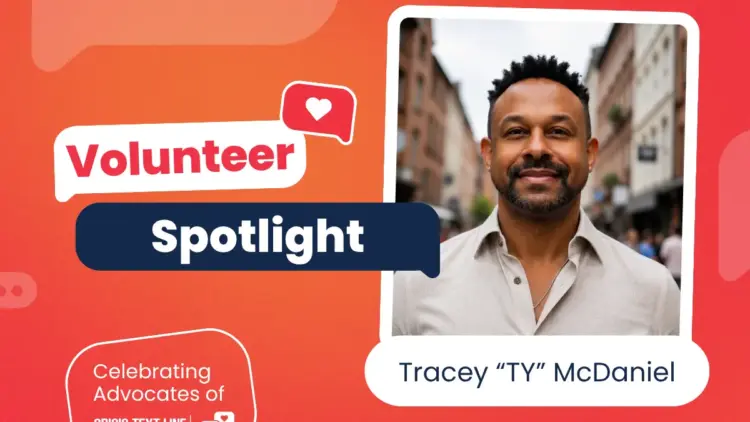
Behind every confidential text conversation answered by the Crisis Text Line is an ordinary person stepping up to listen during someone’s darkest hour. This month, the organization is shining its volunteer spotlight on Tracey "TY" McDaniel, a dedicated crisis counselor whose journey into mental health advocacy began with a deeply personal promise. What started as a commitment to a friend experiencing unimaginable grief has blossomed into a broader mission to destigmatize mental health struggles and remind individuals that asking for help is an act of profound strength rather than weakness.
The path that brought McDaniel to Crisis Text Line is rooted in shared sorrow and a vow to turn tragedy into action. He first learned about the organization following the devastating loss of a dear friend’s son to suicide. Moved by empathy and a desire to provide tangible support, McDaniel made a pact with his friend to help in any way possible. That initial promise ultimately directed him toward Crisis Text Line, offering a structured, impactful avenue to honor his word and support others navigating acute emotional distress.
McDaniel’s connection to the cause extends beyond a single event, as he acknowledges having been personally impacted by suicide on more than one occasion. These heavy experiences left an indelible mark on his perspective, solidifying his conviction that getting involved and making a difference was not merely an option, but a necessity. Supporting people who struggle with their mental health became deeply personal to him. He operates under the belief that if being present for someone during a moment of crisis can make even a fraction of a difference, the time and emotional energy invested are entirely worthwhile.
Understanding the Role of a Volunteer Crisis Counselor
For those unfamiliar with the inner workings of crisis intervention, McDaniel offers vital insight into what a volunteer actually does day-to-day. A common misconception among prospective volunteers is that they must act as therapists or possess immediate solutions to complex life problems. In reality, individuals reaching out to crisis lines rarely expect counselors to hold all the answers. Instead, they are seeking a nonjudgmental ear, a safe space to vent, and someone who can offer gentle support, fresh perspective, or a compassionate guiding hand.
According to McDaniel, the core responsibility often boils down to acting as a steady beacon of light at the end of a dark tunnel, reminding texters that they are fundamentally not alone. This human-centric approach emphasizes empathy over clinical perfection, proving that active listening is frequently the most powerful intervention available.
Translating Volunteer Work into Leadership and Daily Life
The impact of volunteering extends far beyond the confidential chat interface, profoundly shaping McDaniel’s personal outlook and professional life. Serving as a people leader in his everyday career, he keeps mental health and awareness at the forefront of his responsibilities. He integrates the lessons learned from crisis counseling into his management style by scheduling weekly check-ins with his direct reports. These conversations are deliberately designed to provide team members with a secure platform to discuss how they are coping, both professionally and personally.
McDaniel firmly believes that simply asking someone how they are doing—and taking the time to genuinely listen to the response—can fundamentally alter the trajectory of someone’s day. The experience continually reinforces his belief that every individual deserves a baseline of grace, understanding, and compassion.
A Lasting Memory: Supporting a Student Through Bullying
Among the countless conversations McDaniel has engaged in as a counselor, one particular interaction from the start of a school year remains etched in his memory. A young student reached out to the platform because they were suffering under the heavy weight of severe school bullying. Having experienced bullying firsthand during his own youth, McDaniel intimately understood how all-consuming, isolating, and overwhelming that environment can feel.
Drawing from his own past, he took a deliberate, calming breath and dedicated himself entirely to being a reliable shoulder to lean on, creating an environment where the student felt genuinely heard and validated. After establishing that foundational trust and safety, McDaniel gently encouraged the texter to confide in a teacher or school administrator, reinforcing the message that there was zero reason to feel embarrassed or ashamed. The interaction stayed with him because it vividly underscored how vital it is for a vulnerable person to have someone firmly in their corner when the world feels overwhelmingly hostile.
The Modern Landscape of Stress and the Importance of Intervention
Reflecting on the broader state of mental health, McDaniel does not sugarcoat the realities of modern life. He points to an era defined by relentless stressors across homes, schools, and workplaces, where the ability to truly disconnect, unplug, and recharge has become increasingly difficult. With limited hours in the day, constant demands on personal energy, and the pervasive psychological influence of social media shaping how individuals view themselves and the world, the cumulative pressure can quickly become crushing.
When these stressors pile up, they routinely leave people feeling isolated, profoundly overwhelmed, or hopeless. This societal friction highlights why accessible, judgment-free mental health support is more critical than ever. By offering a safe space for those who are struggling or seeking guidance, crisis intervention helps individuals navigate immediate turbulence and realize that a viable way forward exists.
Encouraging Future Volunteers and Normalizing Mental Health
For individuals hesitant to apply as volunteers due to a perceived lack of specialized skills, McDaniel offers reassuring advice. He emphasizes that formal qualifications and exhaustive knowledge of every hypothetical scenario are not prerequisites. If a person possesses genuine compassion in their heart and a sincere desire to help others, the necessary techniques can be effectively taught through training programs. What matters most is a willingness to listen, an openness to continuous learning, and the commitment to show up for someone in need.
Ultimately, McDaniel champions a cultural shift regarding psychological well-being, asserting that mental health is every bit as critical as physical health. Society must normalize the act of asking for help and tear down the lingering stigmas associated with vulnerability. Expressing that one is not okay represents a profound display of personal strength rather than a weakness, reinforcing the fundamental truth that no one should ever have to shoulder life’s heaviest moments in isolation.
Crisis Text Line provides free, confidential, 24/7 support for individuals navigating difficult moments. Anyone in need of assistance can connect with a live, trained volunteer Crisis Counselor by texting the word CONNECT to 741741.