A federal judge has officially entered an order throwing out the vital community integration provisions of the Section 504 rule issued in 2024 by the U.S. Department of Health and Human Services (HHS). Handed down following a joint agreement in the case of Texas v. Kennedy, the sweeping judicial order applies nationwide, stripping away crucial regulatory guidance that had explicitly directed states to support disabled individuals within community settings rather than forcing them into institutional care.
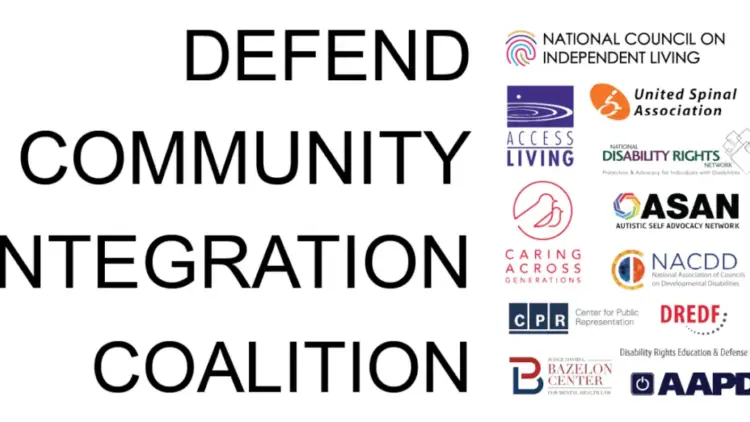
The legal development has sent shockwaves through the disability advocacy community. In response to the ruling, the Defend Community Integration Coalition (DCIC)—a national coalition of organizations led by and for people with disabilities—has issued a strong condemnation of the federal government’s actions. The coalition is actively urging the public, legal advocates, and disability rights organizations to engage in renewed advocacy to protect the fundamental right of individuals with disabilities to live, work, and thrive in their communities.
The court order stems from an agreement proposed jointly by the U.S. Department of Justice (DOJ), acting on behalf of HHS, alongside the state governments of Texas, Florida, Alaska, Louisiana, and Montana. Under the terms of this agreed-upon resolution, specific parts of the broader 2024 rule have been invalidated and dismantled. With the court’s approval of the joint proposal, the underlying case has now been officially closed, leaving advocates scrambling to address the sudden regulatory vacuum left in the wake of the decision.
Despite the sweeping nature of the federal court order, legal experts and coalition leaders emphasize that the agreement does not change foundational federal laws or long-standing constitutional precedents. Even with the removal of the specific 2024 HHS Section 504 rule provisions, Section 504 of the Rehabilitation Act, the Americans with Disabilities Act (ADA), and the landmark 1999 U.S. Supreme Court decision in Olmstead v. L.C. remain fully intact and in effect.
These bedrock legal protections continue to guarantee that individuals with disabilities possess the legal right to live in the community and cannot be subjected to forced institutionalization simply to access the health and social services they require. Disability advocates are stressing that governors, state attorneys general, and policy makers in every state must recognize that the recent court order runs counter to decades of established civil rights law. The unified message from the disability community is clear: they will not go backwards.
While the fundamental legal right to community integration remains protected under existing federal statutes, the removal of the 2024 HHS rule provisions represents a profound practical setback. The federal government has effectively eliminated clear, explicit direction to states mandating that health and social services programs should prioritize supporting disabled people in integrated community settings whenever appropriate. Because this judicial invalidation applies nationwide rather than being restricted solely to the plaintiff states, every state government has lost this vital regulatory roadmap.
Advocates point out that the loss of this clear federal guidance severely hampers ongoing efforts to dismantle institutional bias in public funding and service delivery. Without these explicit regulatory standards, states face fewer federal guardrails preventing them from funneling resources into segregated institutions rather than robust home- and community-based services. For many people with disabilities, obtaining necessary care often depends heavily on clear administrative directives, making the rollback of the 2024 provisions a critical vulnerability in the daily fight for accessibility and autonomy.
Coalition leaders characterize the current landscape as a state of acute crisis for disability rights and personal independence. Although a handful of states have historically demonstrated a steadfast commitment to ensuring that individuals with disabilities can live fully integrated lives within their local neighborhoods, many other states have lagged behind or actively resisted community integration mandates. In light of the federal government’s retreat in Texas v. Kennedy, the DCIC is issuing an urgent call to action for state legislatures across the country.
Advocates are urging state lawmakers to treat this misguided and harmful federal ruling as an immediate wake-up call. Rather than relying solely on federal regulations that remain susceptible to political shifts and legal challenges, state legislatures are being pressed to enshrine the fundamental right of disabled people to live in their communities directly into state law, creating a localized layer of protection against federal rollbacks.
The preservation of these rights is viewed by the community as the hard-fought result of a half-century of relentless activism, sacrifice, and legal battles waged by disability rights pioneers. Over the past fifty years, activists have consistently maintained that disability rights are human rights, demanding equitable access to housing, employment, healthcare, and public life. The overarching sentiment resonating across the national advocacy network is one of absolute resolve: the community will not go back to an era of widespread institutionalization and isolation.
The Defend Community Integration Coalition, as a leading national voice representing organizations run by and for people with disabilities, remains entirely focused on defending the right to community living. As the implications of the Texas v. Kennedy ruling continue to unfold, the coalition has announced plans to provide ongoing updates and mobilize its grassroots network. Advocates are being encouraged to stay tuned for upcoming action opportunities, public awareness campaigns, and strategic initiatives designed to protect and preserve the right of every individual with disabilities to live with dignity in their own homes and communities.