The Centers for Medicare & Medicaid Services (CMS) has officially released its finalized 2027 Medicare Hospital Outpatient Prospective Payment System (OPPS) rule, introducing a contentious policy that significantly scales back Medicare reimbursements for drugs acquired through the federal 340B program. Originally published in July 2026 and recently updated to reflect modifications in the final regulatory text, the policy resets Medicare payments for 340B-purchased medications from the standard average sales price (ASP) plus 6% down to ASP minus 28%. This represents a sharp 32% reduction, though it stops just short of the ASP minus 33.4% rate originally proposed by the agency. According to CMS, the adjustment is designed to more accurately align federal Medicare reimbursements with the actual costs that hospitals incur when acquiring these discounted pharmaceutical products.
The underlying 340B Drug Pricing Program, established decades ago, mandates that drug manufacturers participating in Medicaid must sell outpatient drugs to eligible nonprofit and government-backed healthcare providers at substantial discounts. By purchasing medications at a fraction of their standard cost while receiving higher reimbursements from insurers, eligible entities are able to generate crucial operational revenue. The program was originally created to support safety-net providers—such as specific disproportionate share hospitals and federally qualified health clinics—that shoulder the heavy responsibility of caring for low-income, uninsured, and other medically underserved populations.
However, the program has grown exponentially over the years, drawing intense scrutiny and fierce debate from policymakers, industry analysts, and healthcare stakeholders. Critics argue that the 340B framework has expanded beyond its original intent, pointing out that the program lacks sufficient targeting, fails to directly pass financial savings down to individual patients, and creates a powerful commercial incentive for hospitals to acquire independent physician practices and outpatient clinics simply to extend 340B eligibility and expand their revenue streams. Conversely, program supporters staunchly defend the framework, arguing that the financial margins generated from 340B drug reimbursements are essential lifelines. They maintain these funds enable safety-net institutions to maintain critical services for vulnerable patient communities and invest heavily in clinical operations that would otherwise operate at a deficit.
To determine the exact scale of the payment reduction, CMS relied primarily on the maximum allowed acquisition costs permitted under the 340B program itself. The agency also factored in comprehensive data gathered from a targeted cost acquisition survey of 340B drugs completed by participating hospitals earlier in 2026. While the initial proposal suggested an even steeper cut to ASP minus 33.4% based strictly on survey findings, CMS opted for the maximum allowed acquisition cost threshold in its final rule to simplify administrative tracking and future regulatory updates. This policy resurrection revives an earlier regulatory battle from the first Trump administration, which implemented a similar 340B payment reduction in 2018. That prior iteration was ultimately struck down by the Supreme Court in 2022 because federal health officials had failed to conduct a formal hospital acquisition cost survey before enacting the change. With the newly finalized rule taking effect on January 1, 2027, CMS is moving forward with a freshly justified framework that is projected to yield starkly different outcomes across various segments of the hospital industry.
Under the financial mechanics of the finalized rule, the deep cuts to 340B drug reimbursements are projected to slash total Medicare spending on 340B drugs by approximately $4.65 billion in 2027 alone. However, because federal law strictly mandates that changes within the OPPS must remain budget-neutral, CMS cannot simply absorb these billions in savings. Federal statutory requirements dictate that aggregate spending under the OPPS must remain level regardless of internal reimbursement shifts. To satisfy this legal obligation, CMS has finalized an across-the-board 7.5% payment increase for non-drug outpatient services covered under the OPPS. The agency estimates that this concurrent bump in non-drug outpatient payments will completely offset the $4.65 billion reduction in 340B drug spending.
This mandatory budget-neutral redistribution triggers a complex ripple effect across the broader healthcare ecosystem. Financial savings harvested from reduced 340B drug payments to participating institutions will effectively be recycled and funneled back out to both 340B and non-340B hospitals alike through higher reimbursement rates for general outpatient procedures, clinic visits, and diagnostic services. For Medicare beneficiaries, the shifts create a mixed financial picture. Patients who routinely rely on 340B drugs are projected to save a combined total of $1.1 billion in 2027 due to lower cost-sharing requirements calculated from a reduced drug baseline. At the same time, however, beneficiaries who utilize standard, non-drug outpatient hospital services will face increased out-of-pocket cost sharing driven by Medicare’s proposed 7.5% payment rate increase for those services.
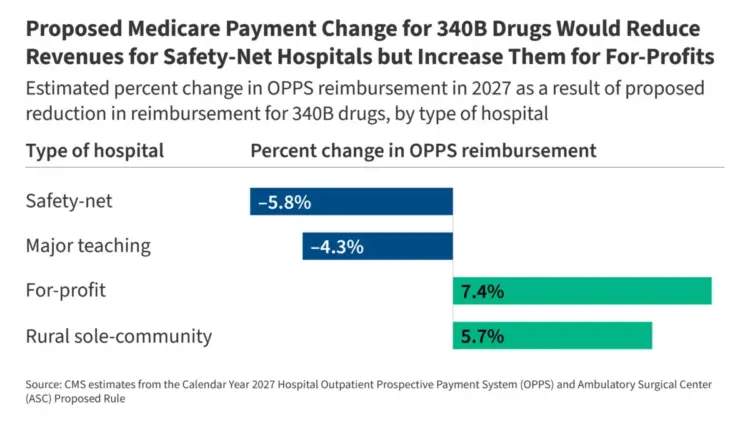
The structural changes will also reshape the financial landscape for hospitals themselves, creating distinct winners and losers depending on institutional type and revenue mix. For hospitals that participate in the 340B program, total Medicare revenue will either rise or fall based heavily on how dependent their financial health is on 340B drug margins versus standard outpatient service revenues. Non-340B hospitals, meanwhile, stand to experience straightforward revenue increases, capturing the windfall from the higher payment rates for non-drug outpatient services without absorbing any corresponding cuts to drug reimbursements. Recognizing the acute vulnerability of certain rural and specialized institutions, the final CMS rule provides explicit exemptions for rural sole community hospitals—defined as rural facilities that serve as the sole source of short-term, acute inpatient care in their region—as well as children’s hospitals and specialized prospective payment system (PPS)-exempt cancer hospitals. Furthermore, facilities that operate outside the OPPS payment structure entirely, such as critical access hospitals that constitute the majority of rural medical centers across the country, remain untouched by the regulatory adjustments.
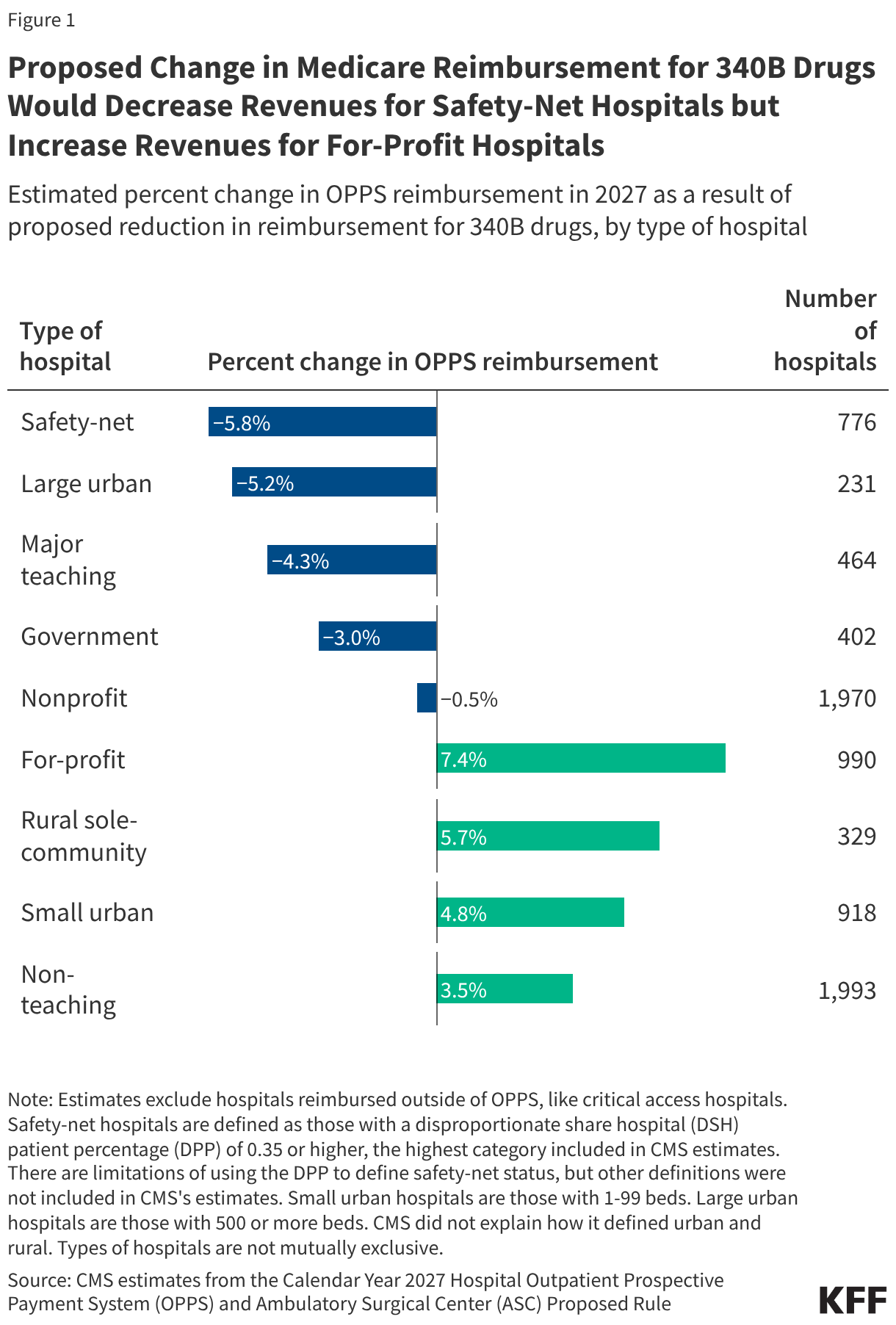
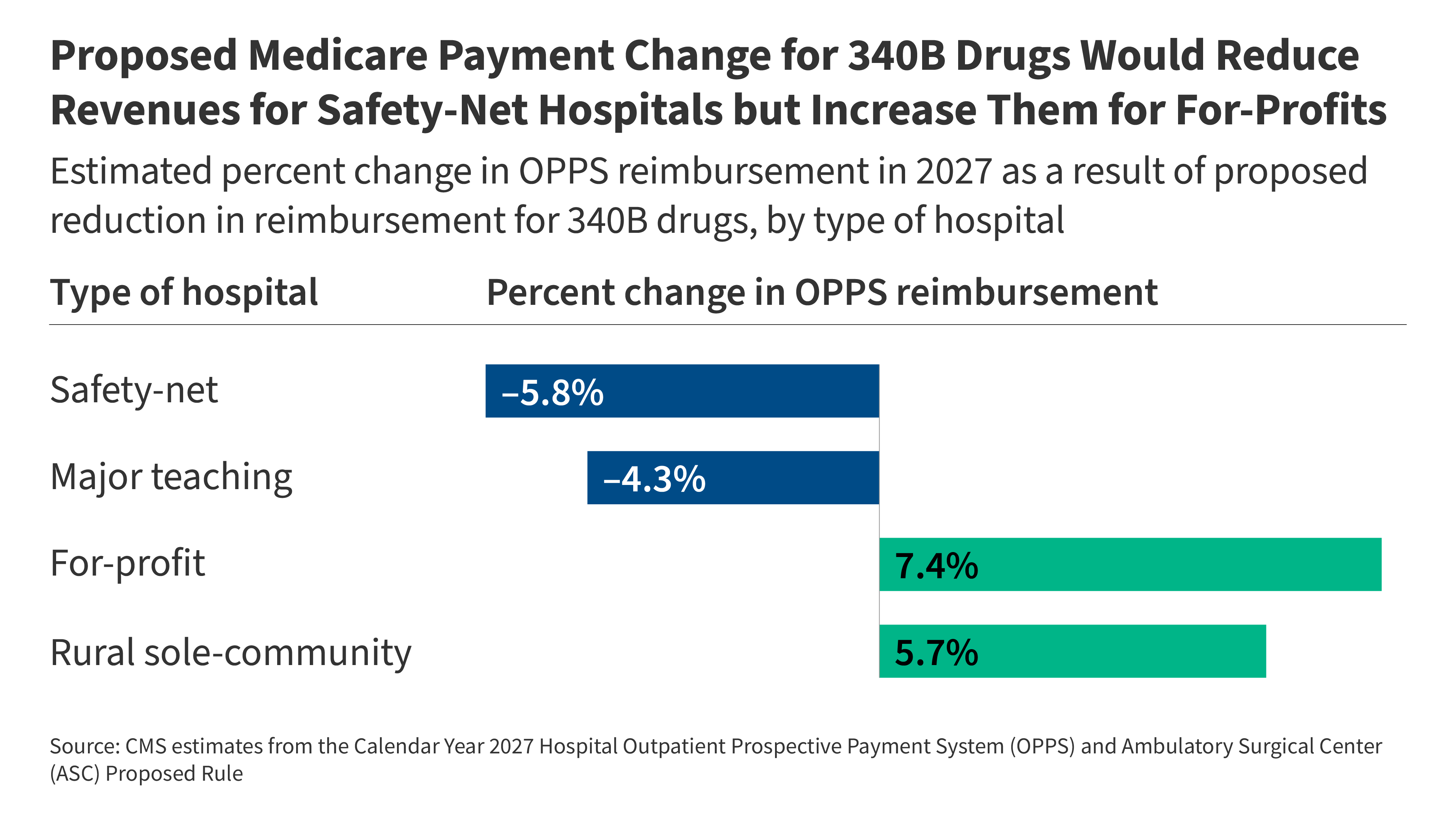
Aggregate projections from federal data illustrate that the financial impact will vary dramatically by hospital classification. Safety-net institutions, which historically operate on razor-thin or negative operating margins compared to the industry average, face mounting financial pressures as they attempt to absorb revenue losses stemming directly from the 340B payment reduction. In contrast, for-profit hospital systems, which routinely report significantly higher operating margins than average healthcare facilities, are positioned to absorb the cuts more comfortably or benefit from the broader outpatient reimbursement bumps. These compounding financial headwinds for safety-net providers are further amplified by broader federal legislative shifts, such as the 2025 reconciliation law, which achieves a substantial portion of its federal healthcare savings through deep reductions in federal Medicaid spending—a funding stream upon which safety-net hospitals are overwhelmingly dependent.
The ongoing controversy surrounding the rapid, multi-year expansion of the 340B program has intensified pressure from hospitals, pharmaceutical manufacturers, and federal lawmakers to re-examine the program’s structural integrity. At the federal level, members of Congress have introduced a variety of legislative proposals aimed at either preserving, narrowing, or restructuring the scope of the program. Lawmakers are also pushing for enhanced transparency measures, such as bills that would legally compel participating hospitals to publicly report their annual 340B savings and outline how those funds are utilized. Simultaneously, state legislatures have stepped into the regulatory vacuum. Several states have enacted laws designed to protect hospitals’ rights to utilize multiple contract pharmacies for dispensing 340B medications, while others have instituted mandatory disclosure requirements forcing hospitals to report the exact volume of savings generated and spent through the program, following a model pioneered by states like Minnesota.
Complicating the landscape further, major pharmaceutical manufacturers have increasingly attempted to restructure how 340B discounts are delivered by shifting toward a rebate model. Under this proposed framework, hospitals would be forced to purchase outpatient drugs upfront at non-discounted market prices and subsequently apply for post-sale manufacturer rebates after submitting detailed claims verification data. These industry-led initiatives, however, have faced aggressive legal hurdles. Courts have repeatedly halted implementation efforts, ruling that manufacturers lack explicit authorization from the Department of Health and Human Services (HHS)—the federal agency tasked with administering the 340B program—to unilaterally impose rebate models.
An attempt by the federal government to bypass these roadblocks through the Trump administration’s 2025 rollout of the 340B Rebate Model Pilot Program was similarly frozen after major hospital associations filed a federal lawsuit. Although HHS announced a revised iteration of the rebate model pilot, that initiative has likewise drawn immediate legal challenges from healthcare providers determined to block any policy changes that threaten the traditional upfront discount mechanism. As the January 1, 2027 effective date for the new Medicare OPPS rule approaches, hospitals, policymakers, and legal experts remain locked in a high-stakes struggle over the future of safety-net funding and drug pricing policy in the United States.