In recent years, scientists, medical researchers, healthcare providers, and major medical organizations have engaged in a comprehensive reassessment of how race is utilized in clinical decision-making tools. This ongoing evaluation aims to understand whether the inclusion of race and ethnicity in medical algorithms exacerbates or mitigates longstanding racial health disparities. A comprehensive brief tracking these developments shows that clinical medicine is steadily moving toward removing race and ethnicity from clinical calculators, risk scores, and practice guidelines. While this transition has successfully mitigated certain disparities and improved health outcomes, significant questions remain regarding the broader impact of this movement.
While many medical specialties and major institutions have abandoned race-based tools, some practitioners continue to view race as a useful guide for clinical decision-making. Proponents of this view argue that race and ethnicity capture critical aspects of a patient’s life that influence health outcomes, even if the underlying mechanisms are not yet fully understood. Researchers and clinicians are still actively investigating the complex ways in which race and racism relate to structural inequalities. These societal factors disparately impact the health and healthcare experiences of specific demographic groups. Consequently, continued research into health outcomes following the shift away from race-based tools is deemed vital for understanding their overall impact, though this work faces growing hurdles amid federal funding cutbacks for disparities-related research.
Race and Ethnicity in Medical Research and Clinical Medicine
Medical research historically incorporated race in numerous ways, despite a complete lack of any biological or genetic basis for the concept. Race operates fundamentally as a socio-political system of human categorization that was historically constructed to justify social hierarchies based on false notions of innate biological differences between populations. Early American medical research frequently relied on pseudoscientific fields like phrenology and eugenics to advance the idea of inherent racial disparities. Although modern medical science has firmly established a consensus disproving these ideas, historical literature often conflated race with genetic variations in disease risk.
In recent years, however, some of the most influential medical journals and professional medical societies have explicitly recognized that race serves as a poor proxy for biological differences. These bodies have increasingly acknowledged the damaging role that scientific racism has played in creating and sustaining racial health disparities, prompting growing calls for researchers to investigate how structural racism directly impacts health. Modern standards increasingly demand a clear, scientifically grounded rationale for whenever race is utilized as a variable in research studies.
Similar misconceptions regarding race have long been embedded within clinical medicine, directly impacting patient care and clinical outcomes. Prior analyses, including landmark overviews by KFF, have detailed how systemic discrimination permeates healthcare delivery. Researchers have successfully identified medical education, disease nomenclature, and unconscious provider bias as primary areas where structural racism persists.
A prominent example involves persistent misconceptions concerning pain tolerance among Black and White patients. Multiple studies have demonstrated that medical students and physicians can hold false beliefs regarding biological differences, such as the erroneous notion that Black individuals possess less sensitive nerve endings. Decades of public health research confirm that the pain experienced by Black patients is frequently unrecognized and consistently undertreated compared to that of White patients. Scholars suggest that these enduring false beliefs about pain directly contribute to the barriers Black patients face when navigating the healthcare system.
The convergence of these realizations, particularly in the wake of the COVID-19 pandemic and the glaring structural inequities it exposed, made the investigation of race in medicine a top priority for the professional community. Clinicians began closely analyzing how race impacts clinical care, focusing intensely on decision-making tools and computational algorithms. This introspection has fueled a persistent push to explore new clinical approaches that remain conscious of how race and racism influence care delivery without relying on flawed biological assumptions.
The Complex Realities of Patient Experience and Clinical Tools
Although biological differences across races do not exist, a patient’s race and ethnicity profoundly shape their healthcare experiences due to systemic bias, discrimination, and underlying structural disparities. Survey data collected by KFF illustrates that healthcare encounters vary widely by race and ethnicity, directly influencing patient trust, treatment decisions, and overall health outcomes. Black, American Indian or Alaska Native, Hispanic, and Asian adults who recently received medical care are consistently more likely than White adults to report being treated unfairly or with disrespect by providers because of their background.
Furthermore, these groups report higher rates of negative experiences, such as providers making unverified assumptions, suggesting personal blame for a health condition, ignoring direct questions, or refusing to prescribe necessary pain medication. Conversely, research demonstrates that racial concordance between patients and providers can foster more respectful interactions and significantly increase the uptake of preventative and invasive services among certain populations, potentially narrowing mortality gaps. Beyond interpersonal interactions, profound racial and economic differences across social determinants of health continue to reflect deep-seated structural inequalities.
Despite the ongoing debate and lack of universal consensus, dozens of clinical decision-making tools continue to incorporate race or ethnicity to inform medical choices. Recent studies have identified numerous risk calculators, laboratory tests, and medications that account for race in some capacity. These instruments utilize clinical and demographic information to estimate disease risk, organ function, and vital health metrics designed to aid clinician judgment.
However, the vast majority of these tools fail to provide a clear rationale for why race is included as a variable, nor do they explain the biological or social mechanism through which race supposedly alters disease risk. When a rationale is provided, it typically relies on retrospective observational studies, epidemiological data, or observed population patterns that are more likely driven by underlying structural factors. For instance, widely used tools such as the National Cancer Institute’s Breast Cancer Risk Assessment Tool and various colon cancer survival calculators incorporate race because incidence rates and risk factors vary across populations within the United States.
In addition to quantitative risk scores, race has historically been embedded in clinical management guidelines for a wide array of conditions. Unlike calculators that output a specific numerical risk, these guidelines shape a clinician’s general thinking, disease screening thresholds, and drug prescribing habits. The incorporation of race into these frameworks often yields mixed results.
For example, diabetes management guidelines have historically utilized a lower body mass index threshold for Asian patients to recommend screening, while also prompting clinicians to consider screening individuals from other high-risk racial and ethnic groups who present with overweight or obesity. While this practice may facilitate earlier diagnoses, it can also lead to over-screening and increased healthcare costs. Similarly, rheumatology guidelines feature differential screening recommendations for certain populations taking specific medications for gout due to known genetic variations associated with severe adverse skin reactions.
Other interventions, such as the heart failure drug BiDil, were initially approved and marketed specifically for self-identified Black patients following clinical trials that lacked broad demographic representation. While intended to target specific populations, race-specific prescribing guidelines frequently generate significant concern among clinicians and researchers regarding unintended downstream consequences.
Research Findings and the Shift Toward Race-Free Medicine
Extensive research confirms that incorporating race into clinical decision-making tools can actively reinforce disproven concepts of biological difference and contribute to persistent health disparities. Calculators that artificially adjust risk scores based on race can result in delayed diagnoses, inappropriate triage, and disparate treatment decisions. For instance, prominent heart failure risk calculators and kidney stone prediction tools have historically assigned lower risk scores to Black patients without a transparent medical rationale, potentially affecting whether individuals receive timely specialty care or hospital admission.
Recognizing these harms, a growing number of medical specialties have actively removed race and ethnicity from their most widely utilized clinical tools and guidelines. Prominent examples include the calculation of estimated glomerular filtration rate for kidney function, where removing race has corrected systemic delays in transplant waitlist eligibility for Black patients. Similarly, risk calculators for vaginal birth after cesarean delivery and pediatric urinary tract infections have been successfully updated to exclude race, with subsequent studies confirming that the revised tools maintain equal or superior diagnostic accuracy.
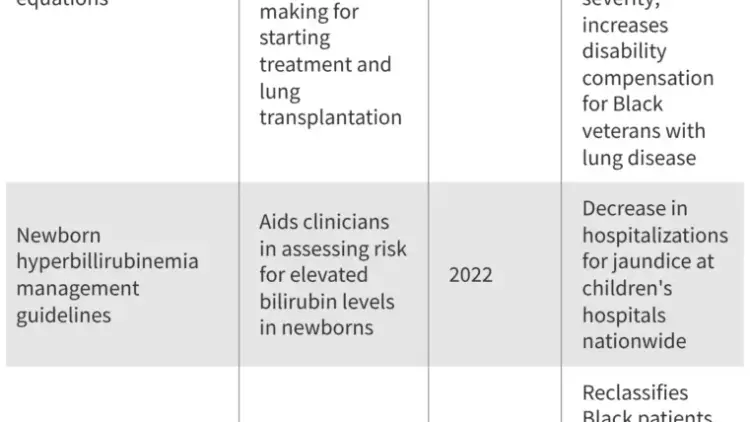
The shift away from race-based practices extends into pharmacology and neonatal care. For decades, hypertension guidelines recommended specific blood pressure medications for Black adults based on clinical trial observations, yet self-reported blood pressure control rates among Black patients remained disproportionately low. Updated hypertension guidelines have eliminated race-based prescribing recommendations, reflecting a broader movement toward culturally competent care practices that address underlying structural barriers rather than relying on demographic generalizations. In neonatal medicine, guidelines for managing hyperbilirubinemia in newborns removed race as a risk factor, leading to a notable decrease in subsequent hospitalizations for severe jaundice.
Looking ahead, major professional organizations—including the American Academy of Pediatrics and the American Medical Association—are spearheading sustained efforts to eliminate race-based medicine and redress historical harms. Surveys of medical societies indicate that a significant majority of institutions are actively reviewing and revising clinical algorithms.
At the same time, experts emphasize that removing race from clinical tools must be executed carefully to avoid unintended consequences that could inadvertently worsen disparities. Ongoing research into patient preferences, implementation strategies, and the influence of social determinants of health remains critical. However, these vital research efforts face mounting challenges due to recent federal funding reductions and cutbacks affecting health equity studies.
Furthermore, as healthcare systems increasingly integrate artificial intelligence into clinical workflows, researchers are closely monitoring how machine learning models utilize historical data rooted in race-based medicine. While unverified training data risks perpetuating algorithmic bias, carefully designed artificial intelligence models built on inclusive, diverse research cohorts hold the potential to assist clinicians, reduce diagnostic bias, and uncover previously hidden health disparities.