A striking paradox defines the landscape of modern aging in the United States. While more than 80 percent of older adults express a firm desire to age in place within their own homes, a staggering 90 percent of American housing stock is entirely unequipped to house them safely. According to industry experts and public health data, without immediate, deliberate structural modifications, remaining at home transforms from a comforting preference into a massive, life-threatening liability.
The financial argument for modifying a home to accommodate changing physical needs is undeniable when stacked against institutional care. Data from the 2025 CareScout Cost of Care Survey reveals that the national median cost of an assisted living facility has surged to $74,400 annually, while a private room in a nursing home now exceeds $129,000. Investing a fraction of that substantial amount into targeted structural safety upgrades keeps seniors independent, preserves their dignity, and keeps them out of overpriced, institutional facilities.
Conversely, ignoring environmental hazards within the home virtually guarantees a costly and traumatic emergency room visit. Statistics from the Centers for Disease Control and Prevention indicate that one in four Americans aged 65 and older suffers a fall each year. These incidents are rarely minor stumbles; the average treat-and-release emergency room visit for a senior fall costs nearly $8,900. Furthermore, experiencing a single fall doubles an individual’s risk of falling again, initiating a dangerous cycle of injury that frequently forces aging adults out of their homes permanently.
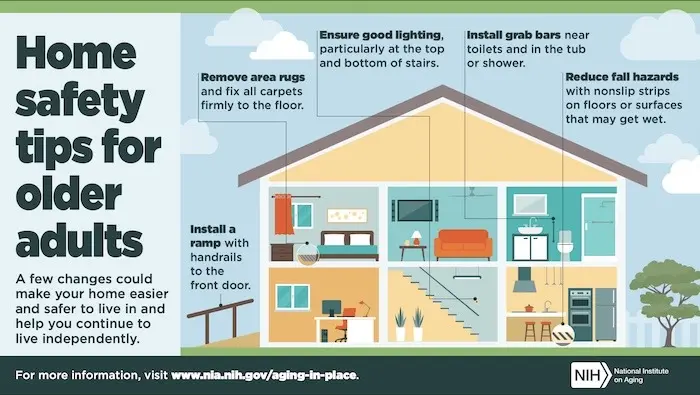
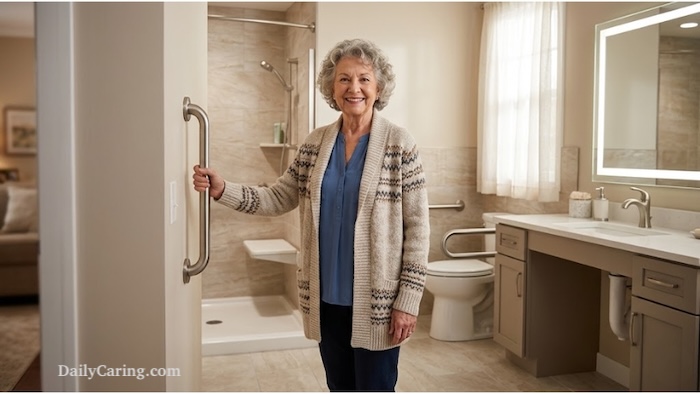
Public health and safety advocates emphasize that retrofitting a home must begin with the highest-risk zone: the bathroom. Nearly 80 percent of seniors eventually require targeted modifications, such as walk-in showers and strategically placed grab bars, to navigate daily hygiene safely. Experts warn against relying on temporary suction cup handles, which inevitably fail under full body weight. Instead, safety equipment must be hard-mounted directly into wall studs. Beyond the shower and tub, eliminating trip hazards by removing loose throw rugs and installing zero-step entryways where possible can dramatically reduce household accidents.

In addition to physical obstacles, poor lighting emerges as a critical environmental hazard rather than a mere inconvenience. As human vision deteriorates with age, standard overhead lighting becomes wholly insufficient for safe navigation, turning a dark hallway at 2:00 AM into a recipe for severe injury. Research analyzing data from the National Health and Aging Trends Study demonstrates that visual impairments, when combined with unmitigated home hazards, significantly increase the risk of catastrophic falls among older populations.
To combat this, public health guidance stresses the necessity of installing motion-sensor pathway lighting along every corridor connecting the bedroom and the bathroom. Residents and caregivers should avoid relying on manual switches that require fumbling in the dark. Baseboard-level LED strips that automatically activate upon detecting movement provide immediate visual cues without blinding the resident. Furthermore, clinical studies show that upgrading to circadian-rhythm lighting can reduce senior falls by over 40 percent, proving that aggressive illumination is essential to compensate for aging eyes.

Kitchen accessibility presents another major hurdle, as traditional kitchen layouts are typically built exclusively for able-bodied adults. For a senior with declining mobility or someone utilizing a wheelchair, standard designs are actively hostile, often requiring them to climb step stools to reach high shelves despite arthritis or balance issues. Systematic barrier removal is vital. Installing pull-down shelving hardware in upper cabinets allows items to be accessed without dangerous reaching or straining. For wheelchair users, removing lower cabinet doors and base structures under sinks and primary prep areas provides the necessary clearance to slide a chair directly underneath. While private residences are not legally bound to comply with Americans with Disabilities Act codes, ignoring these spatial dimensions renders kitchens increasingly unusable, while swapping traditional cabinet knobs for D-shaped pulls accommodates arthritic hands.
Integrating modern technology into the home has also shifted from a luxury to an essential safety net. Relying solely on physical check-ins is an outdated strategy, and failing to utilize smart home technology leaves vulnerable adults exposed. Voice-activated smart thermostats and lighting systems eliminate the micro-hazards associated with managing difficult dials or navigating dark rooms. More importantly, modern personal emergency response systems and medical alert devices have evolved far beyond legacy panic buttons that require manual activation after an incident. Today’s smart home monitors and wearables utilize artificial intelligence algorithms to automatically detect falls, unusual behavior patterns, or sudden drops in mobility, instantly alerting caregivers or emergency services when an accident occurs.
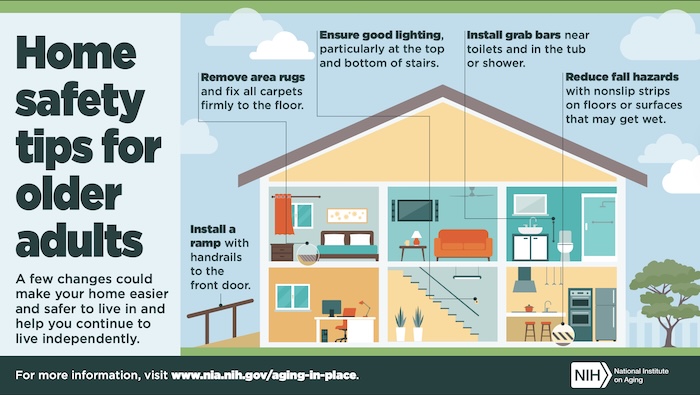
Despite the proven efficacy of these modifications, financial assistance remains severely limited. For families hoping that Medicare will bridge the gap and help pay for senior home modifications, the outlook is grim. Government data shows that only a tiny fraction of Medicare Advantage plans offer even partial coverage for actual structural home modifications, as Original Medicare classifies updates like grab bars, ramps, and pull-down shelving as home improvements rather than durable medical equipment. Consequently, families must plan to fund these critical interventions privately.
Ultimately, aging in place requires an active, structural defense strategy rather than a passive hope for the best. Without concrete changes, families risk inviting a catastrophic fall and an involuntary transition into expensive institutional care. Public health advocates urge homeowners to view stud-mounted grab bars, motion-sensor lighting, and AI-powered fall detection not as optional weekend projects, but as non-negotiable medical interventions designed to protect long-term independence.