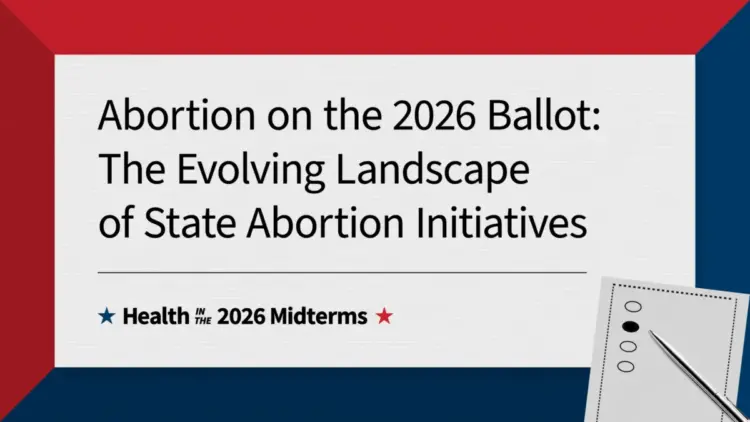
The landscape of reproductive rights across the United States continues to evolve through direct democracy, as voters and advocacy groups utilize state ballot initiatives to shape access to abortion care. Originally published in March 2026 and updated to reflect the final outcomes of pivotal mid-term elections, an analysis of key state measures underscores how ballot initiatives have become primary battlegrounds in the ongoing national debate following the Supreme Court’s 2022 Dobbs ruling.
During the 2026 midterm elections, voters in Nevada and Virginia successfully enshrined the right to abortion directly into their state constitutions. Conversely, voters in Missouri rejected a high-profile constitutional amendment that would have repealed the "Right to Reproductive Freedom Initiative" passed just two years prior in 2024. That proposed 2026 repeal measure sought to reinstate a ban on the provision of abortion with very limited exceptions, while also aiming to prohibit minors from accessing gender-affirming care. Meanwhile, in Idaho, voters rejected a statutory measure that would have reversed the state’s total abortion ban by establishing a statutory right to abortion up until fetal viability.
Since the Supreme Court overturned Roe v. Wade in June 2022, state ballot initiatives have served as a powerful mechanism for both proponents and opponents of abortion access. Ballot measures that successfully enact state constitutional amendments provide significantly stronger legal permanence than standard legislation passed by state lawmakers or rulings issued by state supreme courts. Over the past four years, a dozen states have advanced ballot initiatives, predominantly to fortify abortion access against legislative rollbacks or judicial shifts.
The dynamics of these citizen-led or legislature-referred measures highlight the complex legal hurdles, petition drives, and intense court battles that frequently precede a measure reaching the voting booth.
Ballot Initiatives Seeking to Protect Abortion Rights
Virginia
Prior to the 2026 elections, Virginia stood out as the sole Southern state lacking a total abortion ban or an early gestational limit, permitting abortion access up into the third trimester. Following legislative approval across two successive sessions—as required by state constitutional mandates—Governor Spanberger signed a bill on February 6, 2026, officially placing the Right to Reproductive Freedom Amendment on the November ballot.
This path to the ballot, however, was immediately met with aggressive legal challenges. On March 3, 2026, local government official Charla Bansley filed a lawsuit attempting to block the measure’s inclusion, arguing that state election officials had failed to properly distribute the constitutional text to circuit clerks across every county prior to certification. A district court judge subsequently dismissed the lawsuit with prejudice on July 24, 2026, ruling that the plaintiff lacked legal standing and had relied on a repealed statutory provision. An appeal to the Virginia Court of Appeals was subsequently narrowed when the appellate court denied a request to bypass standard review and move directly to the Virginia Supreme Court.
A parallel legal challenge was filed on April 30, 2026, by medical advocacy groups and local officials, arguing that the ballot initiative’s explanatory language was misleading and that circulation rules had been violated. Despite these ongoing judicial proceedings, early voting in Virginia commenced on September 18, 2026, and voters ultimately chose to approve the constitutional amendment. The measure establishes a fundamental right to abortion until the third trimester, alongside protections for contraception and fertility care, while permitting third-trimester regulations only when the pregnant person’s life or physical or mental health is endangered, or when fetal viability is absent.
Nevada
Nevada’s constitutional framework requires citizen-initiated ballot amendments to win approval across two successive general elections. Consequently, the 2026 election marked the second time Nevadans considered the Reproductive Rights Amendment, which had initially been approved by voters in 2024.
Abortion had previously been legal in Nevada up to 24 weeks of gestation under a 1990 statute affirmation, reinforced by the 2019 Trust Nevada Women Act, which decriminalized medication abortion and removed mandatory informed consent hurdles. The passage of the permanent constitutional amendment in November 2026 solidifies protections by guaranteeing all individuals the right to an abortion performed by a qualified healthcare practitioner up to fetal viability, or whenever necessary to protect the patient’s life or health, free from state interference.
Legal analysts note that the constitutional protection is expected to trigger fresh litigation surrounding Nevada’s parental notification law for minors. A lower court had previously lifted a decades-old injunction to reinstate parental notification requirements, prompting challenges from Planned Parenthood affiliates that resulted in temporary relief from the Nevada Supreme Court. With the constitutional amendment now enacted, advocates are positioned to press further legal challenges regarding minor consent.
Idaho
Idaho has maintained some of the most restrictive abortion laws in the country, enforcing a near-total ban on the provision of abortion with narrow exceptions solely to prevent the death of the pregnant person or in limited first-trimester cases involving reported rape or incest.
Seeking to alter this status quo, the advocacy group Idahoans United for Women and Families organized a petition drive to place the Reproductive Freedom and Privacy Act on the 2026 ballot. Despite stringent signature-gathering thresholds requiring backing from 6% of registered voters across a majority of the state’s legislative districts, the Secretary of State certified that enough valid signatures had been collected to qualify the measure for the November ballot.
The initiative’s journey was marked by multiple legal disputes over ballot phrasing. In early 2025, and again in late 2026, the Idaho Supreme Court ordered the state’s Attorney General and Secretary of State to rewrite official ballot explanations, finding that original drafts failed to clearly and concisely describe the legal effects of a "YES" or "NO" vote, particularly regarding the nuances of Idaho’s existing statutory exceptions. Ultimately, Idaho voters rejected the proposed statutory change, leaving the state’s existing total ban intact.
Ballot Initiatives Seeking to Curtail Abortion Rights
Missouri
Missouri experienced a unique cycle of direct democracy regarding reproductive rights. In 2024, Missouri voters approved Amendment 3, a constitutional amendment that established a right to abortion up to fetal viability and effectively invalidated the state’s previous near-total statutory ban. Following that victory, reproductive health providers filed successful lawsuits striking down several state facility and clinician regulations, though some regulatory litigation continued through the state courts.
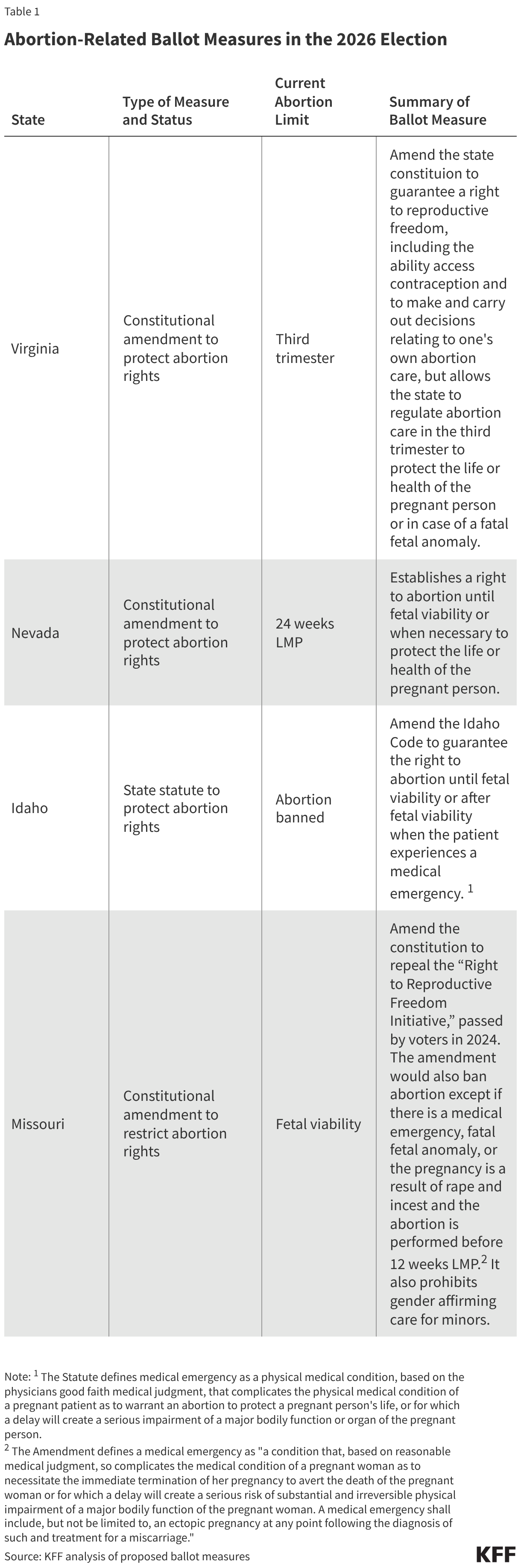
In response, anti-abortion state lawmakers advanced a counter-measure for the 2026 ballot designed to repeal the 2024 amendment. The 2026 initiative sought to ban the provision of abortion except in narrow medical emergencies, fatal fetal anomalies, or early-stage pregnancies resulting from rape or incest, while also incorporating mandatory parental consent rules for minors and prohibitions on public funding for abortion care. The text also sought to codify stringent regulatory powers for the legislature and ban gender-affirming care for minors.
The measure faced immediate scrutiny from civil rights groups. The ACLU of Missouri filed a lawsuit arguing that the proposed ballot summary was intentionally deceptive and violated state rules by combining multiple unrelated subjects, such as abortion restrictions and bans on youth gender-affirming care. The Missouri Western District Court of Appeals subsequently ruled that the original language failed to properly inform voters that a "yes" vote would repeal existing reproductive protections, and certified revised language for the November 2026 ballot. When voters went to the polls, they ultimately rejected the repeal measure, leaving the 2024 Right to Reproductive Freedom Amendment intact within the state constitution.
Pre-Existing Restrictions and the Impact of Constitutional Protections
The interplay between newly adopted constitutional protections and legacy state restrictions continues to play out across multiple jurisdictions. In states like Arizona and Ohio, voters previously approved constitutional amendments guaranteeing reproductive freedom, prompting swift legal challenges against pre-existing statutory barriers.
In Arizona, where voters passed Proposition 139 in 2024, state courts subsequently struck down a 15-week abortion ban, a ban on abortions based on fetal diagnoses, 24-hour waiting periods, and telemedicine restrictions. However, other legacy provisions—such as a ban on state funds for abortion, parental consent mandates, and restrictions limiting abortion care strictly to licensed physicians—have faced separate, ongoing legal challenges led by reproductive rights advocates arguing they conflict with the state constitution’s newly established rights.
Similarly, following the 2023 approval of Issue 1 in Ohio, state courts issued permanent injunctions blocking a 6-week gestational ban. Nonetheless, certain ancillary regulations, such as mandatory documentation requirements and parental consent laws, have remained operational while public funding for abortion continues to be barred.
As the 2026 election cycle concludes, the future landscape for citizen-referred ballot measures remains constrained. Only a small number of states with existing abortion bans allow for citizen-initiated constitutional amendments, and administrative hurdles continue to restrict access to the ballot box in states where comprehensive bans remain enforced. Meanwhile, in states where constitutional protections have successfully been embedded into foundational state law, the focus has shifted from electoral campaigns to protracted judicial enforcement and the ongoing dismantling of remaining statutory restrictions.