The outcome of the 2026 mid-term elections is set to trigger sweeping changes across Congress and state governments when newly elected officials officially take office in January 2027. Amid mounting voter anxiety regarding the spiraling affordability of health care, Democratic candidates campaigned heavily on explicit promises to roll back recent changes to Medicaid and the Affordable Care Act (ACA). Voters heard repeated warnings that these policy alterations would inflate out-of-pocket costs, restrict patient access to necessary care, shift financial burdens downward onto state budgets, increase fiscal pressures on already strained health care providers, and ultimately swell the ranks of the uninsured.
Beyond defending existing federal health programs, the shift in political power across several key states has created fertile ground for renewed debates. States that elected new Democratic governors, or experienced significant shifts in the composition of their state legislatures, are poised to reignite long-stalled discussions surrounding health care coverage expansion by finally adopting the ACA Medicaid expansion framework. Among the ten states nationwide that have steadfastly refused to adopt the expansion to date, Georgia, Kansas, Texas, and Wisconsin have emerged as the primary battlegrounds to watch as policymakers grapple with shifting political mandates.
For these holdout states and others that have debated expansion in prior legislative sessions, the evolving federal policy landscape will serve as a critical catalyst. For instance, the introduction of federal work requirements could alter the legislative calculus in states like Mississippi, where previous expansion efforts collapsed primarily due to an immovable disagreement over incorporating mandatory work rules into the program design. This same dynamic is expected to influence ongoing health care debates across other non-expansion states as well.
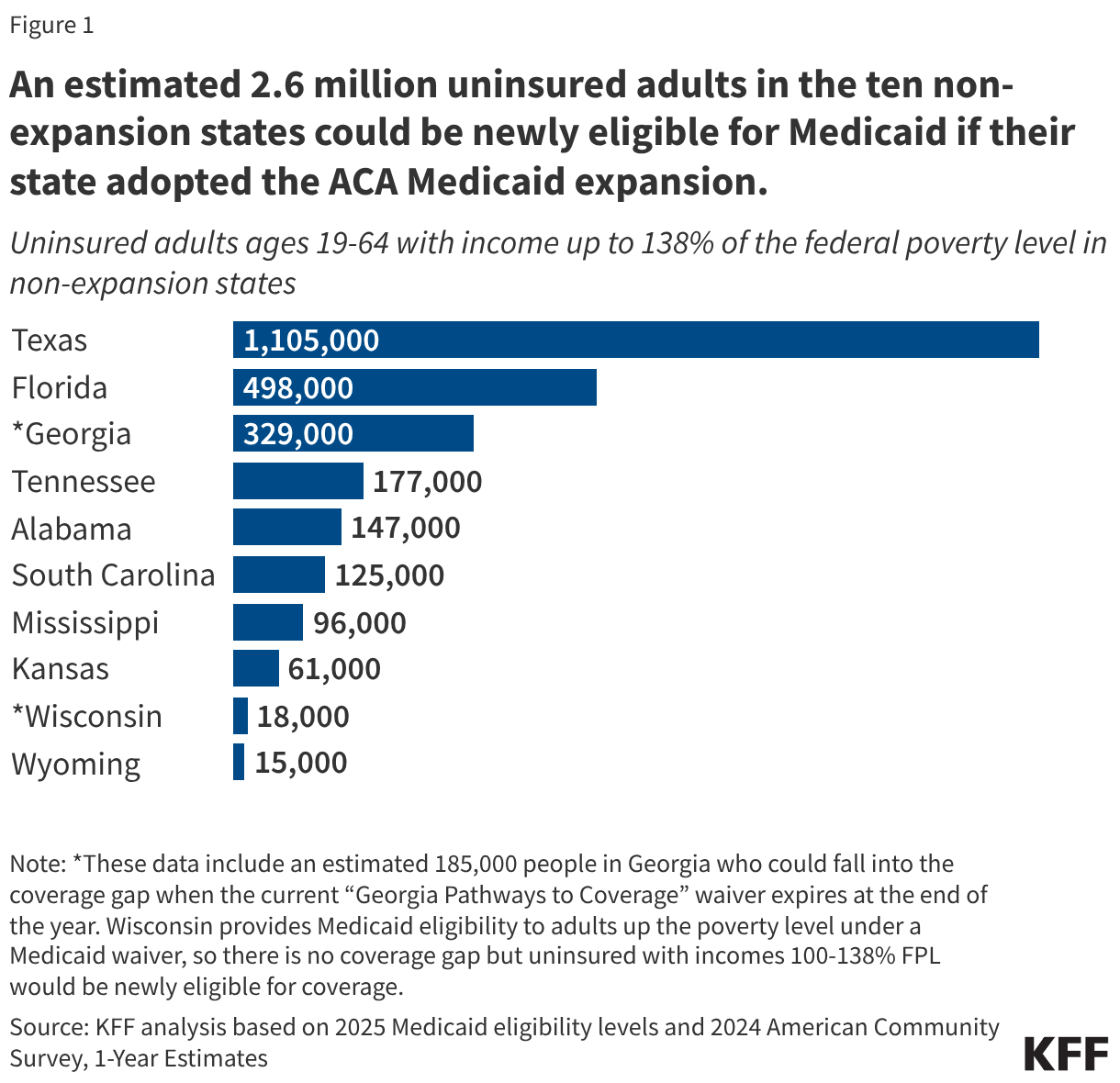
How Many Uninsured People Could Be Newly Eligible for Medicaid if States Adopt the ACA Medicaid Expansion?
An estimated 2.6 million uninsured adults living within the ten remaining non-expansion states could find themselves newly eligible for Medicaid coverage should their respective state governments finally decide to adopt the ACA expansion model. The scope of this potential coverage is heavily concentrated geographically, with nearly half of these uninsured individuals residing in the state of Texas alone.
This vulnerable population encompasses low-income adults whose household earnings fall below 100 percent of the federal poverty level, leaving them trapped in the notorious coverage gap where they earn too much for traditional state Medicaid yet too little to qualify for financial subsidies under the ACA Marketplace. Also included are individuals with incomes ranging between 100 and 138 percent of the federal poverty level who are technically eligible for subsidized Marketplace plans but remain unenrolled.
The overall figure also accounts for an estimated 185,000 people in Georgia who face the very real prospect of falling into the coverage gap when the state’s current "Georgia Pathways to Coverage" waiver officially expires at the conclusion of the year. Texas alone accounts for nearly half of all uninsured Americans who stand to gain coverage if expansion barriers are removed.
These baseline estimates do not yet reflect upcoming federal policy changes, such as the scheduled expiration of temporary enhanced premium tax credits at the end of 2025, nor do they factor in new Medicaid eligibility restrictions targeting certain lawfully present immigrants. Furthermore, these figures exclude individuals currently enrolled in Marketplace plans with incomes between 100 and 138 percent of the federal poverty level who would naturally transition into the Medicaid program if expansion is enacted.
How Has the Political and Policy Landscape for Medicaid Expansion Changed?
The political topography surrounding Medicaid expansion has undergone a profound transformation in the wake of the recent midterm elections. Newly elected Democratic governors—including Keisha Lance Bottoms in Georgia, Cindy Holscher in Kansas, Gina Hinojosa in Texas, and David Crowley in Wisconsin—rallied their campaigns around the promise of tackling soaring health care costs, specifically highlighting Medicaid expansion as a top priority in states like Georgia and Texas.
These executive victories, paired with notable shifts in legislative power, have unlocked unprecedented pathways for reform. In Georgia and Texas, state House chambers flipped to Democratic control, resulting in a newly minted dynamic of split legislative power. In Kansas, Republicans successfully maintained control of both legislative chambers, though their operating margins in the House were notably diminished. Meanwhile, Wisconsin saw Democrats capture the state Assembly, achieving single-party control. These structural realignments stand in stark contrast to prior years, when comprehensive expansion proposals repeatedly stalled or failed to clear legislative hurdles.
Concurrently, the implementation of federal Medicaid work requirements mandated by the 2025 reconciliation law may help dismantle long-standing ideological opposition to expansion in states governed by more conservative officials. Beginning January 1, 2027, the reconciliation law requires 44 states, including the District of Columbia, to condition Medicaid eligibility for adults under the ACA expansion group—as well as certain enrollees participating in Section 1115 waiver programs in the non-expansion states of Georgia, Tennessee, and Wisconsin—upon meeting specific work criteria.
While these federal mandates could provide the necessary political cover to forge a consensus in resistant holdout states, hurdles remain. For example, Mississippi’s inability to secure work requirements for expansion adults torpedoed legislative efforts in 2024. Even with work requirements written into federal law, deep-seated ideological resistance to the ACA framework persists within Republican-controlled legislative caucuses and will prove difficult to overcome. Simultaneously, congressional Democrats have signaled that mounting a defense to roll back Medicaid cuts and work requirements will remain a top legislative priority, though the ultimate success of those efforts remains entirely uncertain.
What Are the Financing Trade-Offs at Play in Expansion Decisions?
State-level deliberations over Medicaid expansion always involve complex fiscal calculus, anchored primarily by the federal government’s structural funding formulas. States that choose to expand their programs receive a generous 90 percent federal matching rate for all adults covered through the expansion group. This federal match is significantly higher than the federal matching rates provided for traditional Medicaid enrollees, which currently range from 50 percent in Wyoming and 59 percent in Texas to 77 percent in Mississippi among non-expansion states.
Despite this substantial federal support, participating states remain legally obligated to fund the remaining 10 percent of expansion coverage costs. In an era marked by increasingly tight state fiscal conditions and constrained budgets, lawmakers frequently express hesitation regarding any long-term commitment to new ongoing state spending.
The financial equation is further complicated for states that have attempted alternative coverage models. Both Georgia and Wisconsin currently operate under federal waivers designed to extend coverage to certain adults up to the federal poverty level, yet neither state receives the preferred 90 percent expansion match rate for those populations. Should these states transition to full ACA Medicaid expansion, they would be required to extend coverage eligibility upward from 100 to 138 percent of the poverty level. This shift would capture a mix of currently uninsured individuals alongside some residents already enrolled in ACA Marketplace plans, while finally unlocking the 90 percent federal match for individuals currently trapped in their limited waiver programs.
Both states are simultaneously required to implement the newly instituted federal work requirements across their existing waiver operations. Georgia’s current waiver program is scheduled to expire at the close of 2026, prompting the state to submit a pending waiver proposal seeking the coveted 90 percent federal matching rate effective January 1, 2027. The Georgia Pathways waiver successfully extended coverage up to the poverty level for parents and childless adults contingent upon work compliance, though it featured far fewer exemptions than standard federal rules require.
Beginning in 2027, state projections indicate that strict compliance with federal work rules and associated administrative exceptions will drive up enrollment within the waiver program to levels the state cannot sustainably fund without an infusion of federal dollars. The Centers for Medicare & Medicaid Services previously rejected Georgia’s 2019 request for an enhanced federal matching rate for its partial expansion design.
Furthermore, the 2025 reconciliation law introduced sweeping financing provisions that directly influence state calculations regarding Medicaid expansion. While these fiscal adjustments impact every state nationwide, the legislation imposes disproportionately heavy financial restrictions on expansion states compared to non-expansion states. When evaluating whether to adopt expansion, state budget directors must weigh the benefits of an enhanced federal match against the potential loss of other federal Medicaid revenues resulting from tighter federal restrictions on provider taxes and state-directed payments.
If congressional Democrats succeed in their stated goals to repeal or modify some of these financing restrictions, it could alleviate the fiscal barriers currently discouraging hesitant states from pursuing expansion.
What Does Research Show and What Is Public Opinion About Expansion?
Decades of exhaustive public health research point overwhelmingly to the positive, measurable effects of Medicaid expansion, providing empirical ammunition for proponents urging state lawmakers to reconsider their positions. A comprehensive review of the available literature reveals that expanding the ACA generated sweeping improvements in overall health care access, service utilization rates, patient affordability, and personal financial security among low-income households.
Furthermore, Medicaid expansion correlates directly with increased rates of early-stage cancer diagnoses, reduced rates of cardiovascular mortality, and higher success rates for individuals attempting tobacco cessation. Mounting evidence demonstrates that acquiring health coverage through Medicaid expansion saves lives. A prominent recent study documented a 2.5 percent reduction in overall mortality among low-income adults residing in expansion states, concluding that expansion lowered the risk of death among new enrollees by an estimated 21 percent and saved approximately 27,000 lives between 2010 and 2022. Additional studies document tangible economic benefits for health care providers, particularly stabilizing the precarious financial footing of rural hospitals struggling in non-expansion states.
Public opinion polling heavily favors expansion, even within conservative strongholds. Previous polling conducted by KFF indicates that roughly two-thirds of residents living in non-expansion states believe their state government should adopt the ACA Medicaid expansion to extend coverage to more low-income individuals. This favorable sentiment outweighs by a nearly two-to-one margin the share of residents who prefer their state Medicaid programs remain unchanged at 34 percent. Moreover, voters in seven states have successfully forced the adoption of Medicaid expansion directly through statewide ballot measures, underscoring the enduring popularity of the program whenever the electorate is given a direct voice in the decision.