Ask almost anyone operating within the modern mental health field what keeps them awake at night, and they will likely offer a version of the exact same sobering response: there simply are not enough of us. Across the United States, a persistent and widening shortage of mental health professionals continues to strain healthcare infrastructure. Millions of individuals find themselves unable to secure the necessary care due to a variety of systemic hurdles, whether that means living in a designated provider desert, facing wait times stretching across multiple months, or confronting prohibitive financial costs that render professional therapy entirely out of reach.
Since its inception in 2013, Crisis Text Line has worked to bridge this widening gap by extending the operational capacity of an overwhelmingly overburdened mental health system. Operating around the clock, the organization deploys trained volunteer Crisis Counselors to provide free, confidential support to individuals navigating acute moments of anxiety, depression, profound loneliness, self-harm, and suicidal ideation. These volunteers operate under the live, active supervision of licensed mental health professionals, serving as an immediate lifeline to people across the nation.
However, a new body of research indicates that the true footprint of this unique model reaches far beyond the individual text-based conversations facilitated through the platform.
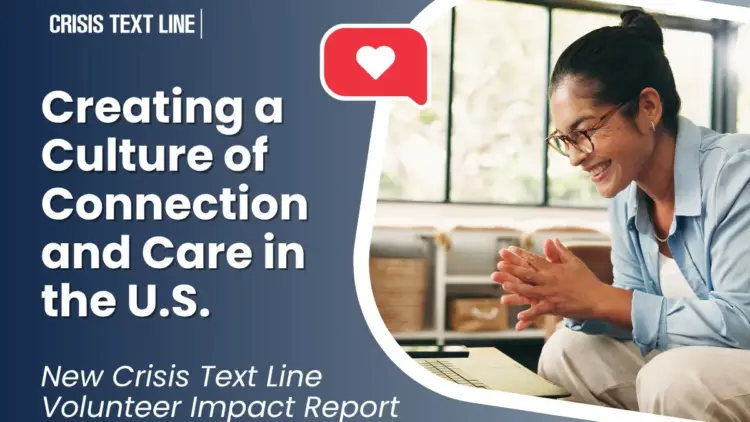
To better quantify and understand this broader societal influence, Crisis Text Line surveyed approximately 1,400 active volunteers in 2026. The survey examined how the act of volunteering has actively shaped the personal lives of the counselors themselves, as well as the social networks surrounding them. The findings point to a compelling ripple effect across American communities, demonstrating that these volunteers are doing much more than expanding immediate access to crisis support. In the process of helping strangers, they are actively building advanced interpersonal skills, cementing deeper social connections, and fostering healthier, more resilient communities.
Volunteering builds skills that extend beyond the conversation
Supporting an individual through a harrowing emotional crisis requires far more than passive listening. Crisis Counselors undergo rigorous preparation that teaches them how to cultivate trust quickly, communicate with profound empathy, navigate volatile and intense emotions, and collaborate directly with a person in distress to outline a viable path forward.
Crucially, those acquired competencies do not simply vanish when a volunteer logs off for the day. The internal benefits to personal well-being are profound, with 97 percent of surveyed volunteers reporting that their time with the organization has directly helped them develop greater personal resilience. The art of de-escalation, emotional regulation, and active listening becomes a permanent part of a volunteer’s psychological toolkit, permanently altering how they process stress in their own daily lives.
Volunteering creates connection
This skills acquisition occurs against a backdrop of widespread social fragmentation. At a time when loneliness and systemic social isolation affect populations across multiple generations, structured volunteering offers a powerful antidote by generating genuine opportunities for human connection.
According to the 2026 survey data, 95 percent of volunteers reported that participating with Crisis Text Line helps them feel a stronger, more meaningful sense of connection to other human beings. Furthermore, 76 percent noted that the experience has tangibly improved their general ability to meet new people and forge lasting friendships, counteracting the atomization that characterizes much of modern civic life.
The impact doesn’t stop when a shift ends
Perhaps one of the most striking revelations of the survey data is the multiplication of the support network. For every individual conversation a volunteer navigates through the official Crisis Text Line service, they are quietly equipped to help manage nearly one additional moment of acute distress within their immediate personal circles.
The data reveals that 98 percent of volunteers have been able to leverage their training to support someone experiencing emotional distress completely outside of their formal volunteer duties. This includes applying these crisis-intervention techniques to family members, close friends, professional colleagues, and academic classmates, effectively turning everyday citizens into frontline mental health advocates within their neighborhoods and workplaces.
Volunteering can shape careers
For a significant portion of the volunteer corps, the experience acts as a profound professional catalyst, fundamentally redirecting their educational and occupational trajectories. Eighty-three percent of respondents stated that their time as a Crisis Counselor has actively influenced how they view their long-term career paths and educational goals.
More specifically, 87 percent indicated that the volunteering experience has inspired a deeper desire to work professionally in a field dedicated to helping others. Among that subset of motivated individuals, 75 percent are actively considering or pursuing careers specifically within mental health, professional counseling, or social work, providing a vital pipeline of passionate talent into an understaffed industry.
A ripple effect that starts with showing up
The comprehensive findings from the 2026 volunteer survey illuminate a powerful dual impact at the very core of the Crisis Text Line model. Volunteers serve as an essential safety net, guiding vulnerable people through some of the darkest moments of their lives. Yet, in the process of extending that help, they cultivate a personal reservoir of resilience, advanced communication skills, and social connections that fundamentally transform how they show up for themselves and their communities.
That positive momentum ripples outward, touching families, friendships, corporate offices, school hallways, and local neighborhoods in ways that statistics alone can scarcely capture, proving that systemic care often begins with the simple act of showing up.