As a caregiver, navigating the daily routine often involves a persistent undercurrent of anxiety that follows an aging parent from room to room. This worry invariably peaks when an aging loved one steps into the bathroom, a domestic space where personal privacy is highly valued, yet physical safety is frequently and severely compromised. Addressing these hidden dangers requires moving beyond casual home improvements and adopting a clinical, precise approach to home modifications designed to support aging in place.
Industry experts and healthcare advocates emphasize that the bathroom presents a uniquely hazardous environment for older adults. Defined by hard surfaces, running water, and slippery soap, the standard bathroom naturally obliterates traction. When these physical elements combine with the normal physiological realities of aging—such as progressive muscle weakness, stiffening joints, and diminished visual acuity—the statistical risk of a catastrophic fall increases exponentially.
Mitigating these hazards demands far more than a quick trip to the local hardware store for generic accessories. Clinicians and safety specialists argue that protecting seniors from severe injuries requires clinical precision, careful measurement, and professional oversight.
Why the Bathroom is the Most Dangerous Room in the House
The combination of moisture and rigid architectural materials creates a high-risk setting for household accidents. For older adults managing mobility limitations, navigating this space can become a daily hazard. Healthcare professionals stress that preventing life-altering injuries begins with understanding why certain fixtures fail to meet the biomechanical needs of aging bodies.
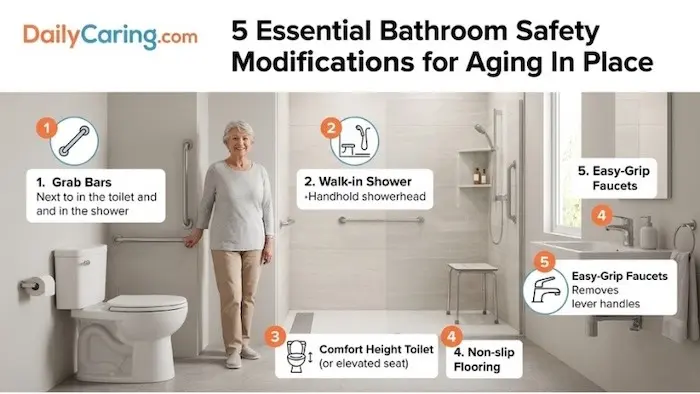
One of the most common pitfalls involves the installation of bathroom hardware without professional guidance. Grab bars, for instance, are frequently treated as simple do-it-yourself accessories that can be mounted anywhere along a wall. However, safety experts insist that grab bars must be regarded as clinical tools mapped directly to a user’s specific functional reach. A clinical expert, such as an occupational therapist, looks beyond basic wall studs to evaluate how specific mobility limitations dictate bar placement to effectively arrest a sudden fall.
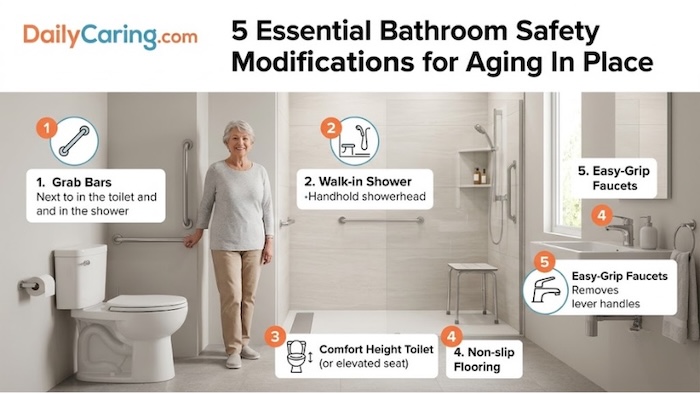
Furthermore, professional installation is mandatory for these devices. Suction-cup bars are entirely inadequate under the sudden kinetic energy of a falling adult, frequently transforming a perceived safety device into a secondary hazard that pulls away from the wall under pressure. When shopping for permanent grab bars, safety advocates recommend selecting diameters between 1.25 and 1.5 inches, which are optimal for aging hands, alongside ADA-compliant knurled finishes that provide a secure grip rather than slick, smooth chrome.
Addressing Critical Fixtures and Environmental Factors
Beyond grab bars, standard residential fixtures often fail to accommodate the physical needs of older residents. Standard toilets, typically standing at a height of 15 inches, present a significant hazard for an aging body. They demand excessive joint flexion and powerful quadriceps strength to transition from a seated position to standing. While the Americans with Disabilities Act recommends a height of 17 to 19 inches for wheelchair accessibility, residential safety requires a customized calculation based on the individual’s anatomy. Determining the correct height involves measuring from the floor to the back of the senior’s thigh behind the knee to minimize undue stress on weight-bearing joints.
Visual challenges also play a major role in bathroom accidents. Aging eyes frequently suffer from decreased pupil size and lens clouding, which naturally demands higher levels of ambient illumination. However, installing excessively bright bulbs often creates a harsh, blinding glare that obscures depth perception, making the space far more dangerous than a dimly lit room. The primary objective for caregivers is achieving uniform illumination paired with high contrast. Experts recommend utilizing bulbs with a Color Rendering Index of 80 or higher and a color temperature ranging between 2700K and 3000K to create stark visual boundaries, ensuring the edge of a bathtub is clearly distinguishable from the surrounding floor.
Flooring materials represent another critical consideration in home safety planning. Traditional ceramic tile is valued for its water-resistant properties, but it offers zero shock absorption. If a fall does occur, a tile floor provides no energy dissipation, frequently resulting in severe trauma, including fractured hips and head injuries. Alternative materials, such as rubber flooring, textured cork, or slip-resistant vinyl, offer varying degrees of natural traction and impact cushioning that can significantly reduce the severity of an impact.
Additionally, architectural features like door saddles and room thresholds are frequently overlooked tripping hazards. A standard threshold creates an abrupt height variation where a carpeted hallway meets a tiled bathroom floor. For seniors who exhibit a characteristic shuffling gait, this minor elevation change can easily trigger a trip-and-fall incident. Replacing standard saddles with graded, smooth transitions helps eliminate these invisible barriers.

The Importance of Professional Expertise and Cost Considerations
Executing these vital structural updates requires specialized knowledge that goes beyond the scope of a general handyman. Families are strongly encouraged to seek out a Certified Aging-in-Place Specialist. Administered by the National Association of Home Builders, the CAPS designation indicates that a professional has completed targeted training addressing the unique biomechanical requirements of older adults, mobility-barrier solutions, and the strict load-bearing structural specifications necessary for safety equipment installations.
While comprehensive bathroom modifications involve a substantial upfront investment—typically ranging from $2,000 to $5,000 for professional grab bar installations, upgraded lighting, comfort-height toilets, and threshold removals—advocates frame these expenses as a vital financial safeguard. In contrast, the baseline cost of a single reactive fall resulting in emergency hospitalization, surgical joint replacement, and subsequent rehabilitation in a skilled nursing facility routinely exceeds $50,000. Experts emphasize that investing in structural safety is an effective insurance policy against a catastrophic event that could otherwise permanently end an older adult’s ability to remain in their home.
Failing to address these environmental hazards leaves the living space hostile to an aging body, vastly increasing the likelihood of severe injury. By proactively executing these structural changes with the help of certified professionals, caregivers can secure the bathroom environment and protect the long-term well-being and independence of older adults.