The landscape of the nation’s healthcare system is undergoing a significant shift as states begin responding to sweeping federal policy changes. Under the 2025 reconciliation law, states are now required to condition Medicaid eligibility for adults in the Affordable Care Act (ACA) expansion group on meeting specific work and community engagement requirements. While the federal mandate sets a universal start date of January 1, 2027, for these provisions to take effect nationwide, a number of states are wasting little time in preparing for the transition. Several jurisdictions have announced plans to jumpstart the process, opting to roll out the requirements ahead of the federal deadline using specific administrative mechanisms provided under the law.
The implementation of these federal directives highlights a renewed policy focus on employment as a condition for receiving government-funded healthcare benefits for low-income adults. As healthcare administrators, policy analysts, and state lawmakers navigate the transition, the timeline for enforcement is varying significantly across the country. While some states are preparing for immediate rollouts well ahead of 2027, others are adopting phased approaches or phasing out older administrative pathways in favor of the newly enacted federal framework.
State Plan Amendments (SPAs)
To enforce the work requirements prior to the mandatory January 1, 2027 implementation date, states have the option to utilize State Plan Amendments, commonly referred to as SPAs. This administrative route allows state governments to modify their official Medicaid operational plans and secure federal approval to institute the rules early.
Nebraska has emerged as the first state in the nation to officially announce that it will enforce the federal work requirements ahead of schedule through this mechanism, targeting a start date of May 1, 2026. Following Nebraska’s lead, two other states have outlined timelines to initiate enforcement before the federal deadline. Montana is scheduled to implement the requirements on July 1, 2026, while Iowa plans to follow suit later that year on December 1, 2026.
Meanwhile, Arkansas has taken a slightly different approach to the early transition period. State officials in Arkansas have announced plans to launch a soft implementation phase of the work requirements beginning July 1, 2026. However, unlike states pursuing full enforcement, Arkansas has clarified that it will not disenroll any individuals for failing to meet the work criteria prior to the mandatory federal enforcement date of January 1, 2027. This soft launch is designed to give beneficiaries time to adapt to the upcoming rules without an immediate loss of healthcare coverage.
1115 Waivers
The pathway for states wishing to impose work requirements has historically run through Section 1115 demonstration waivers, which allow states to test experimental changes to their Medicaid programs. Since the inauguration of the second Trump administration, several states submitted new waiver applications seeking permission to implement work requirements. However, policy experts note that states are now unlikely to move forward with these proposed 1115 waivers given the passage of the comprehensive federal legislation.
With the 2025 reconciliation law now mandating work requirements nationwide, states planning early implementation are bypassing the waiver process and instead utilizing State Plan Amendments. This shift streamlines the administrative process by aligning state programs directly with the new federal statutory requirements rather than relying on temporary demonstration projects.
Currently, Georgia stands as the sole exception in the national landscape. Georgia is the only state with an active Medicaid work requirement waiver already in place, a status it secured following extensive litigation over the Biden administration’s previous efforts to halt such waivers. However, Georgia’s existing waiver is slated to expire on December 31, 2026. Once that waiver lapses, the state will be required to transition and come into full compliance with the new federal requirements that take effect nationwide on January 1, 2027.
Early Implementation and Waiver Status
The national distribution of these policy choices reflects a patchwork approach to Medicaid administration as the country moves toward the 2027 federal deadline. While the majority of states are evaluating their options under the new reconciliation law, a select group has definitively signaled an early transition.
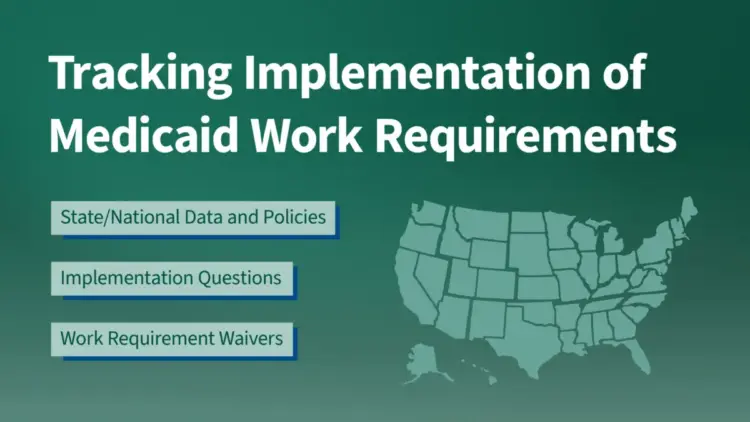
Geographic mapping of current legislative and administrative activity identifies the pioneering states that have formally indicated they will implement federal work requirements ahead of schedule through a State Plan Amendment, alongside Georgia, which maintains its unique position through its approved 1115 waiver. As the deadlines for Nebraska, Montana, Iowa, and Arkansas draw closer, healthcare advocates and state administrators continue to monitor the operational challenges and potential impacts on coverage enrollment for millions of adults across the expansion population.