
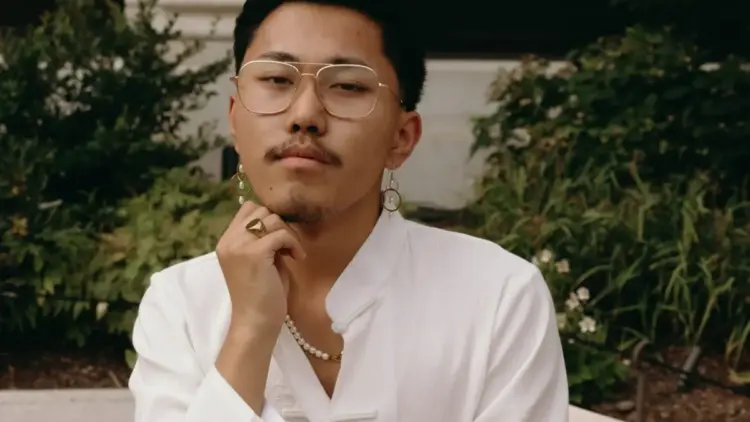
As HuáHuā Samuel Vogel prepared to cross the commencement stage to collect a dual Bachelor of Arts in Interdisciplinary Studies and Liberal Studies in Law, Business, and Society, they were acutely aware of the long, grueling path that led to that moment. For Vogel, an intersectional activist whose identities span the disability justice, Asian American, LGBTQ+, and environmental spheres, the academic milestone is not a neat finale or a tidy celebration of a final victory. Instead, it serves as a testament to a complex, ongoing journey defined by medical trauma, cultural stigma, the unwavering support of family, and a lifelong commitment to authentic systemic advocacy.
Reflecting on the hospital beds of their youth, Vogel recalls a pervasive sense of despair that threatened to consume their early years. Growing up as a medically complex, disabled, international, and interracial Chinese adoptee, Vogel spent a significant portion of childhood trapped by a relentless succession of surgeries, extended hospital stays, and summers lost entirely to recovery.
Born with Spina Bifida—a birth defect of the spine—Vogel’s medical journey began in earnest after adoption and relocation to the United States in 2007. Left in a Chinese hospital for at least 31 days without primary care, love, or fundamental support, the trauma of early institutionalization left an indelible mark even before day zero. This initial imprint laid the groundwork for a childhood marked by fear, anxiety, and profound mental anguish, which was subsequently compounded by innumerable medical interventions by doctors striving to fix, cure, and reconstruct their body.
The medical reality of Spina Bifida brought an invasive daily routine: self-catheterization, countless medical procedures, a rotation of medications, and specialized academic accommodations through IEP and 504 plans. More broadly, it plunged Vogel into a social environment where disability was heavily stigmatized.
During childhood, the fear of rejection in a society ill-equipped to accommodate disability drove Vogel to walk unassisted for as long as possible. The desire to fit in and be perceived as "normal" was overwhelming, particularly in an environment devoid of visible role models on television or within their immediate community who shared similar identities or medical realities.
Rather than fostering inclusion, the dozens of surgical procedures on their legs, feet, hips, and back only added to a growing collection of physical scars. Vogel compares the accumulation of surgical markers to a child collecting trading cards, noting that the reality was far less enjoyable. As they navigated public spaces, strangers frequently breached personal boundaries, inserting themselves into Vogel’s private medical history by staring, shouting, pointing, and asking intrusive questions.
While peers enjoyed their summers outdoors, Vogel’s warm-weather months were spent confined to a recovery bed, enveloped in sadness, tears, and a deep sense of stagnation. Vivid memories remain of the intense emotional distress experienced in hospital settings, alongside the physical agony of frequent needle injections and abrupt disruptions at 2:00 AM by medical staff ready to check vitals or introduce unknown liquids into IV lines.
Through these compounding hardships, Vogel’s mother emerged as a fierce and protective warrior, advocating for her child with the intensity and devotion of a biological parent. Her love and fierce protection provided a crucial anchor as Vogel learned to navigate a harsh world at a remarkably young age.
As they matured through these trials, the pain of those early years forged essential tools for survival and advocacy. Vogel transitioned naturally into the role of an advocate, championing and educating others who lacked the space, voice, or privilege to speak for themselves. This step into public advocacy underscored the critical importance of representation. Discovering prominent disabled Asian American figures such as Mia Ives-Rublee, Chella Man, and Alice Wong provided Vogel with vital anchors, validating their desire to exist, occupy space, and fight for justice at the intersection of multiple marginalized identities.
Now holding dual degrees and reflecting on a path that includes serving as a recent alum of the AAPD Summer Internship Program and founding a university-wide department focused on disability justice in higher education, Vogel remains anchored to their origins. Alongside their academic and activist pursuits, Vogel is a professional photographer, writer, and philomath dedicated to sustainable planning and community-building.
Addressing the broader narrative surrounding disability, Vogel firmly rejects the framing of their life as an inspirational success story designed for public consumption. This perspective is not a tale of simple acceptance or "inspiration porn"—the trope where disabled individuals are lauded merely for existing or performing everyday tasks. Instead, Vogel offers a powerful declaration that their identity is shaped not by a sanitized narrative of overcoming hardship, but by the raw, unfiltered reality of lived experience.
By refusing the superficial tropes of inspiration porn and tidy acceptance, Vogel positions medical trauma, cultural stigma, and profound familial love not as obstacles neatly conquered, but as foundational catalysts for a lifelong dedication to systemic change. It is an honor-bound commitment to continuous resistance, honoring a painful past while fiercely claiming the sovereign right to shape an independent future.



