
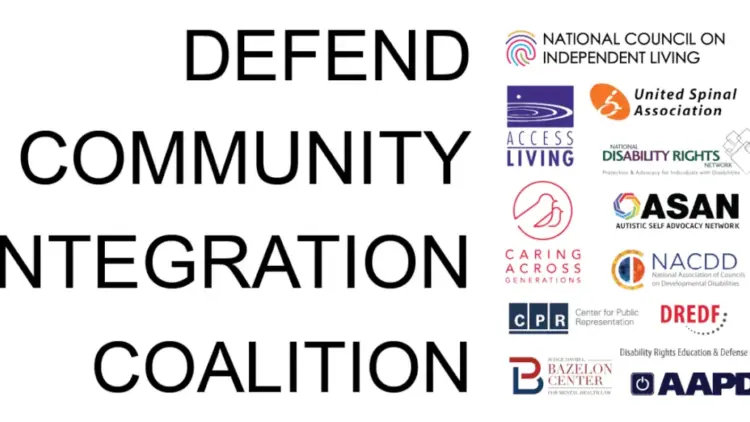
The Defend Community Integration Coalition (DCIC) has issued a strong and unequivocal condemnation of a recently proposed joint resolution filed in the ongoing legal battle of Texas v. Kennedy. Introduced on August 31, the resolution represents a direct and alarming challenge to the 2024 community integration regulations established under Section 504 of the Rehabilitation Act of 1973. According to disability rights advocates, this legislative maneuver directly undermines decades of hard-fought judicial precedent, established administrative law, and clear Congressional intent designed to guarantee that community integration remains an uncompromised civil right for all individuals with disabilities across the United States.
As a unified front of national disability rights leaders, organizations, and allied advocacy groups, the coalition emphasizes that decades of progress are now under serious threat. The campaign to advance community integration as a foundational civil right has never been an easy victory, requiring sustained pressure, legal advocacy, and grassroots organizing. The DCIC has made it clear that it will vigorously oppose any coordinated attacks aimed at rolling back protections that have allowed disabled Americans to live, work, and thrive outside of restrictive institutional settings.
At the heart of this resistance is the fundamental principle of autonomy. For millions of people with disabilities, there is no right more vital than the everyday capacity to make personal choices about one’s own life. Historically and systemically, individuals with disabilities have faced environments where outside entities make critical life decisions on their behalf. Overcoming these barriers has required extensive effort to build the robust community-based supports necessary to ensure that personal choices are genuine and sustainable. These supports encompass every facet of daily existence, enabling individuals to attend school, secure meaningful employment, eat independently, maintain stable housing, and raise their families with dignity.
Human dignity and well-being extend far beyond basic institutional maintenance. As coalition representatives note, a meaningful life cannot be reduced merely to receiving three scheduled meals a day and taking medications on a strict timetable. Instead, a fulfilling human experience involves the freedom to grow, work, love, dream, experience failure, and ultimately reach one’s full personal potential. It involves the everyday autonomy to decide when to wake up in the morning, when to leave the house, what meals to prepare, and with whom to share a home. Exercising these basic freedoms becomes nearly impossible when individuals are forced into restrictive congregate settings where they are systematically denied a voice in the most basic aspects of their daily routines.

Disabled individuals have long demonstrated resilience as survivors, contributing to society as spouses, parents, siblings, classmates, colleagues, and neighbors. Above all, they are American citizens determined to push back against policies, ideologies, and legal actions that strip away their dignity and threaten to erase decades of hard-won civil rights progress. The coalition stresses that the community integration mandate is entirely non-negotiable and represents a core pillar of equal protection under the law.
Recognizing the gravity of the legal challenge in Texas v. Kennedy, the DCIC is urging the broader community to join forces and mount a collective defense. Because the implications of this case extend to the very foundation of disability rights enforcement, advocates emphasize that unity and coordinated action are critical to preserving civil protections.
To support these ongoing advocacy efforts, national organizations have mobilized informational resources and engagement opportunities for the public. The American Association of People with Disabilities (AAPD) has highlighted educational programming, including webinars focused on understanding and protecting disability rights under the landmark Olmstead decision, the Americans with Disabilities Act (ADA), and Section 504, alongside actionable steps for concerned citizens. Additionally, statements from national disability organizations, detailed resource pages provided by the Disability Rights Education & Defense Fund (DREDF), and comprehensive legal summaries from platforms such as Red Line for Civil Rights are serving as vital tools for tracking the progression of the case and understanding its broader legal ramifications.
The Defend Community Integration Coalition comprises an extensive network of prominent national civil rights and advocacy organizations. Its membership includes Access Living, the American Association of People with Disabilities, the Autistic Self Advocacy Network, the Bazelon Center for Mental Health Law, Caring Across Generations, the Center for Public Representation, the Disability Rights Education & Defense Fund, the National Association of Councils on Developmental Disabilities, the National Council on Independent Living, the National Disability Rights Network, and United Spinal Association.



