

For generations, the cultural image of senior safety technology was anchored to a single phrase: "I’ve fallen and I can’t get up." That iconic broadcast pendant—a bulky, single-purpose button tethered to a localized base unit and reliant on a traditional landline—served its purpose for decades. However, the landscape of elder care and personal emergency response technology has undergone a quiet revolution. Today’s medical alert systems have evolved far beyond the basic panic button, transforming into comprehensive safety hubs that increasingly dictate whether an older adult can successfully maintain their independence at home or whether they must ultimately transition to a supervised care facility.
This technological evolution arrives at a critical time for families and healthcare systems alike. According to data compiled by AARP, nearly 90 percent of adults aged 65 and older express a firm preference for aging in place rather than relocating to institutional care settings. Because independent living remains the gold standard for aging populations, the infrastructure supporting it has matured at an accelerated pace. Industry analyses from Grand View Research project that the global market for medical alert and personal emergency response systems will reach $11.8 billion, driven directly by an escalating consumer and institutional demand for sophisticated, proactive safety monitoring.
To understand the magnitude of this shift, industry experts point to the severe limitations of the legacy format. The traditional system model relied on a wearable button connected to a base station that required a landline telephone connection to reach a monitoring center. While revolutionary for its time, that model operated under strict parameters. It functioned only if an older adult remembered to put the device on, remained within a few hundred feet of the home base unit, and stayed conscious enough to physically press the button following a medical crisis, accident, or fall.
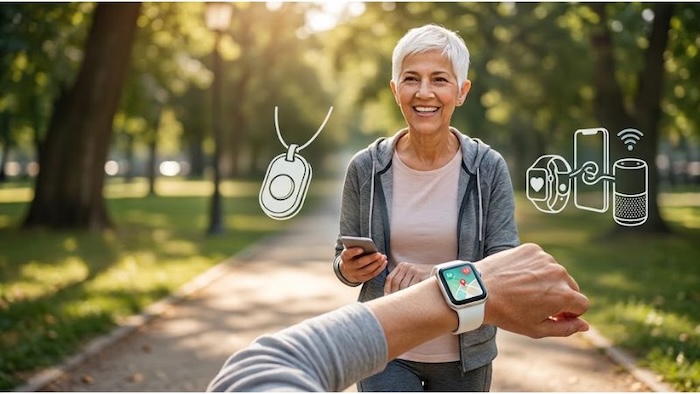
Modern iterations of these devices have discarded those physical boundaries. Today, wearable artificial intelligence devices and cellular connectivity are transforming traditional, reactive alarm triggers into real-time health-monitoring tools designed for proactive care. The integration of wearable technology allows for continuous tracking and immediate communication regardless of whether the user is inside their living room or miles away running errands.
The contrast between legacy technology and current market offerings highlights a profound shift in design philosophy. Traditional systems restricted users to an 800-foot radius around a home base unit, whereas modern smartwatches provide unlimited nationwide cellular coverage supported by integrated GPS tracking. Furthermore, while older fall-detection mechanisms relied on basic impact triggers that frequently generated high rates of false alarms, contemporary devices employ AI-filtered accelerometers and gyroscopes capable of distinguishing between a genuine fall and normal, daily movements.

In households where older adults experience cognitive decline or actively resist wearing traditional devices, the market has expanded to include ambient sensors utilizing radar and Wi-Fi wall monitors. These passive systems provide whole-home coverage and detect falls or unusual activity without requiring the user to wear a physical gadget. Additionally, while older systems offered zero digital integration beyond a telephone call to emergency contacts, modern setups feature comprehensive caregiver applications that deliver real-time data on location, battery status, device connectivity, activity tracking, and routine deviation alerts.
Selecting the appropriate medical alert system requires careful alignment between the technology and the actual needs and cognitive capabilities of the user. Caregivers and family members note that advanced smartwatches equipped with touchscreens and multiple digital features can prove overwhelming or ineffective for individuals dealing with severe cognitive impairment, dementia, or advanced macular degeneration. Conversely, passive monitoring solutions or simplified pendants often serve these populations far better by removing the burden of operation from the user entirely.
Despite these remarkable technological strides, healthcare professionals and industry advocates emphasize that a medical alert system should never be viewed as a complete substitute for direct human supervision or structured in-home care. Instead, these systems function primarily as risk-mitigation tools designed to buy families and emergency responders precious minutes during a crisis. Organizations like the National Institute on Aging continue to stress the importance of comprehensive fall prevention guidelines and home modifications as essential first steps before relying solely on wearable technology.

The question of financial accessibility remains a significant consideration for families navigating these options. Original Medicare, encompassing both Part A and Part B, does not cover medical alert systems because they are not officially classified as durable medical equipment. However, some Medicare Advantage plans under Part C, as well as specific state Medicaid programs, may offer limited financial coverage, partial reimbursements, or equipment discounts depending on regional regulations. Unlike older models, modern systems eliminate the necessity for a traditional landline entirely, relying instead on built-in cellular networks that function wherever cellular service is available.
The mechanism behind automatic fall detection has similarly grown more sophisticated. Contemporary devices utilize complex algorithms powered by internal accelerometers and gyroscopes to monitor subtle changes in motion, posture, and speed. When the technology identifies a kinematic pattern that matches a hard fall, it initiates contact with a monitoring center automatically, ensuring that help is dispatched even if the user loses consciousness or is physically unable to press a button. Caregivers can monitor these automated safety alerts alongside daily medication management reminders through synchronized mobile applications.
Ultimately, navigating the balance between maintaining personal autonomy and ensuring physical safety remains one of the most demanding challenges in modern caregiving. The rapid evolution of medical alert systems has successfully stripped away the social stigma once associated with bulky, clinical panic buttons, replacing them with sleek, proactive health technologies. Whether families choose a discreet GPS-enabled medical watch for an active parent or passive ambient sensors for a relative experiencing memory loss, the current generation of safety technology is engineered to preserve human dignity while offering families vital peace of mind. While no electronic device can ever replicate the warmth, empathy, and watchful eye of dedicated human care, integrating these advanced systems into an overarching care plan ensures that help remains quietly and reliably available when it is needed most.



