Behind every text message sent to a crisis hotline, there is a volunteer waiting on the other end of the line—someone who chose to show up, listen, and offer a steady presence during another person’s most difficult moments. Across the globe, crisis intervention relies heavily on individuals who donate their time to sit with strangers in pain, providing a nonjudgmental ear when the rest of the world feels overwhelming.
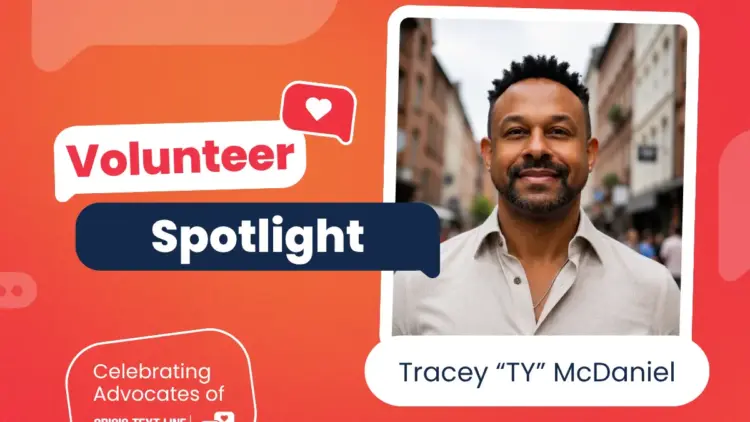
As part of its ongoing monthly recognition of these advocates, Crisis Text Line is shining a light on Tracey “TY” McDaniel. His journey into crisis support began not with a formal career path in psychology or social work, but with a deeply personal promise made to a grieving friend. Over time, that commitment has grown into a broader mission to remind people that asking for help is an act of profound strength rather than a weakness.
A Promise Born from Unimaginable Loss
TY’s path to becoming a volunteer Crisis Counselor started following a devastating tragedy. A dear friend of his lost her son to suicide, leaving behind an irreplaceable void and a community grappling with grief. In the wake of that loss, TY made a pact with his friend that he would do whatever he could to help others and prevent similar tragedies.
That promise ultimately directed him toward Crisis Text Line, transforming a personal vow into tangible, community-level action. However, the mission quickly took on even deeper layers of meaning for him. TY has personally been impacted by suicide more than once throughout his life. Those experiences have stayed with him over the years, solidifying his conviction that he needed to find a way to make a tangible difference. Supporting people who struggle with their mental health became deeply personal. In his view, if being there for someone during their darkest hours can alter their trajectory even slightly, the time invested is profoundly worthwhile.
The Realities of Crisis Counseling
Many people unfamiliar with crisis intervention harbor misconceptions about what it takes to volunteer on a support line. Prospective volunteers often worry that they need to be licensed therapists or possess all the answers to complex life problems. TY emphasizes that this is far from the truth.
When individuals reach out to a crisis line, they are rarely looking for someone to fix their lives or provide a neat, formulaic solution. Instead, they are seeking a shoulder to lean on, an unbiased listener who will validate their feelings, and someone who can offer perspective, guidance, or simply a reminder that they are not alone. Often, the role of a crisis counselor is simply to act as a light at the end of a dark tunnel, reassuring the text sender that their pain is heard and that someone cares.
This philosophy extends directly into TY’s professional life. As a people leader in his everyday career, mental health and emotional awareness remain constantly at the forefront of his mind. He makes it a regular practice to check in with his direct reports on a weekly basis, providing a dedicated space to discuss not just workplace tasks, but how they are doing as individuals. He has found that simply asking someone how they are feeling—and genuinely listening to the response—can fundamentally alter their day.
Creating a Safe Space for Youth
During his time volunteering with Crisis Text Line, certain conversations inevitably leave an indelible mark. One particular interaction stands out clearly in TY’s memory. It took place at the start of a school year, when a young student reached out because they were being bullied.
Having experienced bullying himself during his own school years, TY understood intimately how all-consuming and isolating that environment can feel. He took a deep breath, centered his focus, and dedicated himself to being a reliable anchor for the student, creating a safe and welcoming space where they felt truly heard and respected.
After allowing the student time to express their feelings and fears, TY gently encouraged them to speak with a teacher or a school administrator. He reminded the student that there was absolutely nothing to be embarrassed or ashamed of for seeking protection and support. That conversation has stayed with him because he recognized firsthand how desperately youth need someone firmly in their corner when navigating hostile environments.
Navigating Modern Stressors and Mental Health
Reflecting on the broader state of mental health, TY speaks candidly about the unique pressures of contemporary life. He notes that living in modern society comes with an unrelenting stream of stressors across homes, schools, and workplaces. Finding the space to truly disconnect, decompress, and recharge has become increasingly difficult as technological demands continuously pull at people’s time, energy, and attention.
Furthermore, the pervasive influence of social media shapes how individuals view themselves and the wider world, often amplifying feelings of inadequacy or isolation. When these various pressures accumulate, they can leave people feeling overwhelmed, hopeless, and entirely alone.
This environment is precisely why accessible, nonjudgmental mental health support matters so much to TY. By serving as a safe space for those who are struggling or simply looking for guidance, he hopes to help people navigate through difficult moments and realize there is a viable path forward.
Overcoming Hesitation to Volunteer
For individuals who feel drawn to volunteer with organizations like Crisis Text Line but hesitate out of fear that they lack the proper qualifications, TY offers a reassuring perspective. He stresses that if someone possesses genuine compassion and a sincere desire to help others, the specific technical skills can be taught through training programs.
Volunteers are not expected to arrive knowing every correct phrase or how to handle every nuanced scenario. Crisis Text Line provides the necessary tools and frameworks for success. Ultimately, the most crucial requirement is a willingness to listen, a readiness to learn, and the empathy to be present for someone in their time of need.
Normalizing the Call for Help
At the heart of TY’s advocacy is a simple yet vital message: mental health is just as critical as physical health, and society must normalize the act of asking for help. He advocates for breaking down the social stigmas that prevent people from admitting when they are struggling.
Saying “I’m not okay” should be viewed as a profound sign of strength rather than a weakness, and no one should feel compelled to carry their heaviest burdens in complete isolation.
For anyone currently experiencing a difficult moment or struggling with their mental health, support remains available at all hours. Individuals can text the word CONNECT to 741741 to reach a live, trained volunteer Crisis Counselor through Crisis Text Line’s free, confidential, 24/7 service.