

The classic, bulky pendant bearing the phrase "I’ve fallen and I can’t get up" has long been a cultural touchstone representing the vulnerabilities of growing older. However, the technology behind medical alert systems has advanced far beyond that original concept. Today’s market features comprehensive safety hubs that do much more than simply connect a user to an emergency dispatcher. For millions of families navigating the complexities of eldercare, these modern devices are proving to be pivotal tools that can determine whether an older adult remains safely independent at home or is forced to transition prematurely into an assisted living or care facility.
According to data compiled by AARP, an overwhelming majority—almost 90 percent of people aged 65 and older—express a strong preference for staying in their own homes rather than moving to a structured care facility. Because independent living remains the preferred standard for aging populations, the technology supporting this lifestyle has rapidly matured to meet growing demands. Market research indicates that the global medical alert systems and personal emergency response systems sector is projected to reach $11.8 billion, driven directly by an escalating consumer and institutional demand for advanced safety monitoring, location tracking, and proactive health management.
The Old Medical Alert Standard
To understand the scope of today’s innovations, it helps to examine the limitations of the legacy format. The traditional system typically consisted of a wearable, hard-plastic button connected to a localized base unit inside the home. That base unit then relied heavily on a traditional landline telephone connection to reach a remote monitoring center in the event of an emergency.
While groundbreaking for its time, that model was severely restricted by both geography and usability. It only functioned properly if an aging adult remembered to wear the device around their neck or wrist, stayed within a few hundred feet of the base station within the house or yard, and remained conscious and physically capable enough to press the button manually after an incident occurred. If a senior suffered a severe fall that rendered them unconscious or took place outside the narrow radius of the base station, the legacy system offered no protection.
What Advancements Have Modern Medical Alert Systems Made?
The integration of wearable artificial intelligence and smart connectivity is fundamentally transforming these tools from basic, reactive alarm triggers into real-time health-monitoring systems designed for proactive care. Modern devices leverage cellular networks and sophisticated sensors to bridge the gap between independent living and professional oversight.
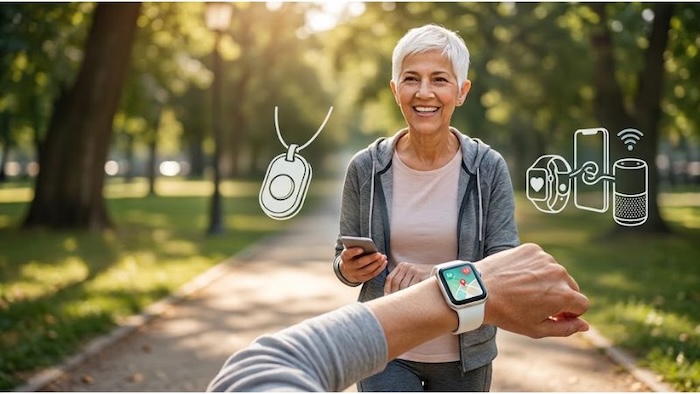
Instead of being tethered to a landline, contemporary options include advanced smartwatches with unlimited nationwide cellular coverage and integrated Global Positioning Systems. This allows older adults to maintain their active routines outside the home—whether walking through a local park, running errands, or visiting friends—with the reassurance that emergency assistance can locate them anywhere cellular service is available.
Furthermore, passive monitoring technologies have entered the mainstream market. Ambient sensors utilizing radar and Wi-Fi networks can now track movement throughout an entire home without requiring the user to wear any physical device at all. This approach has proven particularly transformative for seniors experiencing cognitive decline or dementia who might otherwise refuse to wear a traditional pendant or wristband. These ambient systems monitor daily routines and can automatically dispatch alerts if they detect unusual deviations, such as a lack of movement during normal morning hours.
Automatic fall detection has also undergone a massive technological evolution. Traditional systems relied on basic impact triggers that frequently resulted in high rates of false alarms, often causing user frustration and leading many seniors to stop wearing the devices altogether. In contrast, modern smartwatches and pendants utilize AI-filtered accelerometers and gyroscopes to monitor subtle changes in motion, body angle, and speed. When the hardware identifies a complex motion pattern specifically consistent with a hard fall, it initiates contact with the monitoring center automatically. This ensures that help is dispatched even if the user is unconscious, disoriented, or physically unable to press a manual button.

How to Choose the Right Medical Alert System
Selecting the appropriate safety technology requires careful consideration of the specific needs, daily habits, and cognitive capabilities of the older adult. Caregivers and family members must match the features of a device directly to the user’s lifestyle and medical profile. For example, an advanced smartwatch featuring a complex touchscreen interface may prove entirely ineffective or frustrating for an individual dealing with severe dementia, advanced macular degeneration, or fine-motor skill impairments. Conversely, an active senior who travels frequently and maintains an independent social calendar would benefit very little from a homebound base unit restricted by a landline tether.
Caregivers must also maintain realistic expectations regarding what these technologies can accomplish. Industry professionals emphasize that a medical alert system, regardless of how advanced its sensors or AI capabilities may be, is never a true substitute for direct human supervision, regular check-ins, or structured in-home care services. Instead, these devices should be viewed as essential risk-mitigation tools designed to buy precious minutes during an unforeseen emergency.
Experts advise consulting comprehensive safety guidelines, such as those provided by the National Institute on Aging regarding fall prevention and home modifications, as a mandatory first step before relying solely on a wearable technological solution. Integrating these devices into a broader, well-rounded care strategy ensures that safety protocols address environmental hazards, medication management, and mobility challenges simultaneously.
The Bottom Line on Modern Medical Alert Systems
Balancing personal autonomy and physical safety remains one of the most formidable challenges in modern family caregiving. Fortunately, the rapid evolution of medical alert systems has successfully stripped away the social stigma once associated with bulky, outdated panic buttons. They have been replaced by sleek, proactive health hubs and discreet wearables that blend seamlessly into everyday life.

Whether a family opts for a discrete GPS-enabled medical alert watch for an active parent or relies on passive ambient sensors for a loved one navigating cognitive decline, today’s technology is engineered to preserve individual dignity while granting caregivers invaluable peace of mind. While no electronic device can ever replicate the warmth, intuition, and watchful eye of dedicated human caregiving, incorporating these advanced tools into a comprehensive safety plan ensures that reliable assistance remains quietly available whenever it is needed.



