WASHINGTON — In a significant legislative development for disability rights advocates, a bipartisan resolution was introduced in Congress this week to firmly reaffirm the foundational right of individuals with disabilities to live and receive services in their own homes and communities rather than being segregated in institutional settings.
The resolution, designated as H. Res. 1586, has drawn immediate praise and strong backing from advocacy groups across the nation. Foremost among them is the Defend Community Integration Coalition (DCIC), a prominent national alliance of disability advocacy organizations, which enthusiastically applauded the introduction of the measure as a vital step forward for civil rights and community inclusion.
The Defend Community Integration Coalition formally expressed its gratitude to the bipartisan leadership guiding the measure through the House of Representatives. Specifically, the coalition thanked Bipartisan Disability Caucus Co-Chairs Representatives Debbie Dingell, a Democrat, and Brian Fitzpatrick, a Republican, for their leadership in introducing H. Res. 1586.
The resolution explicitly affirms that the landmark Supreme Court decision in Olmstead v. Lois Curtis reflects the true intent of Congress: that individuals with disabilities should be fully integrated into society, enjoying the right to live, work, and receive necessary care within their local communities. Furthermore, the legislative effort demonstrates a rare and robust display of bipartisan cooperation. H. Res. 1586 is cosponsored by a diverse group of lawmakers, including Representatives Kean, Lawler, Wilson, Scanlon, and Simon, representing both major political parties. According to advocacy leaders, this broad base of support underscores the enduring, bipartisan history of community integration as a fundamental American value.
The introduction of H. Res. 1586 comes more than 27 years after the Supreme Court issued its historic ruling in Olmstead v. Lois Curtis. In that landmark 1999 decision, the nation’s highest court held that the unjustified institutional isolation of people with disabilities constitutes a form of illegal discrimination prohibited under the Americans with Disabilities Act (ADA).
However, advocates and legal experts emphasize that the Olmstead ruling did not emerge in a legislative or historical vacuum. Instead, it was built upon decades of deliberate statutory framework established by Congress and federal regulatory agencies.
H. Res. 1586 meticulously lays out this historical record, tracing the evolution of community integration rights back to the late 1970s. In 1977 and 1978, federal regulations enacted under Section 504 of the Rehabilitation Act explicitly established that services and programs for people with disabilities must be delivered in the most integrated setting appropriate to their individual needs. Congress subsequently ratified these critical rules when it amended Section 504 in 1978.

Decades later, as the legislative process culminated in the passage of the landmark Americans with Disabilities Act of 1990, lawmakers formally codified these protections. Congress explicitly wrote into the ADA a legislative finding that the social isolation and segregation of individuals with disabilities represent a serious and pervasive form of discrimination. Moreover, the legislation incorporated Section 504’s integration regulations directly into the public services title of the ADA.
When the Supreme Court ultimately issued its ruling in the Olmstead case, it affirmed what the legislative and regulatory history already established: that the unnecessary segregation of people with individuals with disabilities is a direct form of disability discrimination. As legal and civil rights advocates point out, the integration mandate is not merely a policy preference or a judicial suggestion; it is the law as written and enacted by Congress, standing as a hard-won civil right reaffirmed by federal courts for decades.
For the coalition and its member organizations, the clarity provided by H. Res. 1586 matters profoundly in the current political and legal landscape. The integration mandate is currently facing new, severe, and unprecedented attacks across various state and federal fronts. Consequently, proponents argue that this formal congressional affirmation of long-standing federal directives could not be more timely.
Disabled Americans belong in our neighborhoods, our workplaces, and our homes—not locked away behind the closed doors of institutional facilities. By introducing H. Res. 1586, lawmakers are sending a clear, unambiguous message from both sides of the aisle that Congress meant what it said when it passed the ADA and upheld the integration mandate. Coalition leaders are urging every member of the House of Representatives to sign on as a cosponsor of the resolution.
Looking beyond the House, the advocacy community is expanding its sights to the broader federal government. The Defend Community Integration Coalition is calling on every member of the House to lend their support to H. Res. 1586, while simultaneously issuing a call to action for the United States Senate to introduce a companion, bipartisan resolution as expeditiously as possible.
Furthermore, the coalition stresses that legislative resolutions, while vital for establishing intent and reaffirming rights, must be matched with tangible fiscal commitments. Advocates are calling on federal, state, and local leaders to back up congressional commitments with robust, increased investments in home and community-based services. They emphasize that community living is only made possible by the dedicated professionals who comprise the direct care workforce, making adequate funding for these services an absolute necessity. As the coalition asserts, the time to defend and secure community integration is right now.
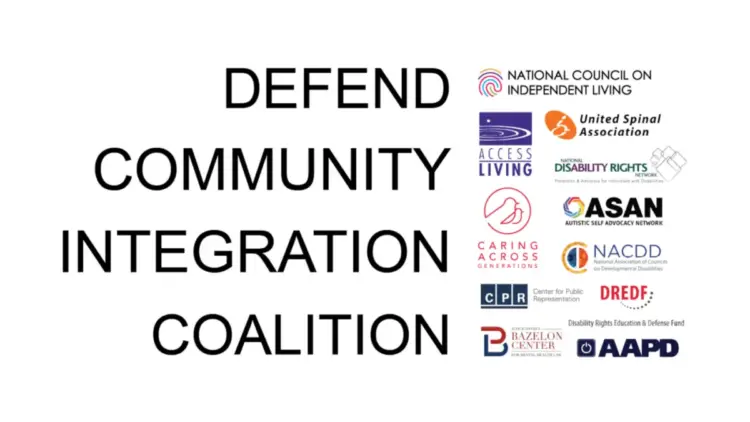
The Defend Community Integration Coalition, which continues to lead the national push for these civil rights protections, comprises a broad alliance of the nation’s leading disability advocacy organizations. Its founding and participating members include the National Council on Independent Living, the American Association of People with Disabilities, the Autistic Self Advocacy Network, Caring Across Generations, the National Disability Rights Network, United Spinal Association, Access Living, the National Association of Councils on Developmental Disabilities, the Center for Public Representation, the Bazelon Center for Mental Health Law, and the Disability Rights Education and Defense Fund.