Healthcare spending in the United States is on a steady upward trajectory, with new federal projections indicating that national expenditures will climb significantly over the coming decade. According to an updated chart collection and analysis from the Peterson-KFF Health System Tracker—which draws directly upon the latest National Health Expenditure (NHE) projections compiled by federal actuaries—the financial footprint of the American healthcare system is set to expand at a rapid pace, raising critical questions about long-term sustainability, federal policy impacts, and the distribution of medical resources.
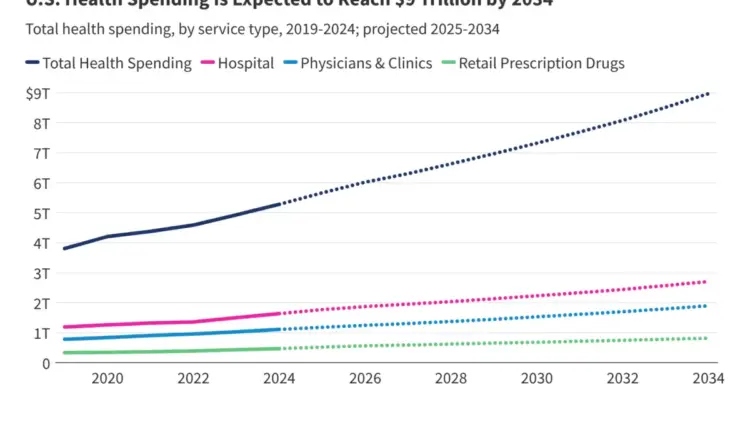
The comprehensive data outlines a future where healthcare consumes an increasingly massive portion of the nation’s gross domestic product. By 2026, total U.S. health spending is projected to hit a staggering $6.0 trillion, translating to approximately 18.7 percent of the entire economy. Within that massive total, hospital care is expected to command the single largest share of spending, accounting for an estimated $1.9 trillion. As the decade progresses, these financial figures will only compound. Looking further ahead to 2034, total national health spending is expected to skyrocket to $9.0 trillion. By that point, healthcare outlays will surpass a historic threshold, making up more than one-fifth of the entire U.S. economy.
Despite this immense long-term growth, the data also reveals nuanced shifts in the annual rate of increase. The annual percentage change in health spending growth is estimated to have moderated down to 6.3 percent in 2026. Looking slightly further down the road, federal actuaries project that spending growth will decelerate even further by 2027, dropping to an annual rate of 4.7 percent. This temporary cooling in the pace of spending growth is not accidental; rather, it is tied directly to a confluence of upcoming legislative shifts, policy expirations, and expected adjustments in how Americans utilize medical services.
A closer examination of the federal projections highlights several key policy mechanisms and systemic changes that are anticipated to dampen the velocity of health spending growth in the near and medium term. Among these influential factors are anticipated modifications to the Medicaid program stemming from the 2025 budget reconciliation law. Additionally, structural financial shifts are expected to occur with the scheduled expiration of the Affordable Care Act (ACA) Marketplace enhanced premium tax credits, also set for 2025. These policy milestones are projected to alter insurance coverage dynamics and, by extension, affect overall utilization patterns and expenditures across the healthcare landscape.
At the same time, federal intervention in pharmaceutical pricing is poised to reshape specific sectors of the healthcare market. The prescription drug provisions and inflation rebates embedded within the landmark Inflation Reduction Act are expected to exert a downward pressure on Medicare prescription drug spending growth over the long term. However, the analysis notes that this long-term moderation will be balanced against higher rates of overall Medicare spending growth projected in the near term, reflecting ongoing demographic shifts as the nation’s population continues to age and demand for elderly care services intensifies.
The underlying data and the detailed charts that map out these monumental economic shifts are hosted on the Peterson-KFF Health System Tracker. Operating as a specialized information hub, the platform is dedicated to continuously monitoring, analyzing, and assessing the performance, financial health, and evolving trends of the U.S. healthcare system. As policymakers, economists, and healthcare leaders grapple with the implications of a multi-trillion-dollar health economy that threatens to consume more than 20 percent of the nation’s financial output, these federal projections provide a critical lens through which the future of American medicine will be shaped.