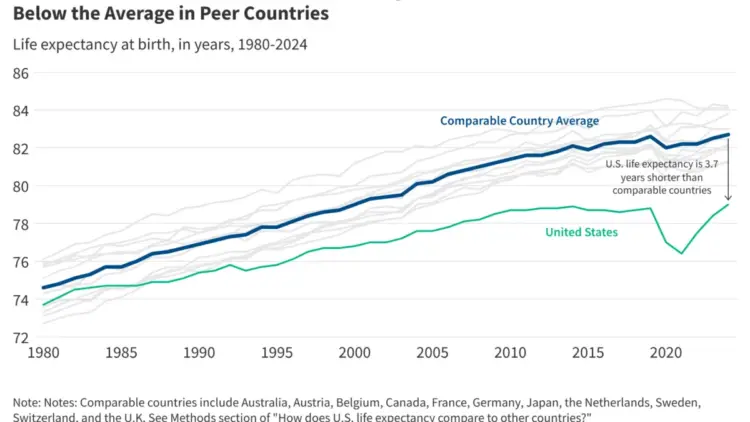
A comprehensive new chart collection released by the Peterson-Kff Health System Tracker sheds fresh light on the standing of the American medical system, illustrating a stark disparity between the immense financial resources poured into the sector and the actual health outcomes experienced by the population. According to the data, which compares the United States with a group of similarly large and wealthy industrialized nations across a diverse array of care quality metrics, the U.S. continues to occupy a unique and troubling position on the global health stage.
The analysis reveals that the United States spends nearly twice as much per capita on healthcare compared to its peer wealthy nations. Despite this unprecedented level of financial investment—surpassing that of any other high-income country—the U.S. population contends with a lower life expectancy than those found in comparable peer nations. This persistent gap between high expenditure and lower overall longevity has long been a central puzzle for health policy experts, economists, and public health officials, and the updated chart collection provides a detailed look at how these trends have evolved over time.
The newly published resources are part of the Peterson-KFF Health System Tracker, an online information hub dedicated to monitoring, analyzing, and assessing the performance of the U.S. health system in comparison to international standards. By tracking longitudinal data, the initiative aims to offer a clear, empirical foundation for understanding where the American healthcare system excels and where it significantly falls short.
When breaking down the data by specific categories of care, a complex and often contradictory picture emerges regarding the performance of the U.S. health system. Generally, the research indicates that the United States performs worse than peer nations when evaluated on long-term health outcomes measures, such as overall life expectancy. Beyond longevity, the country also struggles with certain specific treatment outcomes, most notably maternal mortality rates and hospital admissions related to congestive heart failure.
Furthermore, the data highlights ongoing challenges within the realm of patient safety and health system capacity. In measures such as obstetric trauma with instrumentation, the U.S. frequently trails behind international counterparts. Capacity metrics also reveal structural strains, such as a lower rate of general practitioners available to the population per capita, which can impact preventative care, early diagnosis, and the ongoing management of chronic conditions. These structural and outcome-based shortcomings help explain why higher spending does not automatically translate into superior population health within the American context.
At the same time, the chart collection emphasizes that the U.S. healthcare system is not uniformly underperforming across all measured indicators. In fact, the data demonstrates that the United States performs similarly to, or in some instances better than, peer nations in several other vital areas of medical care.
For instance, the U.S. shows competitive results in certain treatment outcomes, such as mortality rates recorded within thirty days of acute hospital treatment. This suggests that when patients reach acute, high-intensity care settings for urgent medical interventions, the technical quality and immediate responsiveness of American hospitals can match or exceed international benchmarks. Additionally, the country registers favorable or comparable outcomes in specific patient safety measures, such as the rates of certain post-operative complications following surgical procedures.
These nuanced findings indicate that while American medical technology, acute hospital interventions, and specialized surgical care remain world-class, systemic issues in primary care, chronic disease management, public health integration, and equitable access continue to drag down overall national health performance metrics. The Peterson-KFF Health System Tracker collection is designed to capture these fine distinctions, moving beyond broad generalizations to provide a granular view of medical performance across wealthy industrialized economies.