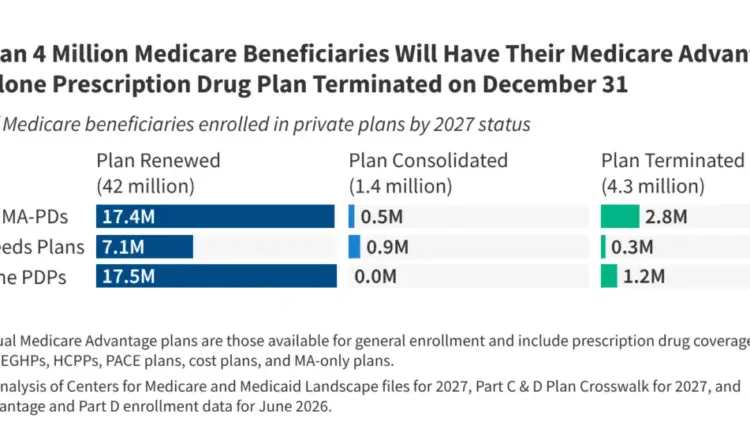
The private Medicare landscape is undergoing a significant shake-up, leaving millions of older adults and individuals with disabilities to navigate sweeping disruptions ahead of the annual open enrollment period. According to a detailed analysis of plan data from the Centers for Medicare & Medicaid Services (CMS), a staggering 4.3 million Medicare beneficiaries will see their current private health or prescription drug plans terminated at the end of the year. This total encompasses 3.1 million enrollees in Medicare Advantage drug plans and 1.2 million participants in stand-alone prescription drug plans, marking a substantial wave of disruptions across the country.
The market for private Medicare options—which includes both Medicare Advantage and Part D prescription drug plans—has always been dynamic, with offerings shifting on an annual basis. However, the scale of the changes taking effect for the 2027 plan year has intensified anxieties among beneficiaries and policy experts alike. Leading up to the Medicare annual open enrollment period, which officially commenced on October 15th, major insurers signaled a strategic retreat by scaling back the number of Medicare Advantage plans they intend to offer.
Compounding this uncertainty are shifting federal policy decisions. The stand-alone prescription drug plan market has faced particular instability following the Trump administration’s decision to end the Part D Premium Stabilization Demonstration one year early. This move has stoked concerns regarding higher-than-expected premium increases and reduced plan availability for beneficiaries who rely on traditional Medicare combined with a separate prescription drug plan.
Private insurers will terminate the Medicare Advantage prescription drug plans, commonly known as MA-PDs, for approximately 3.1 million people on December 31. The vast majority of these affected individuals—roughly 2.8 million enrollees—are currently participating in MA-PDs that are available for general public enrollment. An additional 300,000 affected individuals are enrolled in Medicare Advantage special needs plans, or SNPs. These specialized plans restrict their enrollment strictly to people who qualify for both Medicare and Medicaid, known as dually eligible individuals, or those living with specific targeted health care needs.
For the 2.8 million individual MA-PD enrollees whose plans are being canceled, proactive action is mandatory. If these beneficiaries fail to select and enroll in an alternative Medicare Advantage plan available within their geographic service area, they will be automatically transitioned back into traditional Medicare when the new year begins. The magnitude of these terminations is substantial: the individual MA-PD enrollees losing coverage represent roughly 14 percent of all enrollees in plans open to general enrollment. This proportion is roughly on par with the 13 percent affected by terminations ahead of the previous year, but it remains significantly higher than the cancellation rates seen in years prior. Meanwhile, among special needs plan enrollees, approximately 4 percent will experience a plan termination for 2027. KFF analysts note that historical data on terminations among SNP enrollees has not been previously tracked in the same manner.
A closer look at the data reveals that the cancellations are heavily concentrated among a handful of major corporate players. Just four parent organizations are responsible for terminating plans that account for 50 percent of all enrollees who are losing their individual MA-PD coverage. Humana, Inc. leads the group, accounting for 19 percent, or roughly 530,000 affected enrollees. UnitedHealth Group follows closely, representing 13 percent, or 367,000 enrollees. CVS Health Corporation accounts for 9 percent, translating to 254,000 enrollees, while Aware Integrated, Inc.—which operated and sold Blue Cross-branded plans in Minnesota—also accounts for 9 percent, or 249,000 enrollees.
For beneficiaries whose Medicare Advantage coverage is involuntarily terminated, federal rules provide a safety net by qualifying them for a special enrollment period. During this window, they gain access to Medigap policies with guaranteed issue rights. This crucial protection ensures that insurance companies cannot legally deny them a Medigap policy or charge them higher premiums based on a pre-existing medical condition. Medigap serves as vital supplemental insurance that helps participants bridge the financial gap by paying for out-of-pocket costs, such as copayments and deductibles, that are not covered under traditional Medicare.
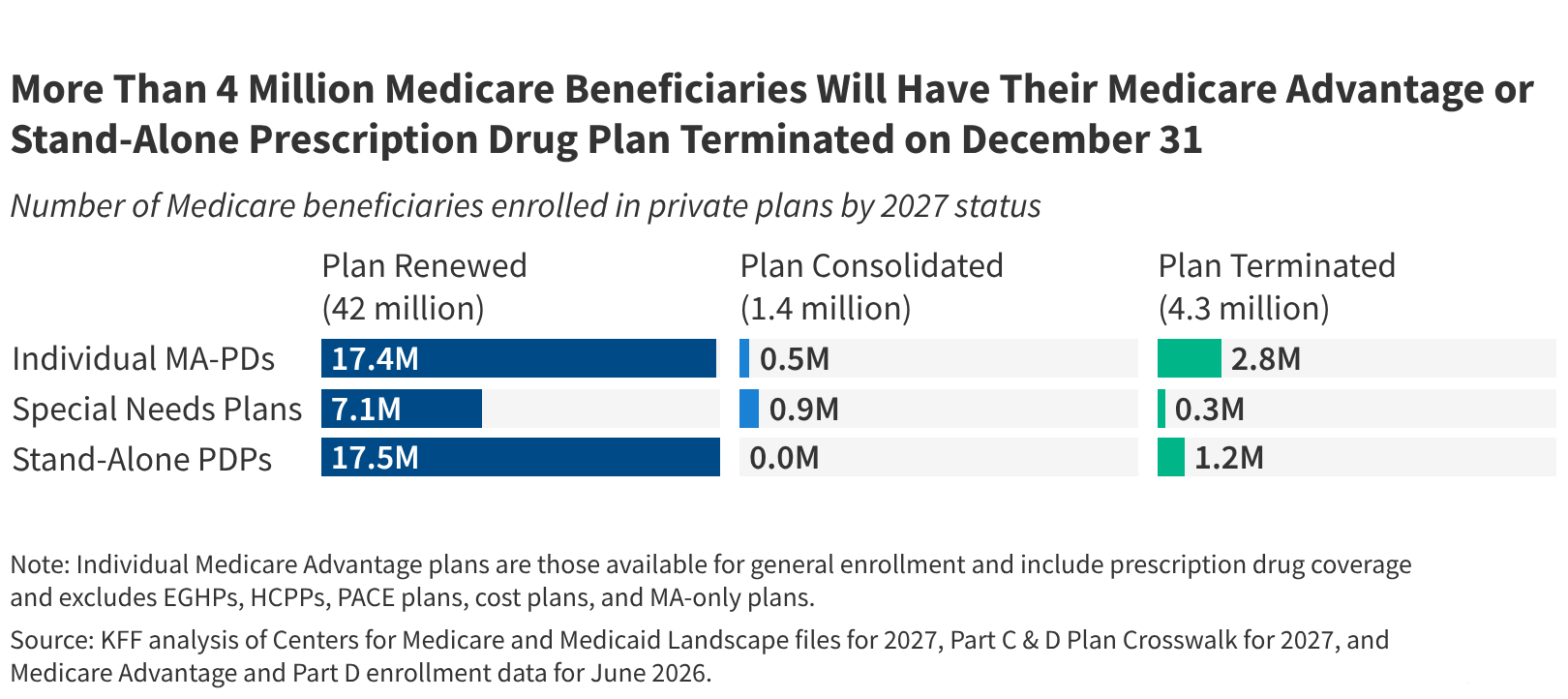
At the same time, the stand-alone prescription drug plan market is experiencing its own wave of turbulence, with about 1.2 million PDP enrollees facing plan terminations at the conclusion of the year. This figure represents 6 percent of all enrollees in stand-alone prescription drug plans, exactly double the 3 percent share that was impacted by similar terminations last year. The vast majority of these individuals—81 percent, or roughly 950,000 people—are enrolled in the SilverScript Choice PDP, sponsored by CVS Health, which is being pulled from 13 distinct PDP regions for the upcoming 2027 plan year. Another 190,000 enrollees, accounting for 16 percent, belong to the HealthSpring Extra Rx plan, sponsored by the Health Care Service Corporation, which is slated for termination across 16 regions. The remaining 3 percent of affected enrollees are distributed across smaller regional plans, including approximately 14,000 individuals in the BlueCross Rx Value plan in South Carolina, alongside 7,000 in the Blue Rx PDP Complete and 7,000 in the Blue Rx PDP Plus, both of which operate in Pennsylvania and West Virginia.
These widespread PDP terminations are driving a measurable contraction in the marketplace, reducing the number of stand-alone prescription drug plans available to the average Medicare beneficiary down to nine options for 2027, compared to eleven choices in 2026. This tighter concentration of enrollment among fewer available plans potentially exposes a larger share of participants to recurring annual disruptions as plan availability, formularies, and monthly premiums fluctuate from year to year. Beneficiaries whose stand-alone plans are ending must actively select a new prescription drug plan to maintain Part D coverage alongside traditional Medicare, or alternatively, transition into a Medicare Advantage plan that includes integrated drug coverage.
Beyond outright terminations, approximately 1.4 million Medicare Advantage enrollees find themselves in plans that are undergoing mandatory consolidations with other options managed by the same parent insurance company. These affected individuals, who will be automatically transferred over to the insurer’s surviving Medicare Advantage plan, include about 500,000 enrollees in general enrollment plans and roughly 900,000 participants in special needs plans.
This wave of consolidations is heavily driven by new regulatory requirements. Beginning in January 2027, private insurance companies that operate a dual-eligible special needs plan alongside an affiliated Medicaid managed care plan within the exact same county are generally restricted to offering only a single D-SNP for full-benefit dual-eligible individuals. In direct response to this federal mandate, private insurers have implemented extensive overhauls and restructuring of their D-SNP portfolios for the 2027 operating year.
Enrollees who are automatically transitioned to a different Medicare Advantage plan due to a consolidation retain the freedom to select an alternative Medicare Advantage plan during the open enrollment window. Furthermore, dually eligible individuals enjoy regulatory flexibilities that permit them to switch plans at other points throughout the year under specific qualifying circumstances. These beneficiaries also retain the option to return to traditional Medicare, though they would not be automatically granted federal guaranteed issue rights if they subsequently sought to purchase a Medigap policy. However, policy experts note that the absence of federal guaranteed issue rights for Medigap is far less consequential for dual-eligible individuals than for the broader Medicare population. Because state Medicaid programs routinely cover Medicare monthly premiums and, in many instances, cost-sharing obligations for dual-eligible beneficiaries, these individuals generally have little need for additional supplemental coverage.
The ongoing annual open enrollment period provides all Medicare beneficiaries with a critical opportunity to carefully review their current coverage options and make necessary adjustments for the year ahead. Aside from the millions of participants directly impacted by plan terminations and consolidations, the vast majority of beneficiaries enrolled in private plans that will remain active next year are nonetheless expected to encounter alterations in their out-of-pocket costs, covered benefits, provider networks, and drug formularies.
For participants in stand-alone prescription drug plans, those who choose to remain in their existing plans may face significant premium increases for 2027, making a thorough review of alternative market offerings a financially prudent step. Yet, comparing available coverage options remains an intricate and often daunting challenge for consumers. Even with the ongoing market contractions, the average Medicare beneficiary must evaluate a crowded field of choices, facing an average of 28 Medicare Advantage prescription drug plan options and 9 stand-alone prescription drug plans as they navigate the annual enrollment landscape.