Navigating the complexities of Tuberous Sclerosis Complex (TSC) involves addressing a wide spectrum of medical, physical, and psychological symptoms. Among the most intricate aspects for individuals, families, and caregivers are the behaviours that can sometimes be challenging. These actions encompass a broad range of difficulties, including unexpected tantrums, incidents of physical harm, and aggressive outbursts. Gaining a deeper, more comprehensive understanding of why these specific actions occur and identifying the underlying triggers represents a vital step toward managing them effectively and improving the quality of life for everyone involved.
What are behaviours that can be challenging?
In clinical and care settings, a behaviour is generally classified as challenging when it places the individual displaying it, or those around them, at a tangible risk of physical or emotional harm. Such behaviours can manifest in various ways, including acts of aggression directed toward others, episodes of self-harm, or destructive actions such as breaking, throwing, or damaging objects in the immediate environment.
While individuals living with learning difficulties or developmental disabilities tend to display these challenging behaviours with a higher frequency, it remains essential to recognize that anyone can exhibit them under the right set of circumstances. Within the specific context of TSC, these challenging behaviours do not occur in a vacuum; rather, they form an established part of a broader clinical classification known as TSC-Associated Neuropsychiatric Disorders (TAND). Recognizing this connection helps frame these difficulties not merely as behavioral problems, but as recognized neurological manifestations of an underlying genetic condition.
Why do people exhibit behaviours that can be challenging?
The underlying reasons for behaviours that can be challenging are rarely uniform, stemming instead from a diverse array of triggers that remain entirely unique to each individual. One of the most common catalysts for such behavior is exposure to a stressful or overwhelming environment, such as a room that is excessively noisy, brightly lit, or crowded. In many instances, the behaviour is not malicious but rather serves as a fundamental attempt to communicate an unmet basic need, such as hunger, thirst, physical discomfort, or pain.
Furthermore, these actions can frequently act as a release valve or an outlet for pent-up frustrations, anxiety, or intense emotions that the individual lacks alternative means to process. This reality is especially pronounced for individuals who are non-verbal or face significant communication barriers. Considering the daily frustrations faced by someone who cannot verbally express their desires, needs, or boundaries makes these challenging behaviours much easier to understand within a framework of empathy and communication breakdown.
How can I predict behaviours that can be challenging?
Anticipating and preparing for these complex behaviours requires a systematic approach to observation and record-keeping. To effectively predict when an incident might occur, caregivers and support networks often find it helpful to maintain a detailed log of each occurrence. Key details that warrant careful documentation include the specific physical location of the incident, the exact sequence of events leading up to the behavior, the subsequent reactions of those nearby, and a precise description of the behaviour itself.

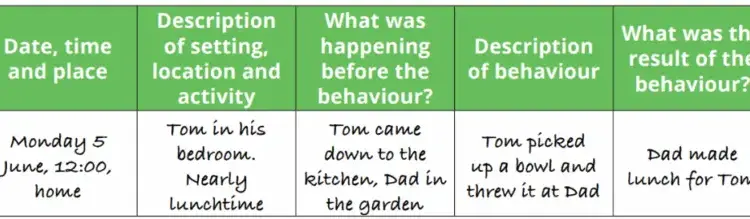
A particularly useful and widely recognized tool in this observational process is the ABC chart, which breaks down incidents into Antecedent (meaning ‘before’), Behaviour, and Consequences. By consistently tracking these three elements over time, families and professionals can begin to identify recurring patterns, specific environmental stressors, and predictable cycles that precede an outburst, transforming seemingly random events into understandable sequences with clear precursors.
How can I reduce behaviours that can be challenging?
Most individuals who display challenging behaviours possess an internal ‘early warning system’ that signals the physiological and emotional onset of distress long before an outright outburst occurs. Initially, these early signs can be subtle, highly individualized, and remarkably challenging to recognize without careful observation. However, utilizing observational frameworks like an ABC chart can train caregivers to detect these indicators with greater accuracy.
Warning signs might manifest as repetitive physical actions, specific vocalizations or noises, or observable physical changes such as muscle tensing and restlessness. Recognizing these early indicators creates a crucial window of opportunity, allowing caregivers to proactively manage the situation and potentially defuse or redirect the challenging behavior before it has the chance to escalate into a crisis.
How can I support someone during the behaviour?
When a challenging behavior is actively occurring, the demeanor and reaction of the caregiver play a critically influential role in shaping the trajectory of the incident. It is essential to strive to remain composed and steady, even in situations where the caregiver themselves feels triggered, overwhelmed, or distressed by the behavior. Projecting a gentle demeanor, maintaining a calm facial expression, and using a quiet, clear voice can encourage the individual in distress to mirror that calm energy.
It is generally advisable to refrain from bombarding the person with a flurry of questions, commands, or demands, while remaining fully prepared to offer them physical or emotional space if doing so appears beneficial to their de-escalation. If a situation rapidly escalates to a point where safety is severely compromised and a potentially dangerous level of risk is reached, caregivers should never hesitate to contact emergency services for professional intervention. Because managing these intense situations day after day is inherently exhausting, it is equally important for caregivers to practice self-compassion and recognize the magnitude of the care they provide.
How can I support the person after the behaviour?
The moments immediately following a challenging incident are often characterized by an atmosphere that remains tense, fragile, and emotionally charged for everyone involved. To help alleviate this lingering tension, transitioning the individual to an entirely different physical environment or engaging them in a distinct, calming activity—such as taking a quiet walk—can prove therapeutic and assist in resetting the overall mood of the room.
Once absolute calmness has been restored and safety is re-established, taking time to reflect on the incident can yield valuable insights for the future. Reviewing what happened through tools like the ABC chart helps refine future prevention strategies and prepares the support network for subsequent occurrences. Because dealing with challenging behaviours can feel isolating and overwhelming for everyone involved, individuals seeking further guidance, practical information, or simply a listening ear can reach out to the TSA Support Line by calling 0808 801 0700, emailing [email protected], or utilizing the dedicated webchat service.