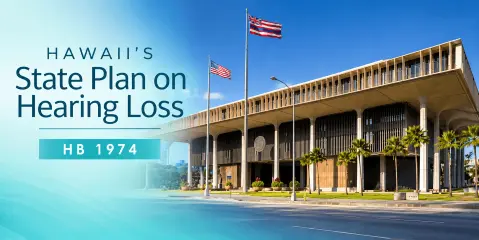
Hearing loss extends far beyond the realm of simple communication. Its far-reaching impacts touch nearly every aspect of daily life, influencing educational achievement, career opportunities, healthy aging, social connectivity, cognitive well-being, and overall quality of life. Recognizing the profound individual and societal implications of unaddressed hearing health, the state of Hawaii has taken a definitive step forward. On July 10, 2026, House Bill 1974 (C.D. 1) was officially signed into law, marking a meaningful, practical, and long-overdue move for the Aloha State.
This new legislative milestone was championed and strongly advocated for by members of the Hearing Loss Association of America (HLAA) alongside numerous other advocates, professionals, and organizations within the broader hearing loss community. At its core, HB 1974 directs the Hawaii State Health Planning and Development Agency (SHPDA) to formulate and publish a comprehensive State Plan on Hearing Loss. This initiative is designed to serve as a foundational blueprint, equipping policymakers, healthcare providers, and community stakeholders with the data and insights necessary to better understand and accurately assess community needs, eliminate persistent service gaps, and drastically strengthen equitable access to hearing care across all islands.
Rather than offering an immediate fix to every systemic barrier currently facing the healthcare landscape, the newly established Hawaii State Plan will construct a shared, collaborative roadmap for future legislative and community initiatives. The overarching goal is to modernize and elevate the state’s approach to hearing health services. Specifically, the legislation mandates that SHPDA develop a statewide strategy focused directly on improving overall hearing healthcare access and affordability. Furthermore, the plan will address the critical need for increasing public awareness, expanding the specialized healthcare workforce capacity, and prioritizing early detection, timely intervention, diverse treatment options, and positive long-term outcomes for individuals affected by hearing loss, ranging from infants to older adults.
To ensure the agency has the necessary resources to execute this vital mandate, the bill appropriates $100,000 in general funds for the 2026–2027 fiscal year. These designated funds are intended to support SHPDA throughout the comprehensive process of developing, drafting, reviewing, and ultimately publishing the statewide plan. Financial resources may be strategically allocated toward project management, fostering effective interagency collaboration, consulting with recognized subject matter experts, and organizing extensive statewide stakeholder engagement sessions to capture the diverse voices of the community.
Perhaps most significantly, the legislation establishes a robust framework designed to ensure ongoing planning, continuous implementation, and strict public accountability. Moving forward, the state government will be legally required to provide regular progress updates and policy recommendations during every odd-numbered legislative session. This built-in reporting mechanism guarantees that hearing health will remain an active, permanent fixture in Hawaii’s long-term legislative policy discussions, effectively cementing hearing health as a recognized and prioritized public health issue.
For many years, children and adults living with hearing loss throughout Hawaii have navigated a complex web of challenges. Residents have frequently encountered delayed diagnoses, a distinct lack of coordinated follow-up care, profound difficulties in locating specialized services, and prohibitively high out-of-pocket costs for essential hearing aids and modern assistive technologies. Compounding these hurdles are limited public awareness regarding hearing health, persistent shortages in the specialized healthcare workforce, and an overall healthcare system that can be exceptionally difficult to navigate. While numerous dedicated community organizations, clinics, and healthcare providers have labored tirelessly to support patients, the state has historically lacked a unified, coordinated statewide effort to systematically identify systemic gaps and construct a cohesive long-term strategy.
House 1974 fundamentally alters this paradigm. Operating under the leadership of SHPDA, the upcoming planning process is structured to bring together a diverse coalition of healthcare providers, educators, state and local government agencies, community organizations, and individuals possessing lived experience with hearing loss. Together, these stakeholders will collaborate to identify core priorities and formulate actionable recommendations. The resulting draft plan will serve as a guiding light, translating high-level policy recommendations into meaningful, real-world actions aimed at transforming hearing health services statewide.
The journey toward this legislative victory began when members of Hawaii’s hearing loss community initiated vital conversations with key lawmakers regarding the urgent need for a coordinated statewide hearing health strategy. Momentum grew substantially when the Hawaii Kupuna Caucus—a prominent bipartisan group of legislators dedicated to addressing issues that directly impact older adults—selected HB 1974 as one of its official priority bills for the legislative session. This crucial endorsement elevated public awareness and galvanized broader legislative support for the measure.
Riding this wave of momentum, the community united around a shared vision to propel the bill across the finish line. Members of the HLAA HOPE support group joined forces with dedicated audiologists, otolaryngologists (ENT physicians), speech and hearing professionals, family caregivers, and a wide array of local community organizations. Throughout the rigorous House and Senate committee processes, these stakeholders submitted powerful written and oral testimony, sharing their personal stories and advocating passionately for systemic change. This collaborative grassroots effort was instrumental in securing the historic enactment of the legislation.
With the signing of HB 1974, Hawaii proudly joins a select group of five other U.S. states that have already established similar statewide planning initiatives. States including Nevada, Minnesota, Massachusetts, Vermont, and New York served as valuable models and inspirations for Hawaii’s legislative framework, demonstrating the proven effectiveness of a coordinated state-level approach to hearing health.
Crucially, the heart of this entire initiative lies in its commitment to centering the voices of individuals with lived experience. Patients and families who navigate the daily realities of hearing loss are positioned at the very center of the conversation. Their firsthand perspectives, combined with the professional insights of community stakeholders—including healthcare providers, educators, and government representatives—will directly shape the priorities, strategies, and final recommendations of the plan.
The formal planning process is now officially underway, with the release of the initial draft plan anticipated by the close of 2026. Once the blueprint is established, the collective focus will pivot sharply toward active implementation, turning identified needs and strategic goals into tangible improvements for residents across the islands.