For family caregivers, a familiar and persistent anxiety often follows aging parents throughout the daily routine. This worry typically reaches its peak whenever an older adult steps into the bathroom, an intimate space where privacy is deeply valued, but personal safety can be severely compromised. Experts emphasize that addressing these safety risks requires clinical precision rather than simple trips to the hardware store, urging families to consider comprehensive environmental updates before a major accident occurs.
The bathroom presents a uniquely hazardous environment defined by hard surfaces, water, and soap, a combination that naturally diminishes traction. When these physical conditions are paired with the realities of aging—such as progressive muscle weakness, stiff joints, and decreasing visual acuity—the risk of a catastrophic fall increases exponentially. Healthcare advocates stress that understanding why this specific room poses such a high threat is the first step toward effective prevention, allowing families to implement targeted changes that support safe aging in place.
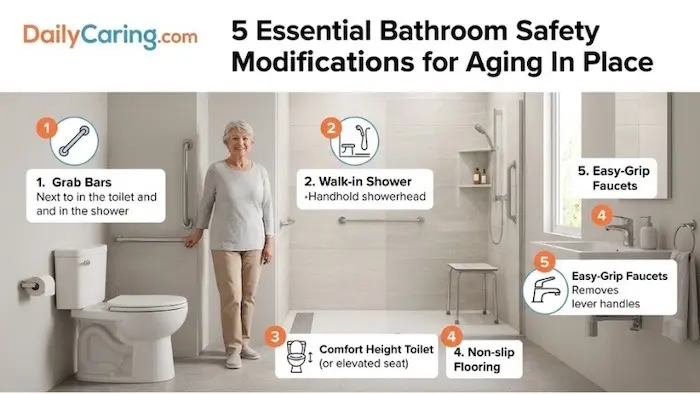
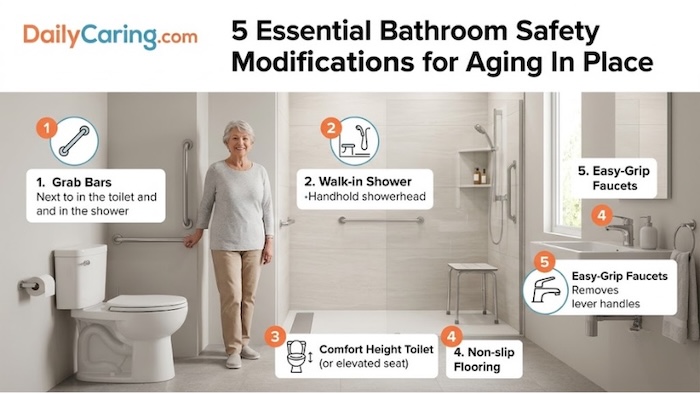
Among the most critical updates is the installation of grab bars, which safety professionals describe as clinical tools rather than standard do-it-yourself accessories. Rather than simply finding a wall stud, occupational therapists and clinical experts evaluate how specific mobility limitations dictate bar placement to effectively arrest a sudden fall. Professional installation is considered mandatory because suction-cup alternatives frequently fail under the sudden kinetic energy of a falling adult, inadvertently transforming a safety device into a secondary hazard. When shopping for permanent fixtures, specialists recommend diameters between 1.25 and 1.5 inches to accommodate aging hands comfortably, alongside textured finishes that enhance grip.
Toilet height is another major factor influencing residential safety, as standard fixtures often demand excessive joint flexion and powerful quadriceps to transition into a standing position. While accessibility guidelines suggest elevated heights for wheelchair users, residential safety requires a customized fit that matches the exact physical dimensions of the resident. Calculating the appropriate height helps significantly reduce joint stress during transitions, preventing loss of balance in tight spaces.
Vision changes also demand careful attention, as aging eyes frequently suffer from decreased pupil size and lens clouding, which naturally increases the need for ambient illumination. However, installing excessively bright bulbs often creates harsh glare that obscures depth perception, creating an environment that can be even more dangerous than a dimly lit room. The primary objective for caregivers is to achieve uniform illumination coupled with high visual contrast, ensuring that structural boundaries, such as the edge of the bathtub, remain clearly distinguishable from the surrounding floor.
Flooring materials play a definitive role in mitigating the severity of accidents, particularly because traditional ceramic tile offers zero shock absorption despite being water-resistant. If a slip does occur, unforgiving tile surfaces fail to dissipate impact energy, frequently resulting in severe trauma and fractures. Alternatives such as rubber flooring, textured cork, and specialized slip-resistant vinyl provide varying degrees of traction and cushion, helping to protect joints and bones.
Door thresholds represent another frequently overlooked tripping hazard within the home. Standard door saddles create sudden height variations where different flooring materials meet, posing an immediate danger for seniors who have developed a shuffling gait. Replacing these abrupt transitions with graded, zero-edge saddles significantly reduces the likelihood of trip-and-fall incidents as residents move between rooms.
When executing these structural changes, industry advocates strongly advise against relying on standard handymen or general contractors. Instead, families are encouraged to work with Certified Aging-in-Place Specialists. Administered by professional home building associations, this specific designation indicates that a contractor has undergone targeted training regarding the biomechanical needs of older adults, mobility-barrier solutions, and complex load-bearing requirements for safety hardware.

Financial considerations often influence decisions regarding home renovations, but safety advocates emphasize the stark contrast between preventive investments and reactive medical costs. Comprehensive professional modifications—including grab bars, upgraded lighting, comfort-height toilets, and threshold removal—frequently require a substantial one-time investment. In comparison, the baseline cost of a single fall resulting in emergency hospitalization, surgical intervention, and subsequent rehabilitation often exceeds that figure manifold, making structural updates a practical priority for long-term independence.
Neglecting these necessary adjustments leaves the home environment increasingly hostile to an aging body, elevating the probability of a severe accident that can abruptly terminate an aging-in-place strategy. By implementing structural changes promptly with the assistance of certified professionals, families can significantly secure the bathroom environment and protect the long-term well-being of older adults.