A new wave of federal transparency rules taking effect marks a significant shift in how states report Medicaid payment data, opening a window into systems that have historically lacked consistent visibility. While states have long held substantial flexibility in setting Medicaid payment rates—a factor that directly influences whether physicians and other healthcare providers accept Medicaid patients—comprehensive information regarding these rates has remained severely limited. Greater transparency is now expected to simplify the comparison of Medicaid rates across different states and healthcare payers, ultimately informing policy decisions designed to bolster provider participation and improve enrollee access to care.
These policy objectives operate somewhat independently from broader federal health care initiatives aimed at making consumer prices more visible to reduce overall out-of-pocket costs. Because Medicaid enrollees already benefit from significant financial protections due to their low incomes, the primary focus of these new rules centers on provider adequacy and systemic transparency rather than shielding consumers from direct market volatility.
To address these long-standing information gaps, the Centers for Medicare & Medicaid Services finalized groundbreaking transparency provisions for Medicaid fee-for-service frameworks, alongside separate regulatory requirements governing managed care arrangements. The distinction between these two models is vital: under a fee-for-service structure, state Medicaid agencies directly reimburse healthcare providers for services rendered. Conversely, under managed care, states allocate funds to a health plan or managed care organization, which subsequently establishes the individual payment rates for participating providers.
Statistical data underscores the division of these delivery systems. Recent healthcare tracking indicates that a substantial portion of Medicaid spending flows through managed care channels, while the remainder is directly administered via fee-for-service arrangements. As the initial provisions of the fee-for-service rule formally took effect, federal regulators issued detailed implementation guidance to assist states with complex mandates, including the execution of comparative rate analyses. With reporting requirements now fully live, the resulting data has begun publishing online, laying the groundwork for ongoing evaluation by health policy researchers.
What Are the New Payment Transparency Rules for Medicaid?
The regulatory landscape transformed substantially following the implementation of the comprehensive Access rule and companion managed care regulations. These rules established rigorous obligations for states to systematically disclose and evaluate information concerning Medicaid payment methods.
Under the fee-for-service Access rule, states are now mandated to perform comparative rate analyses. Using a designated set of evaluation and management billing codes, states must directly compare their fee-for-service payment rates for essential services—including primary care, obstetrical and gynecological care, and outpatient mental health and substance use disorder treatment—against established Medicare rates. States are required to publish these comparative analyses on a biennial basis.
In tandem with rate comparisons, the rules mandate the public release of complete fee schedules. States must host all fee-for-service payment rates on accessible, publicly available websites, updating them promptly whenever a structural payment rate change occurs. This sweeping transparency requirement applies across a broad spectrum of medical care, encompassing inpatient hospital services, outpatient clinics, and nursing facility services. Furthermore, states face specific mandates to disclose average hourly payment rates for critical home care services, including personal care, home health aide support, homemaker assistance, and habilitation services, with disclosures required every two years.
Parallel requirements govern the managed care sector. States must submit an annual payment analysis evaluating how managed care plans reimburse providers for specific services relative to Medicare benchmarks, while also contrasting home care rates against baseline state fee-for-service amounts utilizing actual paid claims data.
To implement the comparative rate analysis, federal regulators designated specific billing codes that states must track. These codes cover routine office visits and specialized clinical interactions spanning primary care, women’s health, and behavioral health. States must document payment rates for each individual code, accounting for variations driven by provider type, geographic region, or specific patient populations, and calculate the exact ratio of Medicaid-to-Medicare payment levels. While standard Medicare payment values exist for all designated billing codes, certain codes that see heavy utilization among pediatric populations experience limited or nonexistent coverage under traditional Medicare, introducing unique analytical challenges.
Despite the broad scope of the fee-for-service schedule requirements, federal authorities did not mandate a single standardized format for online publication. Consequently, considerable variation exists in how individual state agencies present and organize their payment information. Some states offer intuitive, searchable digital databases, while others rely on downloadable documents in varying formats.
A Closer Look at the Data and Service Utilization
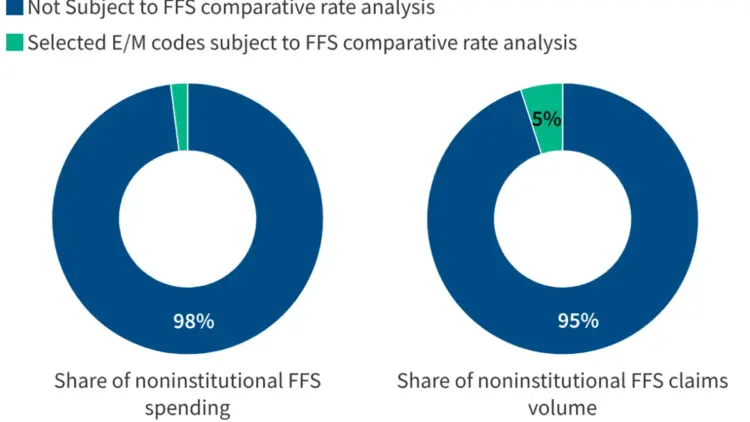
Despite the comprehensive nature of the new mandates, empirical assessments reveal that the fee-for-service comparative rate analysis captures a relatively small fraction of overall spending and service volume. Specifically, the targeted evaluation and management codes account for a minor percentage of noninstitutional fee-for-service spending and a similarly modest share of noninstitutional claims. Noninstitutional services represent a vast array of clinical care, encompassing professional and clinical encounters, laboratory work, diagnostic radiology, outpatient hospital visits, and home-based care, along with professional services billed separately during inpatient hospital stays.
An examination of the demographics of enrollees utilizing services subject to the new transparency provisions reveals notable patterns. Children make up a disproportionate share of individuals receiving care through the selected evaluation and management services compared to the broader fee-for-service population. This concentration aligns with the inclusion of billing codes frequently utilized for pediatric wellness checks and routine sick visits. Similarly, enrollees managing chronic health conditions are heavily overrepresented among those utilizing these targeted services, reflecting their higher overall demand for continuous healthcare interventions.
Navigating Limitations in the New Transparency Framework
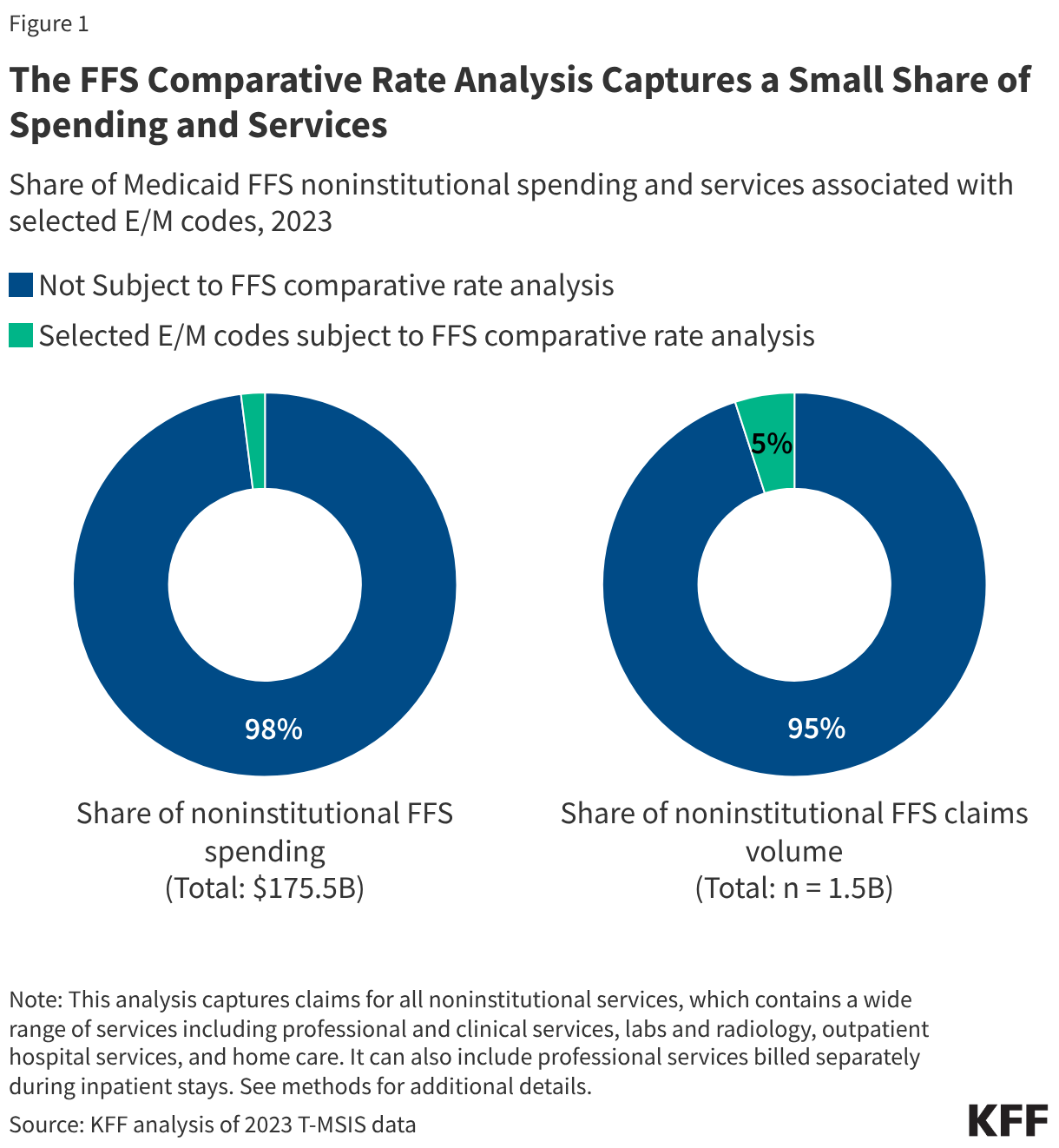
While the comparative rate analysis establishes a more consistent foundation for evaluating payment disparities across different states, policy experts emphasize that it captures a remarkably narrow subset of overall healthcare services. By compelling states to report standardized rates relative to Medicare benchmarks, the policy enables cross-state comparisons, but the selected billing codes represent only a tiny fraction of total noninstitutional claims, leaving the vast majority of services outside direct comparative purview. Furthermore, variations in how state agencies structure payments—such as adjusting rates by geographic region or specific demographic groups—can complicate direct comparisons. Additional complexities arise because certain clinical specialists, including licensed psychologists, social workers, and professional counselors, may not routinely bill using standard evaluation and management codes.
Comparing Medicaid payment rates to Medicare benchmarks also proves challenging when evaluating populations and services that lack robust Medicare analogs. Because traditional Medicare primarily serves older adults and individuals with long-term disabilities, it functions as a less meaningful benchmark for pediatric care and routine developmental screenings.
The lack of standardization in fee schedule publications introduces additional hurdles for researchers and policymakers. Because federal guidelines do not enforce a uniform layout or database architecture, the task of comparing rates across state lines can be exceptionally time-consuming. States utilize widely divergent approaches, ranging from advanced online search portals to static downloadable spreadsheets posted across fragmented web pages.
Ultimately, the practical utility of these new transparency measures depends heavily on the specific delivery systems utilized by each state. In jurisdictions that rely heavily on traditional fee-for-service administration, the newly disclosed rates govern a vast majority of Medicaid services. Conversely, in states where managed care organizations dominate healthcare delivery, fee-for-service rates may apply to only a fraction of services, offering a less comprehensive view of overall provider reimbursement levels. However, even in managed care-dominant states, public fee schedules retain significant value when state-set rates serve as explicit reimbursement benchmarks or floors for managed care contracts.
Methodological Framework Behind the Data
Insights into these transparency dynamics are derived from extensive analysis of federal healthcare data repositories, including research identifiable files capturing noninstitutional service lines, header files, and demographic enrollment records. Analytical models typically evaluate populations continuously enrolled in traditional fee-for-service structures while filtering out individuals enrolled in comprehensive managed care plans based on capitated payment records and official participation identifiers.
Through these rigorous methodologies, researchers continue to evaluate the real-world impact of the transparency rules, tracking how public payment disclosures influence provider participation and shape healthcare access for millions of vulnerable enrollees nationwide.