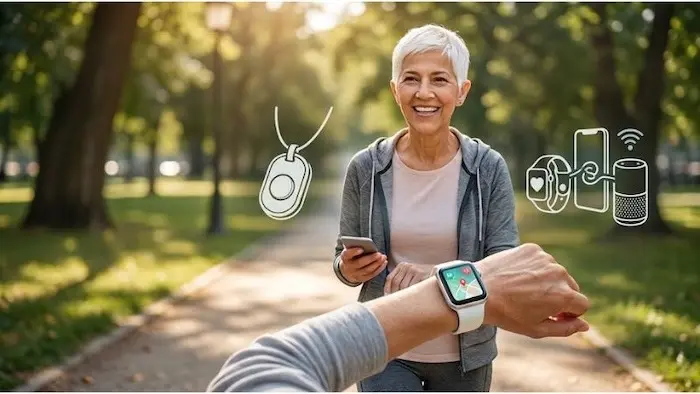
Remember the classic “I’ve fallen and I can’t get up” pendant that dominated television commercials for decades? For millions of older adults and their families, that legacy device was the defining symbol of emergency medical response. However, medical alert systems have progressed entirely beyond that original concept. Today’s market options serve as comprehensive safety hubs that can determine whether an older adult remains independent at home or must transition to a specialized care facility.
According to data from AARP, almost 90 percent of people aged 65 and older prefer to stay in their current homes rather than move to an assisted living facility or nursing home. Because independent living remains the preferred standard for the aging population, the technology supporting it has rapidly matured. The global medical alert systems market size is projected to reach $11.8 billion, driven directly by a surging consumer and healthcare demand for advanced, proactive safety monitoring.
The traditional format of a medical alert device relied on a wearable button connected to a localized base unit, which then required a physical landline telephone connection to contact a monitoring center. While revolutionary for its time, that legacy system was severely limited. It only functioned if an aging adult remembered to wear the device, remained within a few hundred feet of the home base station, and stayed conscious enough to physically press the button after a debilitating incident.
Technological Advancements in Modern Safety Monitoring
Wearable artificial intelligence devices are transforming these tools from basic, reactive alarm triggers into real-time health-monitoring systems designed for proactive care. Modern medical alert solutions have integrated seamlessly into daily life, moving far beyond the kitchen-bound restrictions of the past.
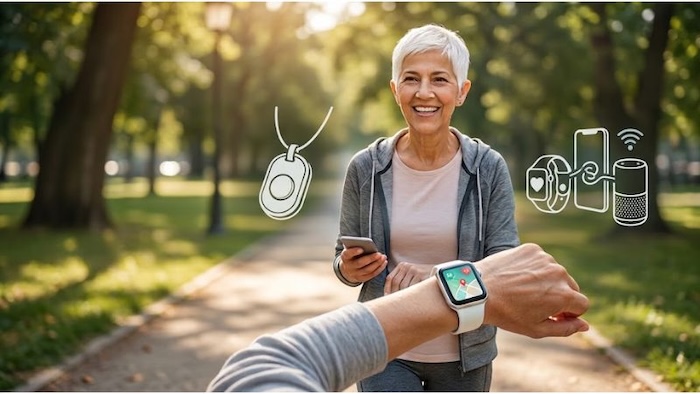
Instead of being confined within 800 feet of a home base unit, modern smartwatch designs offer unlimited nationwide cellular coverage supported by built-in global positioning systems. This allows older adults to maintain their active lifestyles, running errands or taking walks in the park, without sacrificing their safety net. Connectivity is no longer dependent on legacy landlines, as modern units operate on robust cellular networks that function wherever mobile service is available.
Fall detection technology has also undergone a massive evolution. While traditional systems relied on basic impact triggers that frequently resulted in high false-alarm rates, modern alternatives utilize AI-filtered accelerometers and gyroscopes. These advanced sensors monitor changes in motion, speed, and orientation to identify patterns consistent with a hard fall. When an incident is detected, the device automatically contacts a monitoring center, ensuring that help is dispatched even if the user is unconscious or unable to press a button.
Furthermore, modern systems bridge the gap between older adults and distant family members through sophisticated caregiver app integration. Rather than relying solely on sudden phone call notifications during an emergency, caregivers can monitor real-time device locations, battery statuses, and call logs directly from their smartphones. More advanced home environments even utilize passive ambient sensors, such as radar and wall-mounted Wi-Fi monitors, to track daily activities and flag routine deviations. This approach provides whole-home coverage and fall detection without requiring the senior to wear a physical device, making it an ideal solution for individuals with cognitive decline who might otherwise reject traditional wearables.
Choosing and Implementing the Right Safety Technology
Selecting the appropriate medical alert system requires careful consideration of the user’s actual needs, lifestyle, and cognitive abilities. Industry experts emphasize that an advanced smartwatch featuring a complex touchscreen interface will likely fail for a user struggling with severe dementia or advanced macular degeneration. Conversely, an active senior who travels frequently will gain little benefit from a passive, home-bound radar system.

Caregivers are frequently reminded that a medical alert system is never a substitute for direct supervision or structured in-home care. Instead, these technologies function as risk-mitigation tools designed to buy precious minutes during an unexpected emergency. Reviewing comprehensive safety resources, such as the National Institute on Aging’s fall prevention guidelines, remains an essential first step before relying solely on wearable or ambient monitoring devices.
Questions regarding financial coverage and technical requirements often influence family decisions. Original Medicare, encompassing Parts A and B, typically does not cover medical alert systems because they are not classified as durable medical equipment. However, some Medicare Advantage plans or state Medicaid programs may offer limited coverage, equipment discounts, or financial reimbursement depending on regional regulations.
The Evolving Landscape of Caregiving
Finding the delicate balance between personal safety and individual independence remains one of the most difficult challenges in modern caregiving. Fortunately, the ongoing evolution of medical alert technology has largely replaced the social stigma of bulky, outdated panic buttons with sleek, proactive health hubs. Whether families choose a discrete GPS-enabled medical alert watch for an active parent or passive ambient sensors for a loved one navigating cognitive decline, today’s technology is engineered to preserve personal dignity while delivering invaluable peace of mind.
While no electronic device can ever completely replace the warmth, empathy, and watchful eye of dedicated human caregiving, integrating these sophisticated tools into a comprehensive safety plan ensures that professional help is always quietly and reliably waiting in the wings.