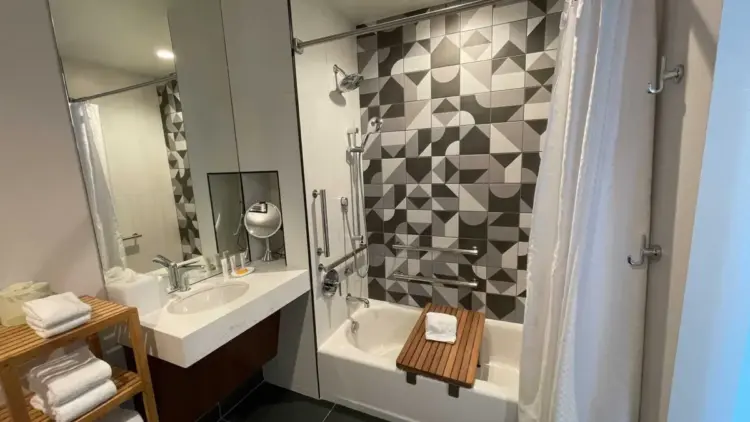
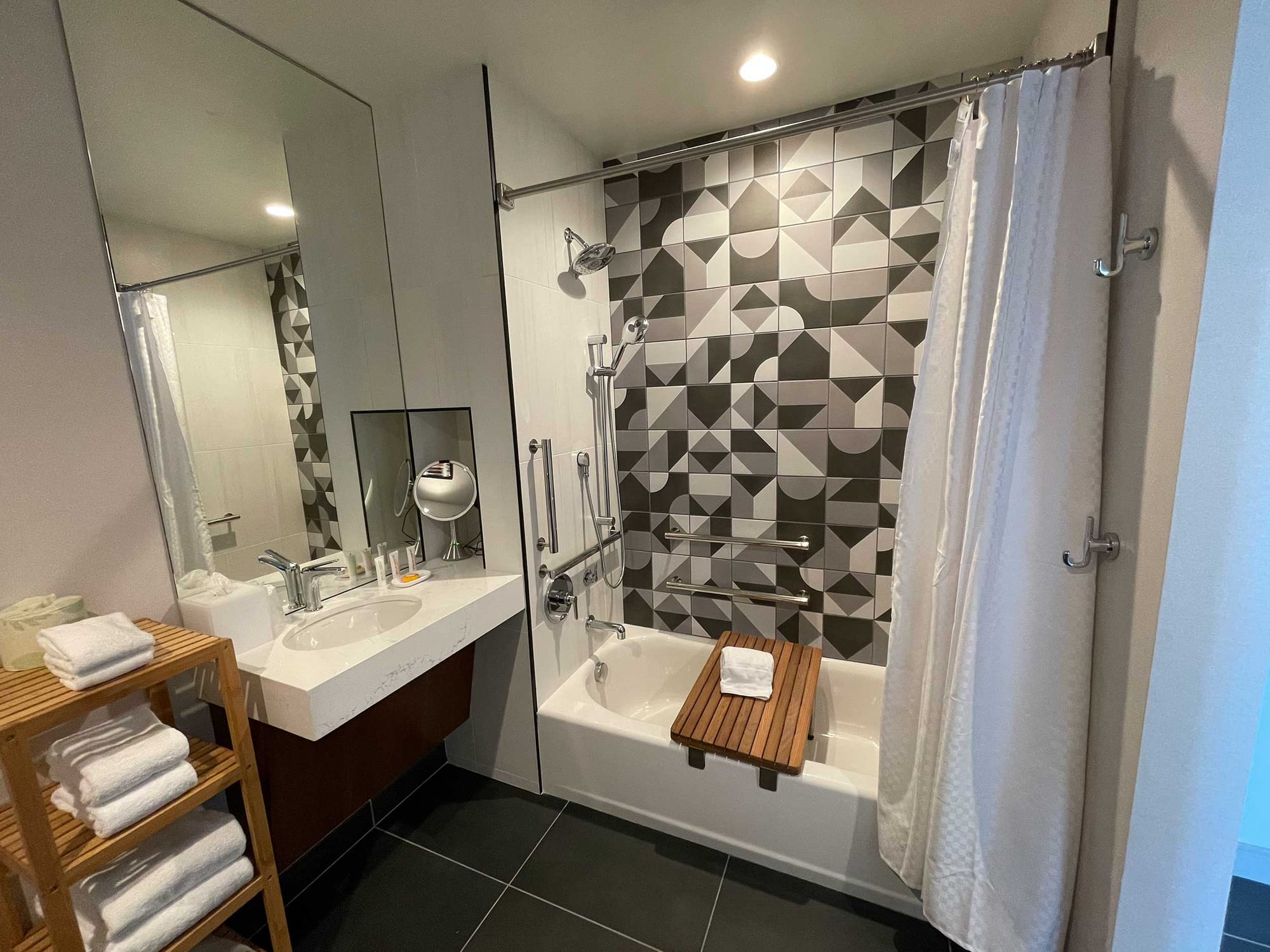
Over the past few years, travelers navigating new hotel builds and major property renovations have likely noticed a striking interior design shift: the traditional bathtub is rapidly vanishing. This evolution is not limited to standard guest rooms designed for the general public; it is increasingly impacting ADA
accessible guest rooms as well. For many disabled travelers, particularly older adults, this development carries significant weight. Bathtubs equipped with grab bars and transfer seats have long remained the preferred bathing fixture for a substantial segment of the travel community, making their quiet removal a matter of considerable discussion and concern.
For a long time, the prevailing assumption among many advocates was that any modern hotel failing to provide guest rooms with an ADA-accessible bathtub was operating outside the law. However, a closer examination of the regulations reveals a different reality, rooted in a technical loophole written directly into the federal accessibility guidelines. Upon reading the accessible bathtub regulations more thoroughly, it becomes clear that there is a legally permissible path for hotels to remove bathtubs from their properties entirely. Yet, executing this transition lawfully requires a very specific architectural adjustment that the vast majority of hospitality operators have failed to make.
ADA Requirements for Accessible Bathtubs and Showers in Hotels
Hotels newly constructed or significantly altered on or after March 15, 2012, are legally obligated to follow the 2010 ADA Standards for Accessible Design, which were formally adopted by the Department of Justice. The specific rules governing hotel guest rooms are housed within Section 224 of these standards, while the intricate technical details are laid out largely in Section 806.
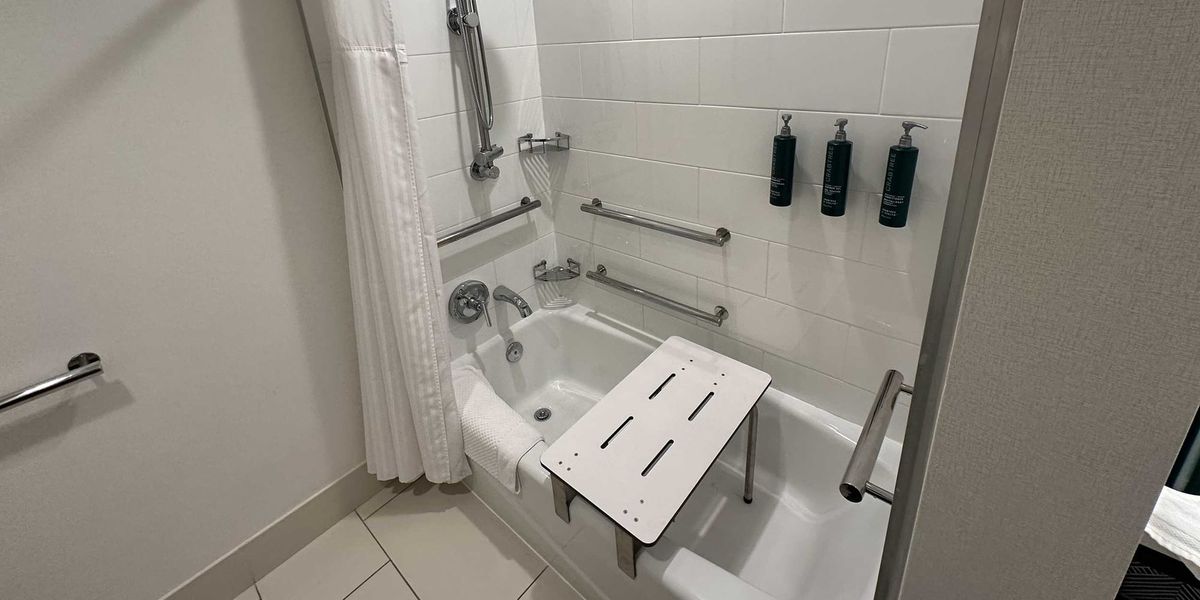
The fact that these critical hotel design standards are spread across multiple, distinct sections of the broader ADA code has long been a source of confusion for architects, interior designers, and project developers. This structural complexity may well explain why a remarkably high number of properties have struggled or failed to achieve full compliance over the years.
Section 224.2 of the standards dictates the exact quantity of mobility-featured guest rooms a property must provide, scaling the requirement according to the total room count of the facility. The regulatory table splits these mandatory rooms into two distinct categories: guest rooms equipped with roll-in showers, and guest rooms without them.
According to these federal benchmarks, the required number of accessible rooms scales incrementally alongside the total hotel size. Properties of virtually any scale, including boutique locations with as few as one total guest room, must feature at least one designated room categorized as not having a roll-in shower. Traditionally and most commonly, bathtubs have satisfied this specific requirement, though the standards also explicitly recognize transfer-type showers as an acceptable bathing fixture alternative. Meanwhile, the legal mandate requiring hotels to incorporate accessible guest rooms with roll-in showers takes effect once a property reaches a threshold of 50 total guest rooms.
The Loophole: Transfer Showers Can Legally Take the Place of ADA-Accessible Bathtubs
When examining accessible rooms that do not feature a roll-in shower, the ADA Standards treat a bathtub and a transfer-type shower as functional equivalents. State-level adaptations of the rule, such as California’s Section 11B-224.2, articulate this principle in straightforward language, directing properties to provide either a bathtub or a transfer-type shower. Consequently, a hotel can legally operate with zero bathtubs across its entire inventory of accessible rooms, provided that a genuine, fully compliant transfer shower stands in place of a tub.
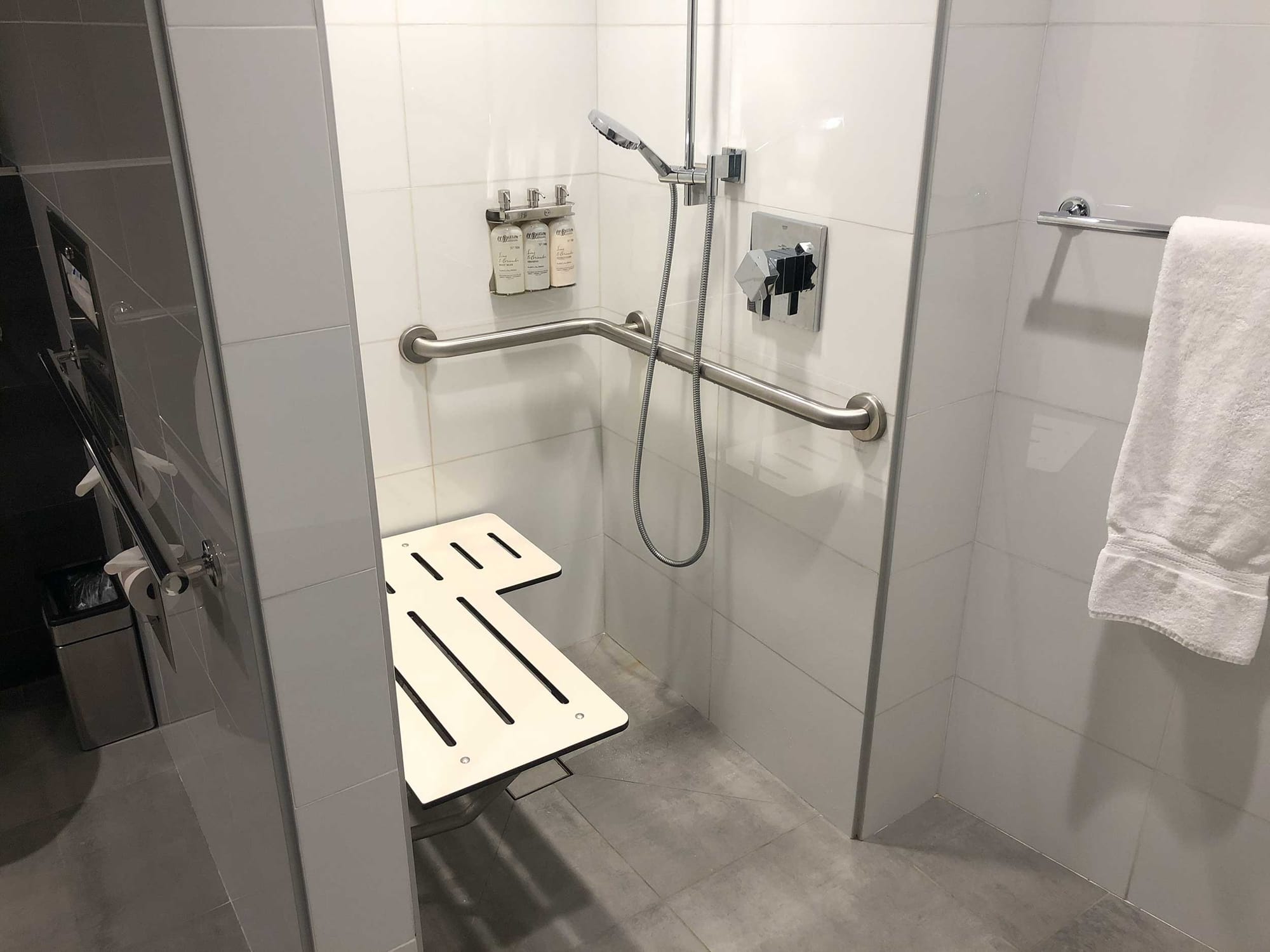
It is critical to understand, however, that a transfer shower is not synonymous with a roll-in shower, nor is it interchangeable with the standard walk-in showers frequently marketed by modern hotels. A transfer-type shower is a rigorously defined technical fixture subject to strict regulatory parameters. By mandate, transfer shower compartments must measure precisely 36 inches by 36 inches square—these figures represent absolute dimensions rather than flexible minimums.
Furthermore, a compliant transfer shower must feature a wall-mounted seat securely positioned between 17 and 19 inches above the finished floor. Grab bars are strictly required on the wall directly opposite the seat as well as on the back wall, and all water controls must remain within easy reach of the seated user. To complete the specification, the threshold or curb required to enter the shower compartment can be no higher than one-half of an inch.
These precise accessibility features draw a stark line between a legitimate transfer shower and what the hospitality industry often advertises as a modern walk-in shower. A curbless, glass-enclosed shower featuring elegant tile work does not automatically qualify as a transfer shower. Without the mandated square compartment dimensions, the secure wall-mounted seat, and the precise positioning of grab bars and water controls, the installation remains merely a standard shower rather than an ADA-compliant transfer-type fixture.
Looking Ahead: Trends Favor the Elimination of Bathtubs in Hotel Rooms
The ongoing elimination of bathtubs from hotel accommodations is accelerating rapidly across the industry. Several major hospitality brands have chosen to do away with tubs entirely in new construction projects, a trajectory that industry watchers expect will continue unchecked for the foreseeable future. Bathtubs consume considerable square footage, and contemporary interior designers increasingly view sleek, open showers as the more modern, marketable aesthetic choice. As a result, tubs are expected to keep disappearing from standard guest rooms, with the trend inevitably bleeding over into ADA accessible inventories as well.
Compounding the issue, many commercial architects and designers lack deep familiarity with the nuances of ADA requirements. Because bathtubs served as a reliable industry staple for decades, relatively few designers have extensive experience engineering spaces around compliant transfer-type shower compartments. Industry observers anticipate that compliance challenges will persist well into the future, noting that roll-in showers have been mandated under federal law for more than 30 years yet frequently remain non-compliant even in modern properties.
Final Thoughts
Within the disability community, opinions remain divided regarding the ideal bathing fixture, largely because individual travelers possess vastly diverse accessibility needs. The optimal hotel environment is one that thoughtfully incorporates ADA-compliant bathtubs, roll-in showers, and transfer showers across its accessible room inventory, thereby granting guests the widest possible range of choices to suit their personal requirements.
In markets where bathtubs are quietly disappearing from blueprints, industry watchdogs emphasize that hotel operators must be held strictly accountable to the letter of the ADA Standards. Only genuine, fully compliant transfer showers serve as a legal replacement for traditional tubs, and every individual component must measure up to the established design codes. Travelers who encounter properties lacking compliant tubs or verified transfer showers in their designated accessible rooms are encouraged to raise the issue directly with property management and, if necessary, file a formal complaint through the Civil Rights Division of the Department of Justice.