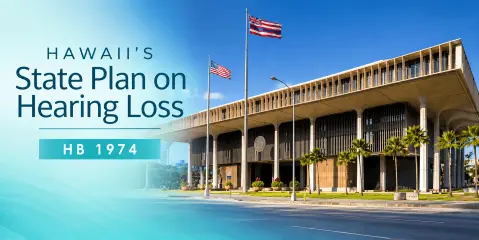
Hearing loss is frequently misunderstood as a simple communication barrier, but its real-world impacts run much deeper. Beyond the immediate challenge of hearing conversational speech, untreated hearing loss affects education, employment opportunities, healthy aging, social connection, cognitive health, and overall quality of life. Recognizing the far-reaching consequences of hearing impairment on individuals and society alike, the state of Hawaii has taken a major step forward by officially signing House Bill 1974 (C.D. 1) into law on July 10, 2026. This legislative
milestone represents a practical and meaningful commitment by the state to integrate hearing health into its broader public health priorities.
The enactment of this new bill follows sustained and dedicated advocacy from members of the Hearing Loss Association of America (HLAA) and various other community stakeholders within the hearing loss sector. Under the provisions of HB 1974, the Hawaii State Health Planning and Development Agency (SHPDA) is officially directed to create a comprehensive State Plan on Hearing Loss. This blueprint is designed to serve as a foundational mechanism, giving stakeholders the tools necessary to better understand and evaluate community needs, close persistent service gaps, and drastically strengthen access to quality hearing care across the entire state.
The legislation outlines a clear mandate for SHPDA: to develop and publish a statewide strategy aimed at improving hearing healthcare access and affordability, increasing public awareness, expanding the specialized healthcare workforce, and prioritizing early detection and intervention. Furthermore, the plan will focus heavily on improving treatment options and long-term outcomes for residents of all ages, ranging from infants to older adults. While officials note that the bill does not instantly dismantle every existing barrier to hearing care, the forthcoming Hawaii State Plan will establish a vital shared roadmap. This framework will guide future legislative and community initiatives, fundamentally reshaping the state’s approach to delivering comprehensive hearing health services.
To support the agency in this ambitious endeavor, the bill appropriates $100,000 in general funds for the fiscal year 2026–2027. These allocated funds are designated to cover essential operational aspects of the planning process, including project management, interagency collaboration, statewide stakeholder engagement, and the recruitment of consulting subject matter experts. Additionally, the budget will cover the administrative costs associated with drafting, reviewing, and ultimately publishing the final plan for public use and legislative review.
One of the most significant structural achievements of HB 1974 is that it establishes an enduring framework for ongoing planning, implementation, and governmental accountability. The state is legally required to provide regular progress updates and policy recommendations during every odd-numbered legislative session. This built-in reporting mechanism ensures that hearing health will remain a permanent fixture in Hawaii’s long-term policy discussions, elevating the issue from an overlooked personal challenge to a recognized and prioritized public health concern.
For many years, children and adults living with hearing loss in Hawaii have confronted a multitude of systemic obstacles. These challenges have included delayed diagnoses, a severe lack of structured follow-up care, difficulty locating qualified local services, and prohibitively high costs for hearing aids and other assistive technologies. Compounding these hurdles are limited public awareness, persistent workforce shortages within the audiology and otolaryngology fields, and an overall healthcare system that can be notoriously difficult to navigate. Although numerous local organizations and dedicated healthcare providers have long worked tirelessly to support the community, Hawaii has historically lacked a coordinated, statewide effort to identify systematic gaps and implement a unified, long-term strategy for hearing health.
HB 1974 fundamentally alters this landscape. Spearheaded by SHPDA, the newly initiated planning process is designed to bring together a diverse coalition of healthcare providers, educators, government agencies, community organizations, and individuals possessing lived experience with hearing loss. This collaborative approach ensures that the voices of those most affected directly shape the identification of priorities and the formulation of realistic, impactful recommendations. The resulting draft plan will serve as a practical guide to translate these recommendations into meaningful action across the islands.
The successful journey of HB 1974 from a legislative proposal to signed law was built on grassroots determination and strong political partnerships. Conversations surrounding the urgent need for a statewide hearing health strategy began when members of Hawaii’s hearing loss community initiated dialogues with key state legislators. Momentum accelerated significantly when the Hawaii Kupuna Caucus—a prominent bipartisan group of lawmakers dedicated to addressing issues that impact older adults—selected HB 1974 as one of its official priority bills for the legislative session. This endorsement was instrumental in raising broader awareness and building essential legislative support.
Riding this wave of momentum, the local hearing loss community united around a shared vision to see the bill through the legislative process. Members of the HLAA HOPE support group, alongside practicing audiologists, ear, nose, and throat (ENT) physicians, speech and hearing professionals, family caregivers, and numerous community advocacy organizations, actively participated by submitting testimony and advocating for the bill throughout the House and Senate proceedings. This broad coalition of advocates played a vital role in demonstrating the widespread community demand for systemic improvements in hearing healthcare.
With the enactment of this legislation, Hawaii joins a select group of five other states that have previously established similar statewide planning initiatives. Models from Nevada, Minnesota, Massachusetts, Vermont, and New York served as important structural inspirations and practical references for the development of HB 1974.
A cornerstone of this entire initiative is its commitment to centering the voices of individuals and families who navigate hearing loss in their daily lives. By placing people with lived experience at the heart of the conversation alongside healthcare providers, educators, and government officials, the state ensures that the resulting strategies will be grounded in real-world realities.
The official planning process is already underway, with the release of the preliminary draft plan anticipated by the end of 2026. Following its publication, the primary focus will shift toward executing targeted actions designed to address the specific needs and goals identified throughout the statewide consultation process.