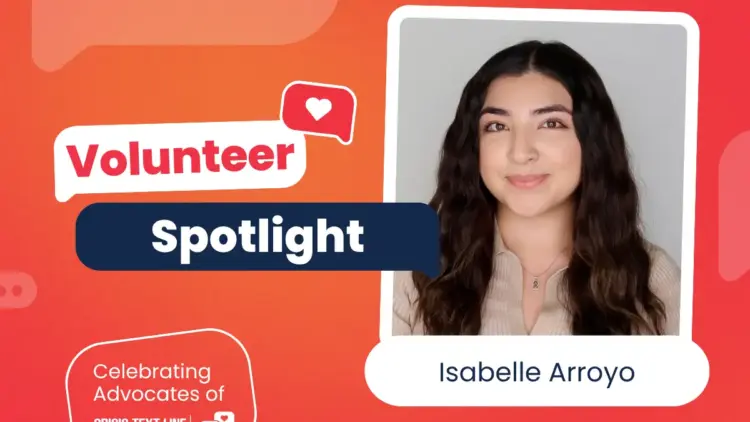
Sometimes a calling begins in the most ordinary and unexpected place. For Isabelle Arroyo, that starting point was a simple post on LinkedIn. That routine scroll through her feed introduced her to Crisis Text Line, setting her on a path that would transform her perspective on community care, mental health support, and human connection. Today, she serves as a dedicated volunteer Crisis Counselor, answering urgent text messages from individuals navigating some of the most difficult and vulnerable moments of their lives.
In this month’s volunteer spotlight, Isabelle opens up about the experiences that shaped her journey. She discusses how her desire for accessible, stigma-free support led her to the organization, why she views her role as akin to "the best friend you hope would listen when you need them most," and how the smallest human gestures—a simple greeting, a warm smile, or holding onto hope for someone else—keep her motivated shift after shift.
How did you first hear about Crisis Text Line?
I stumbled upon Crisis Text Line through LinkedIn. What really drew me in was how accessible the platform is. I deeply admired the fact that people can get immediate, professional-grade support during a crisis, twenty-four hours a day, seven days a week, without having to speak to someone out loud over the phone. I felt it was a vital resource that was desperately needed in our society, and importantly, one that could reach virtually anyone, anywhere, regardless of their immediate circumstances or verbal comfort levels.
Did you ever use our service before becoming a volunteer?
Honestly, I hadn’t used it myself. But if I had known about this resource years ago during my own challenging times, it is definitely a service I would have wanted to explore and rely upon. Knowing it is there now brings a great deal of comfort, knowing how many people it successfully reaches every single day.
What moment or experience has reinforced your commitment to supporting people in crisis?
The work itself is the primary reason I keep showing up for my shifts. Supporting someone in their darkest, most challenging moment can leave a lasting impression on both of us. We provide short-term support, but within that brief interaction, we can offer a safe space and, at times, a genuine sense of light at the end of a very long tunnel. We all inherently deserve to feel heard, cared for, and deeply appreciated as human beings.
Every time I log on for a shift, I remind myself of the small, meaningful impact I can leave with someone. Holding onto hope for a person who desperately needs it most keeps me going through every conversation. I truly love being a voice for those who feel unheard or overlooked by the world around them.
What does a volunteer Crisis Counselor do that people might not realize?
We are there primarily to listen, ensuring that individuals can feel heard and completely free from judgment, while also sharing practical resources that can lead toward further support and long-term healing. I like to think of our role as the best friend you hope would listen when you need them most.
Volunteers truly care about our texters, even though we may never meet them in person or even know their real names. Behind the screen, we also keep looking for ways to continuously adapt, learn, and improve our support for every single person who reaches out for help.
How has volunteering changed you, personally or professionally?
For most of my life, I knew I wanted to become a therapist. I have always naturally possessed a caring heart and a desire to help others navigate their struggles. What I never expected, however, was the profound extent to which Crisis Text Line would shape me, both professionally and personally.
Suicide prevention comes in many different forms. It isn’t only about organizing a big presentation or hosting a large community event. Often, it is as simple as sharing a hello, smiling genuinely at a stranger on the street, and taking the extra time to truly get to know someone. What I’ve learned through this journey is that people ultimately just want someone to show up for them when things get hard. I do that professionally as a Crisis Counselor, but now, most importantly, I do it simply as another human being walking through the world.
I’ve learned how to listen with deep empathy and how to be a steady light for someone navigating darkness. This role has fundamentally helped me become a better, more positive person, and I sincerely hope to share that warmth and understanding with everyone I meet in my daily life.
Why is it important to you to support mental health and crisis intervention?
Many people are raised, often without even realizing it, to harbor a heavy stigma regarding their own mental wellbeing. In recent years, society has barely begun to break through those long-standing barriers. Mental wellbeing matters just as much as physical wellbeing, yet people who are actively struggling often lack the internal strength or resources to advocate for themselves. I take great pride in standing up and doing that crucial advocacy work for those who currently cannot do it for themselves.
My ultimate hope is that one day, communities everywhere will come together to truly understand how much mental health matters. I can see the stigma starting to break down in real time, and I truly believe the work we do every day is the beginning of widespread acceptance and healing. We all deserve to be here, to flourish, and to find compassionate support whenever we need it.
The tragic impact of suicide reaches across generations, tearing families and communities apart, and yet even the smallest actions can be the exact reason someone decides to stay. I hold onto that fundamental truth whenever I am asked my "why."
What would you say to someone who wants to volunteer but worries they don’t have the right skills?
Nothing new is ever completely free of fear or hesitation. What changes is that you decide to go after it anyway, adapt to the challenges, and grow through the experience. Volunteering is no different. As long as you show up with a genuine desire to support people through a difficult time, you will be inherently motivated to learn your role and master the tools provided.
You will receive comprehensive training, and I promise you will grow into the position to the point that it becomes something you genuinely look forward to doing each week. The absolute best part of being involved with Crisis Text Line is the robust support network you receive. You are never left alone to figure things out. There is a welcoming, collaborative community space where volunteers actively discuss ideas, learn from one another, and grow together, alongside a dedicated team of staff members who are right there alongside you during conversations to offer guidance and feedback whenever you want it.
No one expects perfection from you. They only expect that you show up with empathy, patience, and compassion. I encourage anyone on the fence to just try it for themselves. I look forward to seeing new faces join us.
Even if formal volunteering ultimately isn’t the right fit for your schedule or lifestyle, you can still play a critical role in suicide prevention any day, at any time, and anywhere you happen to be. Be the stranger who creates positive change in someone’s day. You never truly know the powerful impact you can have by simply showing that you care.