

For millions of family caregivers, a familiar and persistent anxiety accompanies their aging parents through daily routines, peaking precisely when a loved one steps into the bathroom. While this space is naturally valued for privacy, its hard surfaces, moisture, and soap create an environment where safety is severely compromised. Addressing these risks requires more than a quick trip to the hardware store for off-the-shelf accessories; it demands a clinical, deliberate approach to home modification. Experts emphasize that transforming this high-risk zone can significantly reduce the threat of severe injury and allow older adults to maintain their independence safely at home.
The bathroom presents what safety specialists describe as a perfect storm for domestic accidents. Defined by unyielding surfaces, water, and slick soap residue, the room routinely obliterates traction. When these physical hazards combine with the natural realities of aging—such as progressive muscle weakness, stiff joints, and diminishing vision—the risk of a catastrophic fall increases exponentially. Family members frequently live in a state of heightened watchfulness, acutely aware that a single misstep can alter a senior’s life permanently. Mitigating these dangers calls for a comprehensive evaluation of the space, moving away from temporary fixes and toward permanent structural and functional upgrades.
At the forefront of these necessary changes is the proper installation of grab bars, which must be viewed as clinical tools rather than simple DIY accessories. Occupational therapists and mobility experts stress that grab bars should be mapped precisely to an individual user’s functional reach and specific physical limitations. Rather than merely locating a wall stud, a clinical evaluation determines how mobility challenges dictate bar placement to effectively arrest a momentum-driven fall.
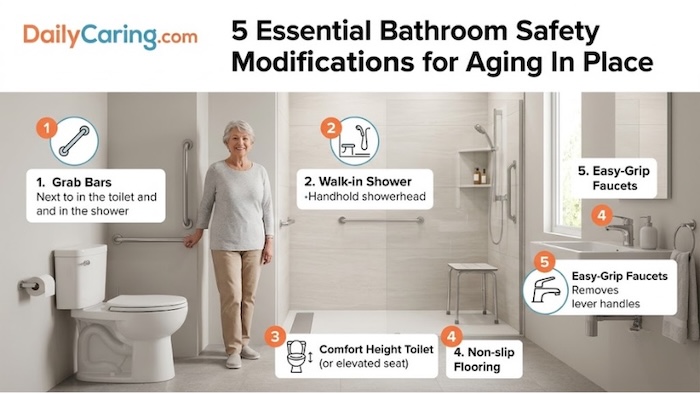
Professional installation is mandatory for this equipment. Suction-cup alternatives inevitably fail under the sudden kinetic energy of a falling adult, transforming what was intended as a safety device into a secondary hazard. When selecting grab bars, purchasing options with diameters between 1.25 and 1.5 inches ensures a comfortable grip for aging hands. Furthermore, experts recommend ADA-compliant knurled finishes, which provide significantly better traction than smooth chrome surfaces when hands are wet or weakened.
Beyond the shower and tub areas, the toilet configuration demands careful attention to prevent debilitating strain. Standard 15-inch toilets present a major hazard for aging bodies, demanding excessive joint flexion and quadricep power just to transition from a seated position to standing. While the Americans with Disabilities Act recommends a height of 17 to 19 inches to accommodate wheelchair users, residential safety often requires a custom fit tailored to the specific biomechanics of the resident.
Calculating the ideal height involves measuring from the floor to the back of the senior’s thigh just behind the knee, ensuring that the resulting elevation significantly reduces stress on the hips and knees. Making this adjustment transforms a daily struggle into a manageable, independent movement.
Lighting within the bathroom also requires a strategic shift toward high-contrast visibility and uniform illumination. Aging eyes frequently suffer from decreased pupil size and progressive lens clouding, which naturally demands higher levels of ambient light. However, simply installing excessively bright bulbs often introduces harsh glare that obscures depth perception, creating a hazard far more dangerous than a dimly lit room.

The primary objective is to achieve uniform illumination coupled with high contrast, utilizing bulbs with a Color Rendering Index of 80 or higher and a color temperature ranging between 2700K and 3000K. Creating stark visual boundaries allows older adults to easily distinguish the edge of the bathtub from the surrounding floor, preventing misjudgments in spatial awareness.
Flooring materials represent another critical frontier in fall prevention. Traditional ceramic tile is water-resistant, but it offers zero shock absorption. If a fall does occur, a tile floor provides no energy dissipation, frequently resulting in shattered hips and severe physical trauma. Shifting the design perspective means planning for potential impact while simultaneously guarding against slips.
Materials such as rubber flooring provide maximum slip resistance and exceptional impact absorption to protect joints and bones. Textured cork and slip-resistant vinyl also offer viable alternatives that balance grip with cushioning, steering homeowners away from the high fracture risks associated with bare tile.
Equally important is the elimination of architectural thresholds, such as door saddles, which frequently stand as the most overlooked tripping hazards in a home. A standard saddle creates a sudden height variation right where carpet meets tile. For seniors who have developed a characteristic shuffling gait, this abrupt transition virtually guarantees a trip-and-fall incident. Replacing these standard thresholds with graded door saddles creates a smooth, zero-edge transition that accommodates mobility aids and unsteady feet alike.

Executing these vital modifications successfully requires specialized knowledge that goes beyond the capabilities of a general handyman. Homeowners are urged to seek out professionals who hold the Certified Aging in Place Specialist designation. Administered by the National Association of Home Builders, this credential indicates that a professional has undergone rigorous training regarding the unique biomechanical needs of older adults, mobility barrier solutions, and structural load-bearing requirements for safety installations. Vetted contractors with this specific training can be located through official industry directories.
While the financial investment required for professional upgrades—ranging from two to five thousand dollars for comprehensive modifications—may seem daunting, industry advocates frame it as an essential safeguard. When compared against the baseline costs of a single reactive fall resulting in emergency hospitalization, surgical hip replacement, and subsequent rehabilitation in a skilled nursing facility, the expense represents a vital insurance policy. Delaying these changes leaves the home environment inherently hostile to an aging body, ultimately threatening to terminate an older adult’s ability to age in place and forcing an unwanted transition into institutional care.



