
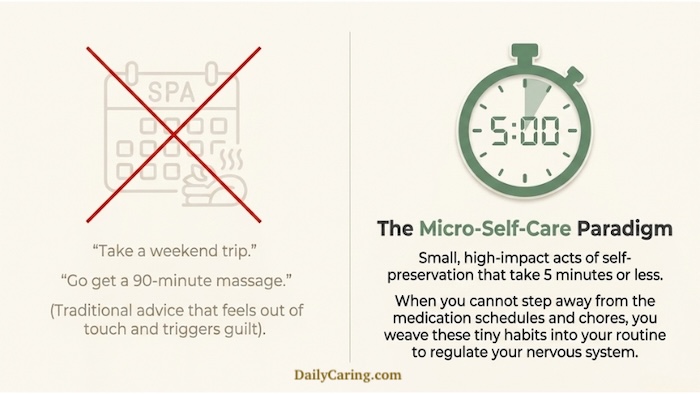
For millions of family caregivers navigating the relentless demands of daily life, standard wellness advice has long felt frustratingly out of reach. When well-meaning friends, doctors, and wellness articles suggest taking a weekend trip, booking a massage, or enjoying a leisurely lunch with friends, the guidance often rings hollow. For someone balancing strict medication schedules, endless medical appointments, vital safety concerns, and the daily grind of household chores, such recommendations frequently feel entirely out of touch with reality.

Far from providing relief, conventional self-care suggestions often turn into just another burdensome chore on an already overwhelming to-do list. When caregivers find themselves unable to carve out hours of uninterrupted free time, the inability to meet these idealized wellness standards frequently triggers heavy feelings of guilt and frustration. The raw, everyday reality of family caregiving is that large blocks of personal time are a rare luxury. However, health advocates and experts are increasingly pushing back against the narrative that self-care requires hours of isolation, arguing instead that running on empty until total burnout sets in is an entirely preventable crisis.
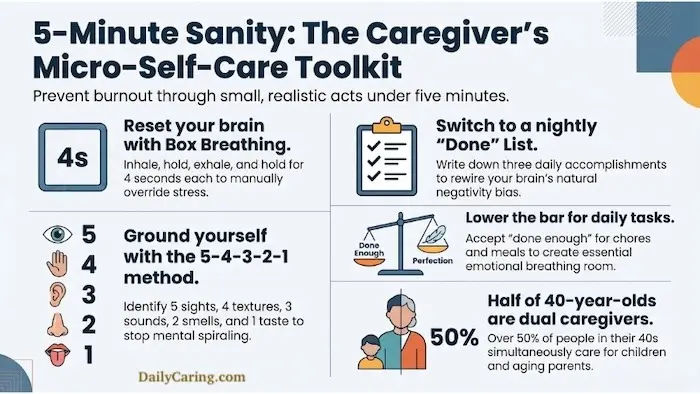
The emerging consensus within caregiver support networks points toward a more realistic approach known as micro-self-care. These are small, high-impact acts of self-preservation that take five minutes or less to execute. By weaving these tiny, manageable habits directly into an already packed daily routine, family caregivers can actively lower their stress levels, regulate an overburdened nervous system, and protect their overall well-being without neglecting their primary responsibilities.

The root of the burnout problem often lies in the physiological toll that continuous caregiving takes on the body. When acute stress hits, the human body automatically enters a survival-oriented fight-or-flight state. Heart rates rise, breathing turns shallow, and muscles tense up in preparation for a crisis. While caregivers cannot always change the external pressures of their daily duties, health specialists note that individuals can manually override this stress response using targeted physiological techniques.
One such foundational practice is box breathing, a simple two-minute exercise designed to reset the nervous system. By inhaling slowly for four seconds, holding the breath for four seconds, exhaling slowly for another four seconds, and holding once more before repeating, a caregiver can physically signal to the brain that the immediate environment is safe. Repeating this brief cycle just three or four times effectively lowers the heart rate, decreases the production of the stress hormone cortisol, and helps the individual regain a steady sense of calm control amidst chaos.

Another critical juncture in the caregiver’s day is the very beginning. How individuals wake up often dictates the emotional trajectory of the hours that follow. If a caregiver immediately jumps out of bed in reaction mode—rushing to check on a loved one, grabbing a smartphone, or mentally cataloging the day’s looming schedule—they surrender their emotional footing before the day has truly begun. Experts emphasize the importance of claiming the first five minutes of the morning entirely for oneself. Sitting quietly with a glass of water, coffee, or tea without immediately engaging with digital screens or household chores creates a vital emotional cushion, equipping the caregiver to handle upcoming challenges with greater patience and resilience.
Throughout the day, the sheer volume of responsibilities can easily cause a caregiver’s mind to spiral into anxious what-if scenarios regarding the future. To combat this mental turbulence, specialists recommend sensory grounding techniques, such as the 5-4-3-2-1 method. By pausing for three minutes to consciously acknowledge five sights, four distinct textures, three sounds, two smells, and one taste in the immediate surroundings, an overwhelmed mind is forcibly pulled out of abstract worry and anchored back into the tangible present moment. This brief mindfulness exercise effectively breaks the cycle of anxiety and restores mental clarity.
The psychological weight of caregiving is also exacerbated by the endless nature of the work. Unlike a traditional job, caregiving has no true finish line; no matter how much is accomplished in a day, an extensive list of tasks will always remain waiting for the next morning. This persistent unfinished feeling frequently leads chronic stress and a distorted sense of inadequacy. To counter the brain’s natural negativity bias—which tends to focus primarily on what went wrong or what remains undone—experts suggest transitioning from a traditional to-do list to a done list at the end of the day. Spending just two minutes before sleep writing down three small accomplishments, such as preparing a soothing cup of tea or managing a difficult conversation, helps shift cognitive focus away from unfinished chores and toward the genuine value of the day’s efforts.
Isolation remains another formidable driver of caregiver burnout, as feeling disconnected from friends and the outside world makes the daily workload feel exponentially heavier. Yet, finding the physical and mental energy for an extended phone call is frequently impossible. To maintain social bonds without draining remaining reserves, professionals advocate for sending brief, no-pressure micro-connections. A simple text message sent during a quiet afternoon—reading something as uncomplicated as "Thinking of you, busy with caregiving but wanted to say hi! No pressure to reply"—allows caregivers to stay tethered to their support systems without committing to exhaustive conversations.
Physical tension compounds these emotional challenges, as chronic stress is frequently stored directly in the neck, shoulders, jaw, and lower back. This physical strain is heavily amplified for those who regularly assist or physically lift their care recipients. A one-minute physical release, involving slow shoulder rolls, gentle neck stretches, and deliberate muscle clenching and releasing, provides immediate feedback to the nervous system that it is safe to let go of accumulated tension, thereby helping to stave off long-term physical strain and injury.
Ultimately, wellness advocates emphasize that prioritizing personal health is not an act of selfishness, but an absolute necessity. When a caregiver becomes entirely exhausted and depleted, providing safe, compassionate care grows increasingly difficult. Protecting mental health does not require hours of away time; rather, it can be achieved by replenishing energy in small, intentional drops throughout the day. By integrating these brief habits into daily life, caregivers can safeguard their own well-being while continuing to support the loved ones who rely on them.



