WASHINGTON — In a significant legislative development for disability rights advocates nationwide, a bipartisan resolution was introduced in the United States House of Representatives this week to formally reaffirm the fundamental right of individuals with disabilities to live, thrive, and receive necessary support services within their own homes and local communities rather than being segregated in institutional settings.
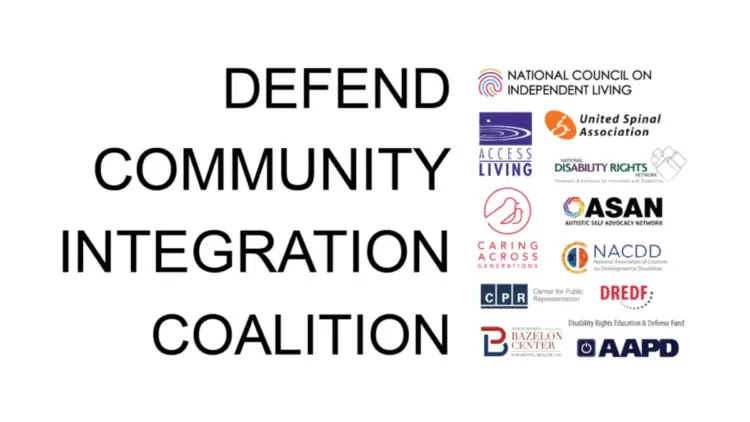
The Defend Community Integration Coalition (DCIC)—a powerful alliance of leading national disability rights organizations—has issued a strong and enthusiastic statement applauding the introduction of the resolution. The measure seeks to reinforce the core principles of community integration at a time when advocates warn that long-standing legal protections are facing unprecedented challenges across the country.
The resolution, designated as H. Res. 1586, was spearheaded and introduced by Bipartisan Disability Caucus Co-Chairs Representative Debbie Dingell, a Democrat from Michigan, and Representative Brian Fitzpatrick, a Republican from Pennsylvania. The bipartisan leadership behind the measure highlights a shared, cross-party commitment to upholding the civil rights of Americans with disabilities, echoing decades of bipartisan collaboration on disability policy in the halls of Congress.
In addition to Representatives Dingell and Fitzpatrick, H. Res. 1586 has garnered initial backing from a diverse group of lawmakers, including Representatives Kean, Lawler, and Wilson on the Republican side, alongside Democrats Scanlon and Simon. This early coalition of cosponsors demonstrates broad, bicameral support for the principle that community integration is a non-partisan American value deeply rooted in the legislative history of federal civil rights laws.
The introduction of the resolution comes as lawmakers, advocates, and legal experts look back on the historic milestones that shaped modern disability law. More than 27 years ago, the United States Supreme Court delivered a landmark ruling in the case of Olmstead v. Lois Curtis. In that historic decision, the high court held that the unjustified institutional isolation and segregation of people with disabilities constitutes a form of unlawful discrimination prohibited under Title II of the Americans with Disabilities Act (ADA).
However, the legal foundation for community integration did not materialize overnight, nor was it established solely by the 1999 Olmstead ruling. H. Res. 1586 meticulously lays out the legislative and regulatory record that led up to the Supreme Court’s decision, demonstrating that the mandate for community-based care is deeply embedded in statutory law enacted by Congress over several decades.

According to the congressional record detailed in the resolution, the framework began to take shape in 1977 and 1978. During those years, federal regulations promulgated under Section 504 of the Rehabilitation Act explicitly established that services and programs for individuals with disabilities must be delivered in the most integrated setting appropriate to their individual needs. Congress formally ratified and solidified those regulatory standards when it amended Section 504 in 1978, affirming the federal commitment to ending unnecessary segregation.
Later, when Congress debated and passed the landmark Americans with Disabilities Act in 1990, it incorporated explicit congressional findings directly into the statute. Lawmakers wrote into the law that the isolation and segregation of individuals with disabilities represent a serious and pervasive form of discrimination. Furthermore, Congress incorporated the integration regulations originally developed under Section 504 directly into the public services title of the ADA.
When the Supreme Court eventually issued its ruling in Olmstead v. Lois Curtis, it affirmed what Congress had already written into law: that the unnecessary segregation of people with disabilities is a violation of federal civil rights. The integration mandate, therefore, stands as established law enacted by the legislative branch and repeatedly reaffirmed by the federal judiciary for decades.
Advocates argue that this legal clarity is more critical today than ever before. The DCIC and its member organizations emphasize that the integration mandate is currently facing new, aggressive, and unprecedented attacks from various fronts, making the timely legislative affirmation by Congress an essential counterweight. Disabled Americans belong in their communities, participating fully in civic, social, and economic life, and the new resolution serves as a clear, unyielding message from both sides of the aisle that Congress intended for the integration mandate to be strictly upheld.
Following the introduction of H. Res. 1586, the Defend Community Integration Coalition is calling on the entire House of Representatives to sign on as cosponsors of the resolution. Furthermore, the coalition is urging leaders in the United States Senate to introduce a companion bipartisan resolution as swiftly as possible to establish a unified front across both chambers of Congress.
Beyond legislative declarations, the coalition is pressing federal and state policymakers to back their verbal and written commitments with tangible financial resources. Specifically, DCIC is calling for increased, sustained investments in home and community-based services (HCBS), alongside robust support for the direct care workforce. Advocates point out that the availability of well-supported direct care professionals is the literal backbone that makes community living possible for millions of Americans with disabilities, preventing institutionalization and ensuring that individuals can safely remain in their homes.
The Defend Community Integration Coalition is anchored by some of the most prominent organizations in the American disability rights movement. The founding members leading this national effort include the National Council on Independent Living, the American Association of People with Disabilities, the Autistic Self Advocacy Network, Caring Across Generations, the National Disability Rights Network, United Spinal Association, Access Living, the National Association of Councils on Developmental Disabilities, the Center for Public Representation, the Bazelon Center for Mental Health Law, and the Disability Rights Education and Defense Fund.