
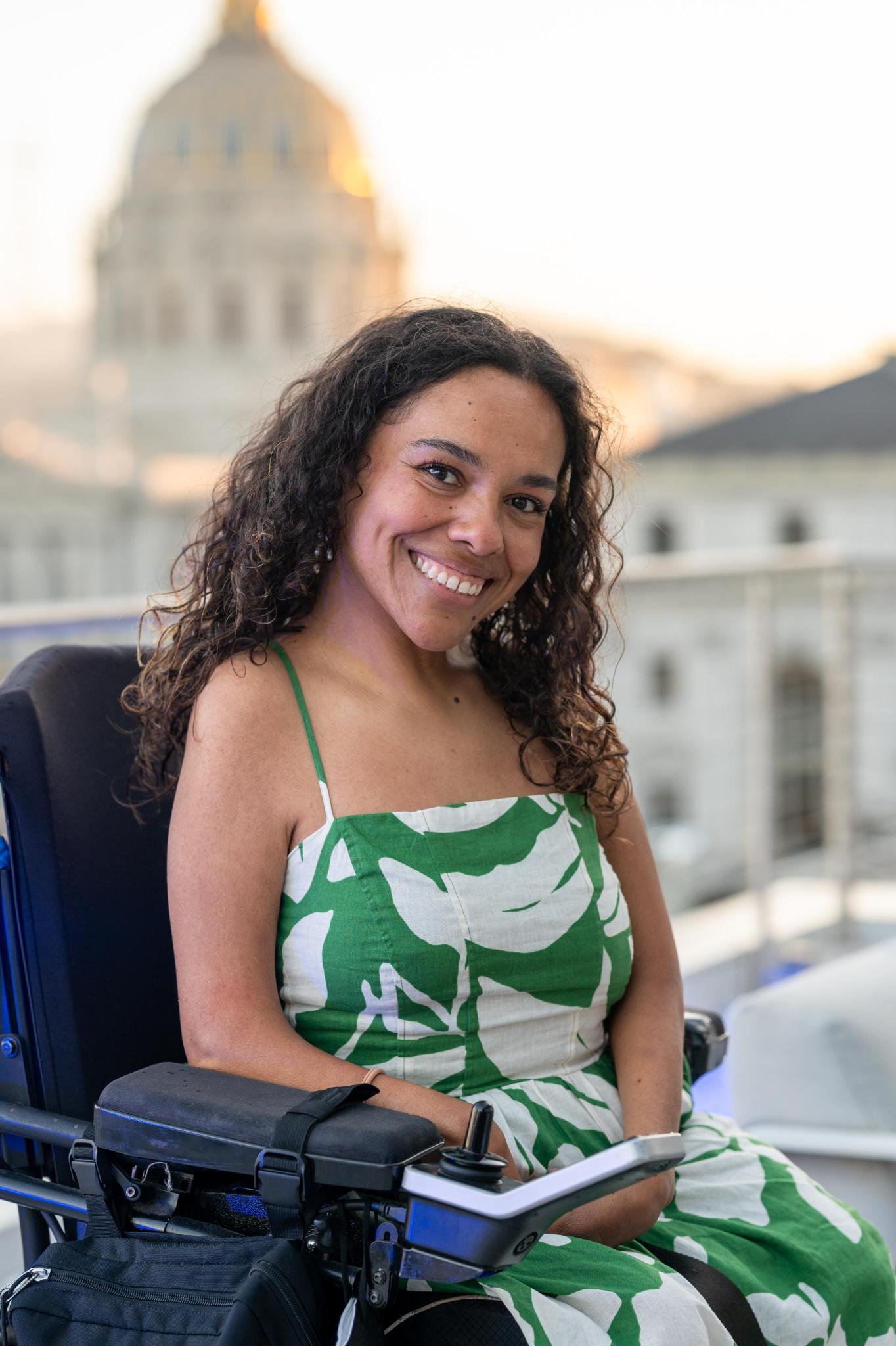
Brittanie Hernandez-Wilson, a recipient of the prestigious American Association of People with Disabilities (AAPD) 2026 Paul G. Hearne Emerging Leader Award, knows firsthand what it means to witness systemic change in action. For Hernandez-Wilson, the true measure of advocacy is not merely found in policy debates or legislative chambers, but in the transformative moment when a disabled individual realizes the undeniable power of their own voice.
Using the funding provided by her AAPD award, Hernandez-Wilson spearheaded “Our Stories, Our Care,” an innovative initiative designed to support disabled Californians in sharing their personal narratives to advocate for fundamental rights and vital services. When reflecting on the profound impact of the project, her face lights up as she describes the exact moment a participant’s perspective on their own personal power and story fundamentally shifts.
For the first time, many of these individuals find themselves speaking directly to state legislators, articulating their lived experiences with clarity and conviction. Witnessing that transformation—seeing how an individual’s self-perception evolves as they realize what they are truly capable of achieving—remains one of the most exciting aspects of the work for Hernandez-Wilson. To her, being a part of that journey in any capacity is a deep and abiding honor.
Hernandez-Wilson has steadily established herself as a formidable force within the California disability advocacy space, contributing significantly to both regional initiatives and the broader national fight to protect Medicaid. In her professional role as the California Lead Homecare Organizer at Hand in Hand: The Domestic Employers Network, alongside her grassroots organizing, she recognized a glaring gap in the local landscape. She saw a distinct opportunity to create a deeply accessible space tailored specifically to her local community, one dedicated to utilizing storytelling as a primary tool for systemic advocacy.
Reflecting on the genesis of the project, Hernandez-Wilson noted that California was missing a dedicated, inclusive space for individuals spanning all levels of experience—from complete newcomers to veterans who had been engaged in the movement for decades. Community members needed a physical and virtual environment where they could feel wholly welcome, where accessibility was prioritized across every metric, and where they could gather in community to learn how their individual stories could drive collective impact, moving through the advocacy process step by step.
That community-driven approach proved critical as the California legislature deliberated high-stakes policies that threatened to severely impact Medi-Cal and In-Home Supportive Services (IHSS). In response to these looming threats, Our Stories, Our Care, alongside the LTSS4All Grassroots Coalition—whose storytellers Hernandez-Wilson actively helped mobilize—rallied with relentless energy. Together, the programs organized 11 virtual action hours, generated nearly 1,000 direct phone calls to legislative offices, and successfully mobilized more than 70 people to attend six distinct rallies and press conferences throughout the year.
To prepare participants for this intense legislative engagement, Hernandez-Wilson personally hosted three comprehensive storytelling trainings with a total attendance exceeding 95 people. As the momentum surrounding Our Stories, Our Care continues to build, the number of individuals trained through the initiative is expected to grow exponentially, establishing a lasting pipeline of grassroots advocates.
Thanks to the phenomenal, coordinated advocacy led by Hernandez-Wilson and numerous other disability advocates across California, the state legislature ultimately rejected all of the major proposed cuts to in-home supportive services. For Hernandez-Wilson, the successful defense of these programs serves as undeniable validation of their collective efforts. The proof is visible in their ability to prevent every single major cut, demonstrating the tangible power of organized advocacy. At the same time, she remains clear-eyed about the realities of political advocacy, acknowledging that legislative battles are cyclical and that advocates will undoubtedly return to the capitol next year to continue fighting for the fundamental right of disabled individuals to live in their communities and receive care in their own homes.
Beyond its legislative victories, Hernandez-Wilson firmly believes that the advocacy trainings she facilitates yield profound personal benefits for every participant. She emphasizes that these experiences do more than just influence policy; they help develop participants’ identities, positively shaping their self-concept and deepening their understanding of their own worth and place in society. She expresses absolute confidence that these individuals will continue advocating alongside the broader movement in whatever capacity they are able, transformed by a newfound sense of personal agency.
Maya Morya Selkie Scott is one of the many participants whose life was touched by the program. Having worked closely with Hernandez-Wilson to refine their storytelling skills, Scott spoke highly of the positive influence Hernandez-Wilson had on their development as an advocate. According to Scott, Hernandez-Wilson possesses a unique talent for drawing out an individual’s authentic words and experiences, shaping them into narratives that emotionally resonate with listeners.
Scott further praised Hernandez-Wilson’s deep, passionate commitment to accessibility and her dedication to amplifying the voices of people and communities that are frequently marginalized or entirely invisible, even within broader disabled communities.
Looking ahead, Hernandez-Wilson has ambitious plans to expand Our Stories, Our Care to make the initiative even more impactful and inclusive. Her primary hope is that the momentum will continue to snowball, with this year’s participants returning next year alongside members of their own extended communities. She stresses that a tremendous amount of work remains to ensure the movement is as intersectional and genuinely grassroots as possible, actively reaching out to bring in individuals who are rarely heard or seen by those in power.
For Hernandez-Wilson, the core of advocacy lies in recognizing that real lived experience is the most potent tool available. Using one’s genuine lived reality is the most effective way to make decision-makers understand that the policies they sign into law carry the weight of real lives—they can make or break an individual’s existence, their autonomy, and the opportunities available to them.
Despite the tangible, measurable impacts she and Our Stories, Our Care have achieved over the past year, Hernandez-Wilson maintains a profound sense of humility and sincerity. She is quick to emphasize that this vital work cannot be accomplished in isolation; rather, it is part of a larger, interconnected collective movement. Even as her name is nationally recognized alongside fellow award recipients, she insists the honor belongs to the entire community. The work is fundamentally about stewarding everyday people through the legislative process and teaching them how to distill the most impactful parts of their personal stories to reshape legislation.
Receiving the Paul G. Hearne Emerging Leader Award is not viewed by Hernandez-Wilson as a capstone achievement, but rather as a profound recommitment to her ongoing advocacy efforts. Her immediate focus remains squarely on continuing this essential work hand-in-hand with her community. Pointing to current national developments, including legislative changes and ongoing challenges to foundational protections like Section 504 and the Olmstead decision, she concludes that meeting these challenges will require a unified, all-hands-on-deck approach now more than ever.



