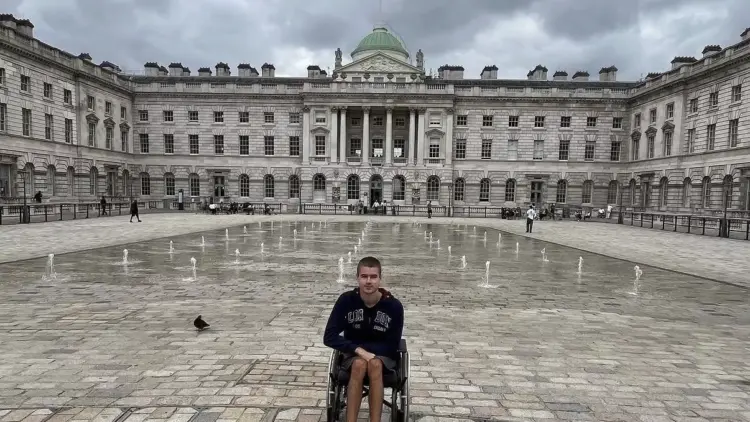
When Liam Virgo was 13 years old, his life changed in an instant. Up until 2016, he was an active, healthy teenager with no indication of the medical crisis that was about to unfold. Suddenly, without warning, the complex communication pathways between his brain and his body suffered a catastrophic breakdown—a moment he describes as the software in his brain suddenly crashing. Within a matter of days, Virgo was diagnosed with a severe case of Functional Neurological Disorder (FND), a condition that abruptly took away his ability to walk and speak.
Trapped inside a body that was no longer responding to his command, Virgo went from an active adolescent to being completely paralyzed and non-verbal. For months, he remained in a hospital bed, lost in a harrowing blur where even basic cognitive recognition vanished. Yet from the depths of a total loss of independence, Virgo discovered a singular goal that would ultimately save his spirit and redirect his life: a determination to travel to London. Today, having transformed that initial dream into a reality, Virgo has visited more than 120 towns and cities across the United Kingdom, turning his personal experience into a powerful platform for accessibility advocacy.
A Sudden Diagnosis and the Reality of Functional Neurological Disorder
The onset of Functional Neurological Disorder in 2016 delivered an overwhelming shock to Virgo and his family. Unlike structural neurological conditions caused by physical damage or disease, FND is characterized by a disruption in how the brain sends and receives signals to the rest of the body. For Virgo, the initial months following his diagnosis were marked by severe physical confinement and overwhelming disorientation.
Reflecting on those early days, Virgo recalls feeling like a prisoner in his own body. The loss of function was complete and immediate. He went from walking effortlessly to being entirely paralyzed and unable to speak. The cognitive impact of the sudden onset was equally severe; for the first six months, his mind effectively switched off, leaving him unable to recognize people or understand his surroundings. The life he had known prior to FND dissolved into a blur.
The physical reality of his condition was equally punishing. Virgo became bedbound, locked inside a body where even attempting to sit upright triggered extreme pain. In those early stages, standard adaptive equipment offered no relief. No wheelchair was suitable or tolerable, leaving his hospital bed as the only place where he could experience any degree of physical comfort. Having all of his physical abilities stripped away in a matter of days presented a profound mental and emotional challenge, leaving him facing an uncertain future from a bed in a hospital ward.
The "London Dream": Finding Purpose in Rehabilitation
During the dark and difficult days of his initial hospitalization, Virgo realized that survival and recovery required something to look forward to—a tangible goal beyond the medical routines of the hospital ward. That spark of motivation came in the form of a target destination: London.
Virgo made a firm promise to himself that if he could find a way back from total paralysis, he would travel to the nation’s capital. What began as a simple holiday wish quickly evolved into something much deeper. His "London Dream" transformed into a core element of his physical and psychological rehabilitation. Having a concrete, meaningful destination gave his recovery a clear purpose, changing daily therapy from an exhausting chore into a focused mission.
The path to sitting up and regaining basic movement was neither swift nor easy. It required three long years of patience, endurance, and intensive rehabilitation before Virgo reached a major breakthrough. Finally, three years after his diagnosis, he was well enough to sit in his new wheelchair for the very first time. For someone who had spent years lying flat in a bed, stepping—or rolling—into a wheelchair felt like entering an entirely new world. The custom mobility equipment served as the key that unlocked his world once again, setting the stage for his long-awaited trip to London.
Navigating the Capital: Accessibility and Hospitality in Historic London
Arriving in London marked a monumental personal milestone for Virgo, signaling his transition from a bedbound patient back to an active participant in the world. London, with its centuries-old architecture and sprawling urban layout, presents a complex landscape for individuals with mobility challenges. Yet, as Virgo discovered during his visit, the UK capital is increasingly adapting to meet modern accessibility standards, making it one of the most accessible major cities in the country.
Navigating an ancient city in a wheelchair requires careful planning and realistic expectations. While historic streets and legacy infrastructure present built-in challenges, many of London’s primary public areas and major cultural institutions have undergone significant modernization to accommodate step-free access. For Virgo, exploring the city firsthand offered valuable insights into how historic preservation and modern accessibility design can coexist, providing a blueprint for how urban centers can become more inclusive.
Hotel Infrastructure and the Importance of Thoughtful Design
A crucial aspect of any travel experience for a wheelchair user is securing appropriate accommodation. During his milestone trip to London, Virgo stayed at the Park Plaza County Hall, located near Waterloo and the South Bank. The choice of lodging proved pivotal in ensuring a stress-free experience, highlighting the essential role that accessible hotel design plays in adaptive tourism.
For Virgo, the hotel offered key architectural features necessary for a comfortable stay. The accessible guest rooms provided ample space to maneuver a wheelchair effortlessly, avoiding the cramped layouts that often hamper adaptive travel. Crucially, the rooms featured roll-in wet rooms equipped with sturdy grab rails, allowing for safe and independent personal care. Beyond the guest rooms, step-free access extended throughout the hotel’s common areas, including the main lobby and elevators. Coupled with accommodating hotel staff who understood the nuances of accessible service, the environment provided a smooth and supportive home base during his time in the capital.
Dining and Everyday Barriers in the Urban Landscape
While exploring London’s culinary scene, Virgo found that accessibility varies significantly depending on the age and location of the venue. Modern commercial developments and recently regenerated districts—such as the South Bank, Central London, Canary Wharf, and Stratford—generally excel in providing seamless access. In these areas, step-free entrances, spacious floor plans, and modern accessible restrooms are standard features, making dining out relatively straightforward for wheelchair users.
Conversely, older independent restaurants and historic venues present a different set of considerations. In legacy buildings, a single small step at the entrance remains one of the most common physical barriers. To navigate these challenges effectively, Virgo advocates for practical preparation, such as making a quick phone call to the venue ahead of time or examining the entrance virtually using digital tools like Google Street View.
Beyond dining, navigating any major city involves managing potential structural obstacles. Broken street lifts, steep inclines, uneven paving, and out-of-order accessible restrooms can quickly derail a trip if not anticipated. By learning to identify and navigate these barriers on the ground, Virgo developed a practical framework for urban travel that would serve him well in the years to follow.
Expanding Horizons: 120 Cities and Future Dreams
What began as a singular goal to reach London quickly ignited a broader passion for travel and exploration. Reclaiming his mobility and his voice gave Virgo a renewed perspective on life, sparking a determination to see as much of the country as possible.
Since his initial trip to the capital, Virgo has traveled extensively, visiting more than 120 towns and cities across the United Kingdom. His journeys have taken him to major urban centers and historic locations alike, including Manchester, Leicester, Birmingham, Leeds, Liverpool, Edinburgh, Cardiff, and Brighton. While London retains a special significance as the birthplace of his travel dream, each new city represents another milestone in his recovery and another step toward total independence.
Having thoroughly explored the UK, Virgo is now preparing to take his travel ambitions international. His next major goal is to travel abroad to Cyprus, a journey that holds deep personal significance as he seeks to connect directly with his family heritage. Moving from a bedbound existence in a hospital room to planning overseas travel marks a remarkable trajectory, demonstrating the transformative impact of setting ambitious personal targets.
Redefining Mobility and Advocating for Inclusion
Through his travels and public advocacy, Virgo is working to reframe how society views physical disability and mobility devices. For many, a wheelchair is perceived as a symbol of limitation; for Virgo, it is precisely the opposite. He views his wheelchair as a vital tool for freedom, a passport to personal independence, and the instrument that expanded his world at a time when his horizon had shrunk to the four walls of a hospital room.
Virgo strongly emphasizes that the true barriers facing disabled individuals are not inherent to their medical diagnoses or mobility wheels. Instead, the real obstacles are environmental and structural: steep flights of steps, malfunctioning lifts, poorly designed facilities, and an urban landscape that too often fails to prioritize inclusive design from the outset.
By sharing his travel experiences and documenting his journeys on social media under the handle @liamloveslondon, Virgo continues to raise vital awareness for Functional Neurological Disorder—a condition that remains widely misunderstood by the general public. Through his ongoing advocacy, he aims to demonstrate that even after experiencing severe, life-altering medical events, it is possible to reclaim independence, challenge societal barriers, and turn long-held dreams into reality.