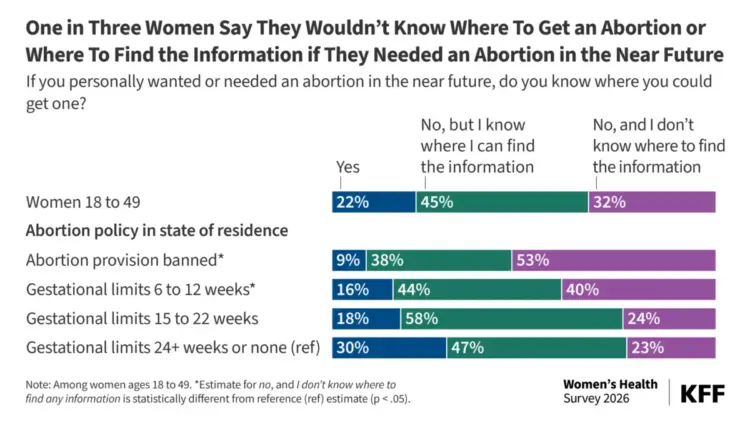
Four years after the historic Supreme Court decision that dismantled the constitutional right to abortion, a striking and widening information gap continues to impact women across the United States. According to a comprehensive new survey released by KFF, an increasing majority of reproductive-age women living in states with strict abortion bans report that they would not know where to turn or how to find reliable information if they or someone they loved needed an abortion. The findings underscore a climate of escalating confusion, legal uncertainty, and restricted healthcare access that persists nationwide as a complex patchwork of state-level restrictions reshapes the medical landscape.
The data reveals that more than half—53 percent—of reproductive-age women living in states that have enacted abortion-provision bans say they would not know where to go or how to locate information regarding abortion services. This figure marks a sharp increase from 43 percent in 2024, demonstrating that as time passes and regulations solidify or grow more restrictive, the information barrier is compounding rather than dissipating. The confusion is not isolated strictly to complete ban states; four in 10 women, or 40 percent, residing in states with gestational limits set tightly between six and 12 weeks report the same lack of knowledge. On a national level, one in three reproductive-age women—32 percent—state they would not know where to access care, rising from one in four, or 26 percent, in 2024.
These troubling findings emerge against the backdrop of a rapidly shifting medical environment, wherein the greater availability of medication abortion via telehealth has fundamentally transformed how many individuals secure abortion care, including those residing in restrictive jurisdictions. Medication abortion, primarily involving a two-pill regimen, has become a central battleground in the ongoing legal and political conflicts surrounding reproductive rights.
Yet, despite the widespread public discussion surrounding pharmacological options, a profound disconnect remains regarding how these services actually function and where they can be legally or practically obtained. While roughly two-thirds—68 percent—of reproductive-age women indicate they have heard of medication abortion pills, a mere 18 percent are aware that individuals in their respective states can acquire them online. This awareness drops to a stark eight percent among women living in states with explicit abortion-provision bans. The vast majority of women are either entirely unsure how they would secure these medications or have never heard of medication abortion at all, with 11 percent incorrectly believing that people in their state have no online access to the pills whatsoever.
The cumulative toll of these overlapping restrictions is increasingly visible in the personal experiences of women across the country. Four years after the Supreme Court’s Dobbs decision overturned Roe v. Wade, one in eight reproductive-age women—12 percent—report that they personally know someone, which includes themselves, who has encountered difficulties in obtaining an abortion due to the restrictions enforced in their state. This metric has also climbed from eight percent in 2024, reflecting a growing number of individuals directly impacted by the legal barriers.
When examining the specific hurdles faced by those seeking care, respondents pointed overwhelmingly to three major obstacles: the necessity of traveling out of state to find a legal provider, a complete lack of knowledge regarding where to go for assistance, and the prohibitive financial costs required to cover the procedure and associated travel expenses. The logistical and economic burdens of crossing state lines often mean that care is delayed or entirely out of reach, particularly for low-income patients who lack the resources to absorb the costs of transportation, lodging, and time away from work.
Beyond the immediate hurdles of accessing abortion procedures, the survey highlights a pervasive sense of anxiety regarding general maternal health and the safety of future pregnancies. A strong majority of reproductive-age women—59 percent—express deep concern that the proliferation of abortion-provision bans may negatively impact the safety of a future pregnancy for themselves or someone close to them. This apprehension is shared broadly across most demographic and political groups, with the notable exceptions of Republican and rural women, who tend to report lower levels of concern regarding the indirect medical consequences of the restrictions.
Public health experts note that these widespread fears are tied to broader uncertainties surrounding emergency pregnancy complications, the legal liability of medical providers, and the availability of comprehensive obstetric care in states where sweeping penalties discourage physicians from performing certain interventions. As the legal framework continues to evolve, the data paints a picture of a population navigating an increasingly complex and intimidating healthcare maze, where basic information about legal rights and available medical options grows harder to find precisely when it is needed most.
The insights and statistical findings detailed in this report are derived from the 2026 KFF Women’s Health Survey. The comprehensive research initiative was fielded from March 11 to April 14, 2026, and gathered responses from a nationally representative sample of 3,538 women ranging in age from 18 to 49.