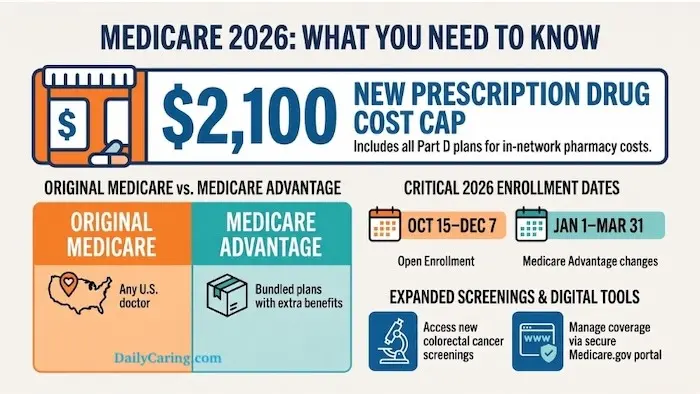
Managing an older adult’s prescription medications has long been a persistent financial drain for families and caregivers across the country. Historically, families have been forced to navigate convoluted coverage phases that made budgeting for healthcare nearly impossible from one month to the next. However, major structural changes to Medicare Part D are taking effect for the 2026 plan year, designed to eliminate much of that historical volatility and bring a new level of financial predictability to the prescription drug market.
The reforms are driven by the final implementation phases of the landmark Inflation Reduction Act. Under the updated federal rules, out-of-pocket costs for covered prescription drugs are now strictly capped at $2,100 annually for enrollees. Additionally, the maximum standard deductible for the plan year has been legally established at $615. These sweeping changes fundamentally alter how seniors and their caregivers plan for medical expenses, shifting away from unpredictable spending toward a fixed maximum liability.
The Medicare Part D Changes 2026: The End of the Donut Hole
For well over a decade, the most destructive and widely criticized element of Medicare Part D for seniors was the coverage gap, universally known as the "donut hole." During this frustrating phase of coverage, seniors who reached a specific cumulative spending threshold suddenly found themselves responsible for a massive percentage of their total drug costs. They were forced to shoulder these exorbitant expenses until their spending finally reached catastrophic coverage levels.
As of the 2026 plan year, the donut hole is permanently gone. It no longer exists within the Medicare framework.

Understanding these Medicare Part D changes and the newly established prescription caps has quickly become a mandatory component of comprehensive eldercare financial planning. Under the current rules, once an enrollee spends exactly $2,100 out of pocket within a single calendar year, their Part D plan or Medicare Advantage plan is required to pay 100% of the cost for all covered medications for the remainder of the year. There are no exceptions to this rule, and the previous catastrophic phase—which still required patients to pay a 5% coinsurance rate—has been entirely wiped out. Once the cap is reached, the patient’s financial obligation for covered drugs drops to zero.
The Real Threat: Formulary Manipulation
Despite the financial protections offered by the new annual caps, healthcare advocates warn that families should not assume their current coverage is entirely safe. Insurance companies and plan sponsors are commercial entities that are not absorbing these mandated multi-billion-dollar cost reductions out of corporate goodwill. Instead, many providers are aggressively manipulating their approved lists of covered drugs, known as formularies, and shifting vital medications into higher pricing tiers to offset their financial exposure under the new caps.
A specialty drug or maintenance medication that was fully covered or reasonably priced in 2025 may be dropped entirely or restricted by prior authorization requirements in 2026. Because of this corporate maneuvering, caregivers and beneficiaries must meticulously verify that their loved ones’ specific medications remain on their chosen plan’s exact formulary during the Annual Enrollment Period. Healthcare experts emphasize a critical caveat: if a prescribed medication is not listed on the plan’s official formulary, any money spent out of pocket on that specific drug will not count toward the crucial $2,100 annual cap.
How the Medicare Prescription Payment Plan Works
To protect seniors from facing immediate, large financial hits when standard deductibles reset at the beginning of the year, federal regulations mandate the continuation of the Medicare Prescription Payment Plan. This specialized, opt-in program is designed to smooth out-of-pocket prescription expenses evenly over the course of the calendar year rather than demanding large lump-sum payments at the pharmacy counter.

Instead of paying hundreds of dollars upfront in January to meet the $615 standard deductible or initial copays, a caregiver can opt their loved one into this structured payment arrangement. Under this system, the pharmacy continues to bill the insurance provider normally, and the insurance plan subsequently sends the enrollee a manageable monthly bill for their smoothed share of the costs. While optional, this mechanism is designed to prevent beneficiaries from skipping necessary doses due to temporary cash flow crunches at the pharmacy counter.
Another critical component of the federal overhaul is the premium stabilization program. To prevent commercial insurers from simply jacking up monthly plan premiums to make up for the revenue lost from the new out-of-pocket caps, the law legally restricts base premium increases to a maximum of 6% per year. However, analysts note that this protective cap applies specifically to the base premium calculation; individual plan premiums will still fluctuate based on regional market pressures, making annual comparison shopping an absolute necessity for households managing tight fixed incomes.
Reviewing available coverage options early gives families a distinct financial advantage as they evaluate their options. Navigating these complex financial shifts requires careful attention to detail, particularly as insurance providers adapt their offerings to comply with the federal mandates. Families are encouraged to utilize official federal resources to verify specific drug coverage and learn more about how the structured payment plans operate within their specific region.
What the New $2,100 Limit Means for You
The arrival of these strict Medicare prescription caps marks a monumental shift in how families approach eldercare financial planning. The era of the dreaded coverage gap is officially over, offering a profound sense of relief for individuals managing chronic conditions and high-cost medication regimens. Once a beneficiary reaches the $2,100 out-of-pocket threshold, the financial burden for covered medications lifts entirely for the remainder of the year.

At the same time, the reality of insurance formulary adjustments means that vigilance is more important than ever. Caregivers must remain proactive in reviewing annual plan changes, checking drug lists, and consulting with qualified professionals when necessary to ensure that their loved ones’ healthcare needs are fully protected under the updated federal guidelines.