Families, caregivers, and individuals affected by Tuberous Sclerosis Complex (TSC) frequently encounter complex behavioral challenges as part of their daily lives. These actions, which can range from sudden tantrums to incidents involving physical harm and property destruction, represent a significant aspect of the condition that requires deep understanding, patience, and structured management strategies. Recognizing the root causes and specific triggers behind these incidents is emerging as a vital step in helping families maintain safety and emotional well-being.
What are behaviours that can be challenging?
In clinical and care environments, a behaviour is classified as challenging when it places the individual displaying it, or those around them, at direct risk of physical or emotional harm. Such episodes encompass a broad spectrum of actions, including acts of direct aggression toward family members or caregivers, episodes of self-harm, and destructive actions such as breaking or throwing household objects. While individuals living with learning difficulties or developmental disabilities tend to display these challenging behaviours with a higher frequency, healthcare professionals emphasize that anyone can exhibit them under the right combination of pressure and distress.
Within the specific medical context of TSC, these challenging behaviours are formally recognized as a manifestation of TSC-Associated Neuropsychiatric Disorders, commonly referred to as TAND. TAND is an umbrella term that captures the wide range of psychiatric, psychological, behavioral, and intellectual difficulties that can accompany tuberous sclerosis complex. Because TAND affects individuals differently, the manifestation of challenging behaviours can vary dramatically from one person to another, making personalized understanding and tailored responses essential for effective long-term care and family support.
Why do people exhibit behaviours that can be challenging?
The underlying catalysts for behaviours that can be challenging are rarely uniform; rather, there can be various triggers that remain entirely unique to each individual. A remarkably common trigger is a stressful or overwhelming environment, such as a crowded, noisy room where sensory overload quickly takes over. In many instances, the behaviour is not an act of defiance, but rather an urgent, albeit distressed, attempt to communicate an unmet basic need, such as hunger, thirst, or physical discomfort.
Furthermore, these actions can frequently serve as an emotional outlet for pent-up frustrations, anxiety, or intense feelings that the individual lacks the internal capacity to process or regulate conventionally. This dynamic is especially pronounced for individuals who are non-verbal or face significant speech impairments. Considering the profound daily challenges faced by someone who cannot verbally express their fundamental needs, desires, or physical pain, episodes of challenging behaviour become much easier to understand as a form of communication rather than purely disruptive conduct.
How can I predict behaviours that can be challenging?
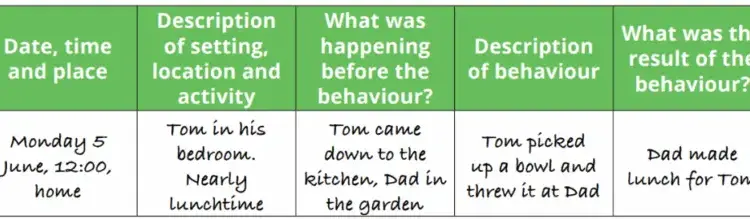
To effectively anticipate these challenging behaviours before they fully manifest, caregivers and support networks have found it immensely helpful to maintain a detailed, ongoing record of each occurrence. Comprehensive documentation involves noting precise details about the environment and context, including the specific physical location of the incident, the immediate events and interactions leading up to it, the subsequent reactions of everyone involved, and a clear, objective description of the behaviour itself.

A widely recommended and practical tool utilized in behavioral management is the Antecedent, Behaviour, and Consequences chart, commonly known as an ABC chart. The antecedent represents what happened immediately before the behaviour occurred, helping to isolate triggers. The behaviour section captures the exact actions observed, while the consequences detail what happened immediately afterward. By systematically analyzing these charts over time, caregivers can begin to discern recurring patterns, identify hidden environmental or emotional stressors, and predict future incidents with much greater accuracy.
How can I reduce behaviours that can be challenging?
Most individuals who display challenging behaviours possess an internal early warning system that signals the physiological and emotional onset of distress before an incident boils over. Initially, these early signs might be exceptionally subtle, highly individualized, and inherently challenging to recognize without careful observation. However, tools like the ABC chart can gradually train caregivers to detect these preliminary indicators with greater confidence.
These early warning signs might manifest as repetitive actions, specific vocalizations or noises, or visible physical cues such as muscle tensing, pacing, or changes in breathing. Recognizing these early indicators allows families and support staff to pre-emptively manage the environment and potentially defuse a challenging behaviour before it escalates into a crisis. Intervening early might involve altering the environment, reducing sensory stimuli, or offering a quiet space to help the individual regain their composure.
How can I support someone during the behaviour?
When a challenging behaviour actively occurs, the demeanor and reaction of the caregiver play a crucial, stabilizing role in how the situation unfolds. Support networks are encouraged to strive to remain composed and steady, even if they personally feel triggered, overwhelmed, or distressed by the unfolding behaviour. Exhibiting a gentle, reassuring facial expression and maintaining a calm, clear voice can often encourage the individual to mirror that composure, slowly bringing down the emotional temperature of the room.
At the same time, caregivers should consciously refrain from bombarding the distressed individual with a barrage of questions, demands, or instructions, which can inadvertently heighten their anxiety. Instead, supporters should remain prepared to offer physical space if it seems beneficial to the individual’s emotional regulation. If a situation rapidly escalates to a dangerous or volatile level where safety can no longer be guaranteed, caregivers should never hesitate to contact emergency services for immediate assistance. Managing these high-stress behaviours day in and day out is profoundly exhausting, making it vital for caregivers to practice self-compassion and acknowledge their own emotional limits.
How can I support the person after the behaviour?
The moments immediately following a challenging incident are frequently characterized by a tense and emotionally charged atmosphere that affects everyone involved in the household or care setting. Transitioning smoothly to a completely different physical environment or engaging in a distinct, calming activity—such as taking a quiet walk outdoors—can prove therapeutic and help reset the emotional mood for both the individual and the caregiver.
Once absolute calmness has been successfully restored across the environment, it can be worthwhile to calmly reflect on the incident to better prepare for future occurrences. Reviewing the event through the lens of an ABC chart helps integrate lessons learned into the ongoing care plan. Because navigating challenging behaviours can be an isolating and exhausting experience for families and professionals alike, those seeking further information, guidance, or simply a listening ear are encouraged to reach out to the TSA Support Line by calling 0808 801 0700, sending an email to [email protected], or utilizing the dedicated webchat service.