As the healthcare landscape prepares for sweeping federal changes, millions of vulnerable Americans face critical decisions regarding their public health coverage. Medicaid, which currently provides essential healthcare coverage to nearly one-third of all adults living with mental health conditions, is bracing for a profound policy shift. Beginning January 1, 2027, the implementation of the 2025 federal budget reconciliation law will fundamentally alter eligibility criteria for adults in the Affordable Care Act (ACA) expansion group and certain waiver programs. Under these new guidelines, states will be required to condition Medicaid eligibility on meeting specific "community engagement" or work requirements, unless enrollees qualify for a designated exclusion.
While states must officially initiate these changes starting January 1, 2027, recent administrative developments have introduced a brief window of adjustment. In November 2026, the Centers for Medicare and Medicaid Services announced that it would grant states an optional six-month delay on enforcing the newly mandated Medicaid work requirements. Despite this potential grace period for enforcement, the underlying structural mandates remain on the horizon, leaving advocacy groups, healthcare providers, and policy analysts closely examining how enrollees will navigate the impending requirements and potential exemptions.
Navigating the Medical Frailty Exclusion
For adults managing mental health conditions, the primary avenue for bypassing the upcoming work requirements is the "medical frailty" category. Federal guidelines explicitly include individuals with "disabling mental disorders" within this classification, shielding them from mandatory community engagement rules. However, the legal and regulatory framework surrounding medical frailty has experienced significant turbulence over the past year, creating a shifting landscape of compliance and proof.
The requirements for establishing medical frailty have undergone multiple revisions. In June 2026, the Centers for Medicare and Medicaid Services issued an interim final rule that introduced an additional hurdle: enrollees would need to provide concrete evidence that their qualifying condition actively impaired their ability to meet the new work requirements. This added evidentiary burden sparked immediate concern among patient advocates and legal experts. The situation shifted again in October 2026, when a federal district court struck down this additional requirement, ruling against the strict proof-of-impairment mandate. Although the Centers for Medicare and Medicaid Services may still appeal the decision, the current legal status has temporarily eased the initial burden of proof for enrollees seeking the medical frailty exclusion.
The practical ability of an individual to document a disabling mental disorder and successfully secure a medical frailty exemption will heavily depend on individual state definitions and administrative verification processes. If enrollees face insurmountable challenges in qualifying for an exclusion, the consequences could prove severe. Loss of Medicaid coverage risks interrupting ongoing mental health treatment, which can rapidly lead to worsening symptoms and an increased reliance on acute care facilities. Such coverage disruptions threaten to place unprecedented strain on local safety-net providers and broader community mental health systems.
The Scope of Impact in ACA Expansion States
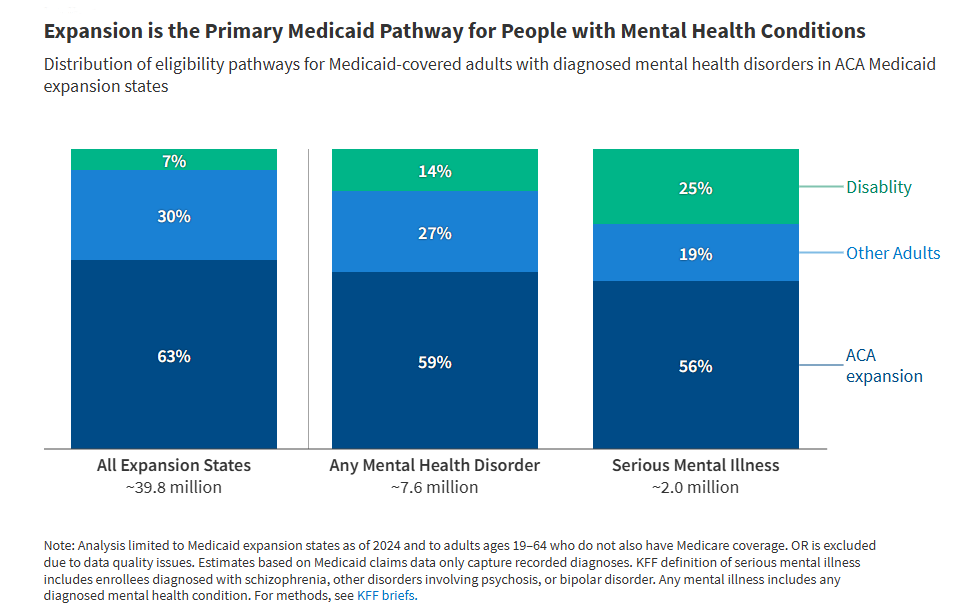
To understand the scale of the challenge, it is necessary to examine the demographic makeup of the Medicaid expansion population. The majority of adults with mental health conditions residing in ACA expansion states could find themselves subject to mandatory work requirements unless they successfully secure an exemption. Adults enrolled through the ACA expansion pathway generally must meet work mandates unless they fall under an approved exclusion category, such as having a recognized disabling mental disorder.
Data indicates that the stakes are remarkably high. In expansion states, over half—specifically 59 percent—of Medicaid-covered adults under the age of 65 who live with at least one diagnosed mental health disorder qualify through the expansion pathway. Furthermore, 56 percent of those diagnosed with a serious mental illness also rely on this pathway for their coverage. For the purposes of policy analysis, serious mental illness is broadly defined to encompass conditions such as schizophrenia, bipolar disorder, and other psychotic disorders. While these definitions may overlap with, they do not always perfectly mirror, individual state definitions of disabling mental disorders.
These serious mental health conditions often involve profound and debilitating symptoms, including hallucinations, severe delusions, significant mood disturbances, and cognitive difficulties affecting concentration, memory, or planning. Additionally, individuals may experience anosognosia, a neurological or psychological symptom that impairs a person’s ability to recognize their own mental illness. Among overall expansion enrollees, approximately 17 percent present with at least one type of diagnosed mental health condition, with roughly 4 percent carrying a diagnosis of a serious mental illness. Health policy experts note that these figures likely underestimate the true scope of the population, as they do not account for undiagnosed conditions or mental health issues that fail to appear in formal Medicaid claims data.
State Discretion and the Verification Maze
Under the federal framework, individual states are granted substantial latitude to determine precisely which mental health diagnoses qualify for a medical frailty exclusion. Furthermore, states are mandated to attempt the automatic verification of eligible individuals using existing administrative data, such as past Medicaid claims, thereby sparing enrollees from the burden of submitting supplementary paperwork where feasible.
Whether an individual is automatically identified and exempted depends heavily on state-specific criteria, the sophistication of local data systems, and the historical information contained within enrollee records. These criteria remain fluid, subject to further evolution should the October 2026 court ruling be successfully overturned on appeal or if federal health officials release subsequent guidance. For the upcoming 2027 implementation year, states are permitted to accept self-attestation for medical frailty exclusions if they are unable to verify an enrollee’s status using available data, though a handful of state administrations have already signaled they will opt out of this pathway. Beginning in 2028, however, self-attestation will be restricted to a single instance per continuous enrollment period, forcing states to collect formal documentation at the time of coverage renewal for anyone claiming medical frailty.
The lack of uniformity across state lines is already becoming apparent. In September, federal health officials outlined an optional tiered framework that states could utilize to verify medical frailty. This framework divides conditions into those that qualify based on diagnosis alone versus those requiring both a diagnosis and secondary evidence of functional severity. While state-specific lists must be continually updated to comply with ongoing judicial rulings, they clearly illustrate the patchwork nature of how disabling mental conditions are interpreted nationwide.
State approaches vary wildly. North Carolina’s proposed guidelines include major depressive disorder, bipolar disorder, schizophrenia, and several other conditions, while also permitting specific behavioral health services—such as crisis intervention, partial hospitalization, and assertive community treatment—to independently establish medical frailty. Similarly, Nevada’s draft code list incorporates select intensive behavioral services. Conversely, Michigan’s code list allows diagnoses like dementia and dissociative disorders to qualify automatically without supplementary evidence, but mandates documented service utilization for conditions like schizophrenia or bipolar disorder. Meanwhile, Indiana requires additional evidence for all mental health conditions without exception, and a small number of states have even incorporated codes for past suicide attempts as qualifying events that can independently establish medical frailty.
Verification Barriers and the Threat of Stigma
A significant portion of individuals living with serious mental illnesses may slip through the cracks of automatic verification systems simply because comprehensive information regarding their condition is either unavailable or has not yet been captured in administrative databases. Although federal guidelines dictate that states must initiate manual reviews when existing data proves insufficient, the practical mechanism for identifying these individuals remains ambiguous, particularly in jurisdictions lacking robust historical claims data.
To bridge this gap, numerous states are incorporating targeted health screener questions into their standard application and renewal paperwork, prompting applicants to disclose underlying physical or mental health conditions. Nevertheless, many vulnerable enrollees may struggle to recognize that they qualify for an exemption, placing the burden on them to actively request consideration. This administrative friction introduces profound hurdles for individuals already grappling with cognitive or psychiatric impairments.
Disclosing a mental health condition and navigating verification procedures also brings to the surface persistent concerns regarding social stigma and personal privacy. Fear of judgment or discrimination can actively discourage individuals from disclosing sensitive health information on state paperwork. Furthermore, individuals who fail to secure automatic verification and reside in states that reject self-attestation in 2027 will find themselves forced to obtain formal documentation directly from healthcare providers. This requirement threatens to overwhelm local mental health providers with administrative paperwork, diverting critical time and resources away from direct patient care and clinical treatment.
Vulnerabilities of Mild and Moderate Disorders
Beyond the population with severe conditions, adults managing mild or moderate mental health disorders face an entirely separate set of obstacles. If their specific diagnoses fall outside a given state’s narrow definition of a disabling mental disorder, they may find themselves entirely ineligible for the medical frailty exclusion.
Mental health symptoms are rarely static; they frequently fluctuate over time. Individuals coping with mild or moderate disorders often experience episodic symptoms, such as severe anxiety or debilitating depressive episodes, which can severely compromise their ability to maintain steady, consistent employment. Even when these fluctuating symptoms directly interfere with a person’s capacity to work, they may encounter insurmountable barriers trying to prove their eligibility if their diagnosis is excluded from state guidelines. Should the October 2026 court decision be reversed on appeal, reinstating the requirement that a condition must explicitly impair work capacity, individuals with episodic disorders will face an even steeper climb to document
functional limitations that naturally wax and wane.
Ultimately, disruptions in access to continuous health coverage carry devastating consequences for mental health management. Extensive clinical research links the discontinuation of necessary medications among individuals with conditions like schizophrenia and bipolar disorder to a significantly heightened risk of symptom recurrence, including severe manic, depressive, or psychotic episodes. The return of acute symptoms frequently correlates with catastrophic social outcomes, such as housing instability and homelessness. Conversely, studies demonstrate that individuals with schizophrenia who maintain consistent access to treatment medications experience suicide rates and all-cause mortality rates that are roughly 50 percent lower than those who do not. Similarly, disruptions in Medicaid coverage for adults suffering from major depression have been directly associated with increased emergency department utilization, longer inpatient hospital stays, and a surge in overall healthcare expenditures when compared to patients with uninterrupted, continuous coverage.