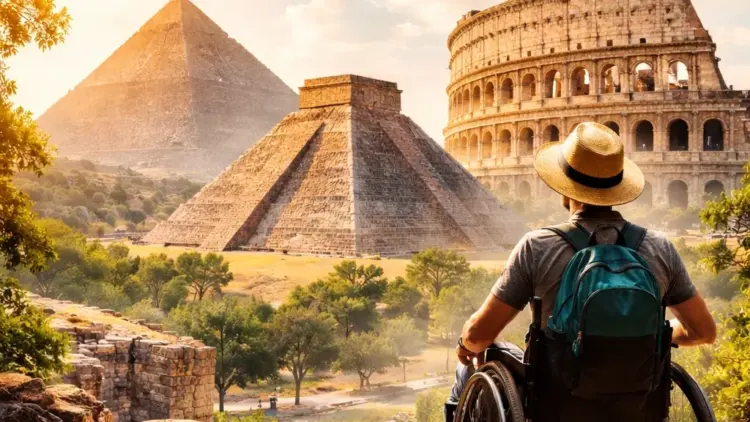
The core philosophy behind global heritage conservation is straightforward: the history of human civilization belongs to everyone. Across the world, ancient monuments stand as physical testaments to human ingenuity, artistic expression, and architectural achievement. However, because these iconic ruins were constructed centuries or even millennia before modern concepts of universal design and physical accessibility emerged, travelers with mobility limitations have historically faced immense barriers when seeking to experience them firsthand.
In recent years, a growing movement among international heritage organizations, cultural ministries, and travel advocates has sought to bridge this gap. By carefully integrating modern accessibility infrastructure—such as inclined lifts, retrofitted elevators, stabilized pathways, and designated viewing corridors—into delicate historic landscapes, site managers are proving that physical preservation and universal access can coexist. While no ancient site can be rendered completely barrier-free without compromising its structural integrity, a rising number of world-famous ruins now offer realistic, meaningful access for wheelchair users.
Navigating these historic locations requires careful preparation, as accessibility conditions remain dynamic. Factors such as changing weather, ongoing archaeological excavations, emergency preservation works, and local management policies can alter access routes on short notice. Accessibility organizations emphasize that travelers should verify site conditions shortly before embarking on a visit. Despite these logistical considerations, the opportunity for wheelchair users to personally encounter these remarkable historic places represents a major milestone in inclusive travel.
The Great Pyramid of Giza (Egypt)
Dating back to approximately 2600 BCE, the Great Pyramid of Giza holds a unique place in human history as the only surviving entry among the original Seven Wonders of the Ancient World. Constructed during the Old Kingdom period of ancient Egypt, the massive stone structure has drawn travelers, scholars, and explorers across thousands of years.
When considering accessibility at Giza, physical expectations must be managed regarding the internal chambers of the pyramid. The narrow, steep, and stepped interior shafts were engineered purely for ancient funerary practices rather than human traffic, making internal exploration inaccessible to wheelchair users. However, the experience of the Great Pyramid extends far beyond its interior passages.
The broad exterior plateau surrounding the Giza pyramids features open terrain and paved access routes in key viewing areas, allowing wheelchair users to approach the base of the massive limestone structures. Navigating the perimeter offers an unobstructed, up-close perspective on the scale and precision of the ancient masonry. For mobility-impaired visitors, standing in the shadow of the Great Pyramid provides a powerful, full-body connection to ancient engineering and a tangible reminder of humanity’s historic capabilities.
The Colosseum (Rome, Italy)
Constructed in the 1st century CE under the Flavian dynasty, the Colosseum in Rome stands as one of the most recognizable architectural monuments of the classical Roman Empire. Originally designed to hold tens of thousands of spectators for gladiatorial contests and public spectacles, the amphitheater was built with complex staircases and tiered seating that presented significant vertical challenges for modern visitors.
In recent decades, Italian heritage authorities have established the Colosseum as a prime global example of how modern accessibility infrastructure can be successfully integrated into ancient monuments while fully respecting historical preservation. Through sensitive architectural retrofits, modern elevators and smoothly graded ramps have been installed within the historic stone frame.
These modifications allow wheelchair users to navigate multiple levels of the structure, including designated viewing balconies that overlook the central arena floor and the exposed hypogeum below. Pathways throughout the major circulation corridors have been leveled and stabilized to accommodate mobility devices. By balancing preservation with inclusion, the Colosseum demonstrates that even multi-tiered classical structures can be thoughtfully adapted to ensure equal enjoyment for international travelers.
The Acropolis & Parthenon (Athens, Greece)
Perched high above the city of Athens, the Acropolis and its central temple, the Parthenon, represent the pinnacle of 5th-century BCE Classical Greek architecture and democracy. For centuries, reaching the rocky citadel meant navigating steep, slippery limestone slopes and rugged stone steps, posing an insurmountable obstacle for travelers using wheelchairs or mobility aids.
To address this historic inequality, Greek authorities undertook major infrastructure enhancements to open the UNESCO World Heritage site to all visitors. A key element of this effort was the installation of a state-of-the-art slant lift, or incline elevator, along the northern cliff face of the Acropolis, alongside the creation of specially designed paved stone pathways along the summit plateau.
When the state elevator is operational, wheelchair users can bypass the treacherous historical ascent and emerge directly onto the upper plateau. Once atop the citadel, wide, smooth pathways allow visitors to roll directly up to the Parthenon, the Erechtheion, and surrounding classical monuments. Reaching this elevated sanctuary as a wheelchair user serves as a powerful affirmation that world-renowned cultural heritage should be accessible to all individuals regardless of physical mobility.
Chichén Itzá (Mexico)
Located in the dense jungle landscape of Mexico’s Yucatán Peninsula, Chichén Itzá was a pre-Columbian city built by the Maya civilization between approximately 600 and 1200 CE. Celebrated for its astronomical alignment and monumental architecture, the site is dominated by the grand step-pyramid known as El Castillo, or the Temple of Kukulcán.
Unlike many mountain-top or heavily terraced ancient ruins, Chichén Itzá is situated on relatively flat, expansive terrain. This geographical characteristic makes it one of the most accessible ancient ceremonial centers in the Americas for wheelchair travelers. The main central plazas and grand thoroughfares surrounding the principal monuments consist largely of packed earth, hard dirt, and smooth pathways that present fewer physical barriers than steeper sites.
While certain outer trails and outlying ruins feature uneven roots or soft gravel, wheelchair users can comfortably explore the central archaeological zone. Rolling across the expansive central plaza and taking in the sheer scale of El Castillo proves that experiencing ancient world wonders does not always require overcoming dramatic vertical obstacles, offering a smoother and highly rewarding heritage experience.
Ephesus (Turkey)
Flourishing during both the Classical Greek and Roman periods, the ancient city of Ephesus in modern-day Turkey was once a thriving Mediterranean metropolis and commercial hub. Today, it remains one of the most complete and extensive classical urban ruins in the Mediterranean basin, featuring grand civic buildings, public baths, and historic thoroughfares.
What makes Ephesus particularly compelling for wheelchair users is the layout of its historical urban grid. The ancient city is traversed by grand paved avenues, including the famed Curetes Street and Marble Road, which were originally built to accommodate foot traffic, chariots, and civic processions. While centuries of wear and geological shifts have left some paving stones uneven, large sections of these wide marble streets remain continuous and negotiable for mobility devices.
Navigating through Ephesus allows wheelchair travelers to experience the site much like its ancient inhabitants did—rolling directly down ancient streetscapes past the intricate facade of the Library of Celsus, the Grand Theatre, and classical temples. This rare degree of physical continuity creates an immersive feeling of traveling back in time through an intact ancient city.
Petra – Treasury Viewpoint (Jordan)
Carved directly into vibrant red sandstone cliff faces by the Nabataean kingdom around 300 BCE, the ancient desert city of Petra in Jordan is one of the world’s most spectacular archaeological sites. The entry to Petra requires traveling through the Siq, a narrow, winding natural gorge over a kilometer long flanked by soaring rock walls.
For wheelchair travelers, navigating Petra presents unique terrain challenges, as the inner desert valley consists of loose sand, uneven cobblestones, and steep trails leading to higher tombs. However, reaching the iconic viewpoint of Al-Khazneh, or The Treasury—the dramatic facade that greets visitors as they emerge from the Siq—is achievable with proper planning and accessible transport arrangements available at the site.
The path through the main Siq has been stabilized in key stretches, allowing wheelchair users to make the journey from the visitor entrance to the open plaza directly in front of The Treasury. Experiencing this breathless moment, where the towering carved facade suddenly appears between the narrow canyon walls, stands as a legitimate and profound way to witness Petra’s historic grandeur without needing to trek into the more rugged backcountry trails.
Machu Picchu (Peru) – Limited Access
High in the Andes Mountains of Peru, the 15th-century Incan citadel of Machu Picchu represents one of the world’s most desired travel destinations. However, its dramatic geographical setting—perched on a narrow ridge surrounded by steep cliffs, multi-tiered agricultural terraces, and hundreds of narrow stone stairways—creates profound physical challenges for accessibility.
Machu Picchu is not broadly accessible for independent wheelchair users. The site’s fragile historic stone steps, narrow pathways, and extreme topography prevent standard mobility devices from traversing the citadel grounds. It is included in accessibility discussions specifically to establish honest expectations for travelers, ensuring that prospective visitors can plan based on accurate realities rather than misleading claims.
For wheelchair users determined to experience Machu Picchu, specialized tour operators utilizing adaptive mountain wheelchairs and dedicated support teams can facilitate access to specific upper terraces and scenic viewpoints overlooking the ruins. Understanding the limitations of the site allows travelers to focus on realistic, well-planned itineraries that prioritize safety, dignity, and authentic sight-seeing without encountering unexpected barriers.
Ensuring a Successful Visit
As heritage management continuously evolves, the intersection of modern accessibility and historical preservation remains an active work in progress. Site managers and international bodies continue to evaluate new technologies—such as lightweight ramp systems, adaptive transit, and tactile digital models—to further expand access without compromising archaeological sites.
For travelers planning visits to these historic monuments, ongoing research and pre-trip verification remain essential. Confirming current operational status for lifts, ramps, and specialized access services ensures a smooth and memorable journey into human history. As of August 23, 2026, these ancient destinations stand as enduring proof that world history can be brought within reach for travelers of all physical abilities.