
For millions of family caregivers navigating the demanding realities of daily eldercare, well-meaning advice to "take care of yourself" often feels entirely out of touch. Whether it comes from concerned friends, physicians, or wellness articles, the standard prescription for preventing burnout usually involves getting a massage, planning a weekend trip, or enjoying a leisurely lunch with friends. However, for individuals knee-deep in managing complex medication schedules, coordinating doctor appointments, addressing safety concerns, and keeping up with endless household chores, such suggestions can feel impossible to execute.
When caregivers are constantly pressed for time, being told to practice traditional self-care frequently transforms into just another burdensome task on an already overflowing to-do list. The inability to make those time-consuming activities happen often triggers a heavy cycle of guilt and frustration. The reality of family caregiving is that individuals rarely possess large blocks of uninterrupted free time. Yet, healthcare advocates emphasize that running on empty until complete burnout occurs is not a sustainable path.
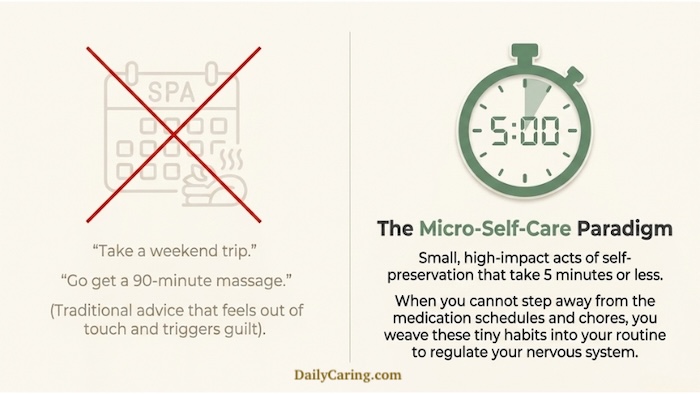
The emerging solution gaining traction among health experts and veteran caregivers is known as micro-self-care. This approach focuses on small, high-impact acts of self-preservation that take five minutes or less. By weaving these tiny habits into an already crowded daily routine, caregivers can effectively lower stress levels, regulate their nervous systems, and protect their overall well-being without requiring schedule overhauls or external childcare relief.
Shifting Away From Unrealistic Expectations
The fundamental disconnect in traditional self-care messaging lies in the assumption that caregivers have leisure time at their disposal. In practice, the Sandwich Generation—adults caught between caring for aging parents and raising their own children—alongside solo family caregivers, face relentless scheduling pressures. When an individual spends twelve hours a day monitoring a loved one with dementia, managing mobility issues, and handling household maintenance, carving out a two-hour window for relaxation is rarely an option.

Experts point out that viewing self-care as a major luxury rather than a daily necessity sets caregivers up for failure. When self-care requires extensive planning, it becomes a source of anxiety rather than relief. Instead, shifting the focus toward micro-habits allows caregivers to accumulate small moments of mental and physical reset throughout the day. These brief interventions are designed to interrupt the body’s acute stress response before it compounds into chronic exhaustion.
Practical Micro-Habits for Daily Stress Relief
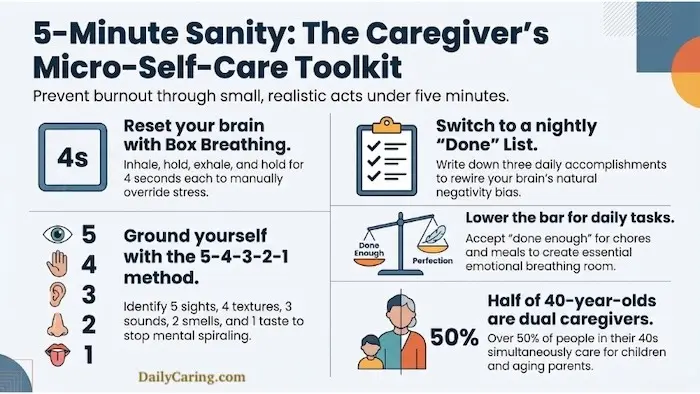
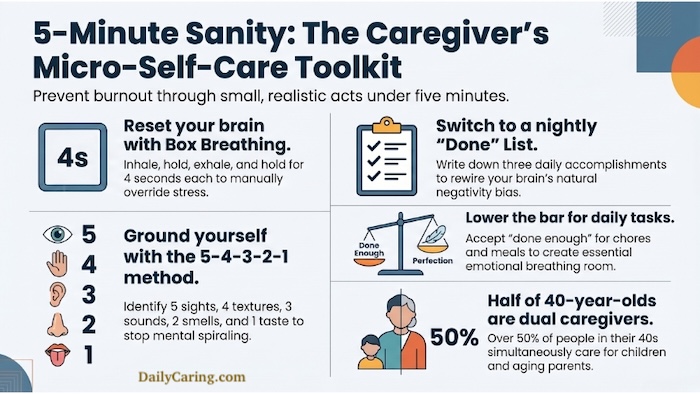
Among the foundational micro-habits recommended for managing acute caregiver stress is the two-minute box breathing reset. When a crisis arises or general overwhelm sets in, the human body instinctively enters a fight-or-flight state. Heart rates rise, breathing becomes shallow, and muscles tense up. By consciously engaging in a regulated breathing cycle—inhaling slowly, holding the breath, exhaling completely, and holding again for equal intervals—an individual can manually override this physiological stress response. Repeating this simple cycle just three or four times signals to the brain that the immediate environment is safe, lowering cortisol levels and restoring a sense of calm control.

Another critical juncture in the day is the very first five minutes after waking. Many caregivers wake up immediately in reaction mode, rushing to check on their care recipient, reviewing a packed schedule, or picking up a smartphone to address overnight concerns. Claiming those initial five minutes entirely for oneself—perhaps sitting quietly with a glass of water, tea, or coffee before tackling any chores—creates a vital emotional cushion. This boundary allows the caregiver to step into the day on their own terms rather than immediately surrendering to external demands.
Mental spirals and chronic worry about the future also take a heavy toll on caregivers. To counter this, experts suggest utilizing sensory grounding techniques, such as the 5-4-3-2-1 method. When caregiving duties feel overwhelming, taking three minutes to actively identify sights, textures, sounds, smells, and tastes in the immediate environment pulls the mind firmly back into the present moment, interrupting the cycle of anxiety.
Reframing Productivity and Connection
The nature of caregiving means that the work is never truly finished. No matter how many tasks are checked off, a new list awaits the following morning. This endless cycle frequently leads to chronic stress because the brain focuses heavily on what remains undone. Shifting from a traditional "to-do list" to a "done list" at the end of the day helps counteract this psychological trap. By writing down three small accomplishments—such as preparing a comforting meal or successfully managing a difficult medication shift—caregivers can actively train their brains to recognize the value of their daily efforts.
Social isolation remains one of the primary drivers of caregiver burnout. When friends and external networks fade away, the responsibilities of caregiving feel substantially heavier. However, finding the energy for a prolonged phone call or a social outing is often impossible. A pragmatic alternative is sending a brief, no-pressure micro-connection text to a friend or loved one during the afternoon or evening. A simple message letting someone know you are thinking of them while busy with caregiving duties, paired with an explicit note that no reply is necessary, maintains vital social bonds without draining remaining energy reserves.
Finally, physical tension accumulated from lifting, assisting, or general emotional stress is often stored directly in the neck, shoulders, and lower back. Dedicating just sixty seconds to physical release—slowly rolling the shoulders, gently stretching the neck, and consciously releasing muscle tension—sends direct feedback to the nervous system that it is safe to relax, helping to prevent long-term physical strain.
Healthcare professionals emphasize that embracing these micro-habits reframes self-care from an elusive luxury into an attainable daily necessity. By recognizing that small actions can yield significant mental health benefits, family caregivers can better protect their own well-being while continuing to provide compassionate care for their loved ones.



