For generations, caregivers and fitness experts have championed standard leg exercises like squats and lunges as the ultimate defense against the physical decline of aging. Yet, when an older adult struggles with a routine walk to the grocery store, well-meaning family members often chalk up the exhaustion to general aging or weak knees. According to recent clinical findings, the actual culprit behind declining senior mobility is hiding right at their feet.
The intricate link between ankle mobility and the aging process has long been an overlooked factor in eldercare. New research highlights that the aging human body undergoes a profound mechanical rewiring at the ankles. Rather than a simple loss of muscle mass, the aging nervous system consciously and silently sacrifices mechanical efficiency in a desperate bid to prevent falls. This biological trade-off ultimately restricts a senior’s range of motion, drains their energy reserves, and gradually strips away their independence.
The Science of Wasted Effort: Ankle Mechanics in Older Adults
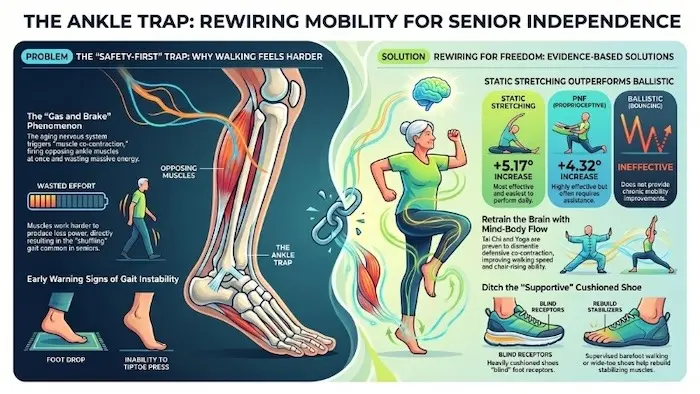
According to a study published in the Journal Gait & Posture, the aging nervous system frequently adopts a rigid, safety-first strategy to cope with perceived instability. This defense mechanism triggers a physiological phenomenon known as muscle co-contraction. Instead of allowing opposing muscles around the ankle to fire in a smooth, alternating sequence, the nervous system activates them simultaneously. In practical terms, it is the biological equivalent of pressing the gas pedal and the brake at the exact same time.
This simultaneous activation stiffens the joint to improve immediate balance when the foot strikes the ground, but the unintended consequence is massive wasted effort. The muscles of the lower leg must work significantly harder, yet they manage to generate only a fraction of the necessary push-off power. Consequently, strides grow shorter, and overall walking speed declines sharply.
This mechanical inefficiency explains why many older adults experience disproportionate fatigue during routine walks or face an escalating risk of falls as they age. They are essentially burning vital energy fighting their own muscle contractions with every single step.
Expert Insights on Ankle Mobility and Aging
Addressing these underlying mechanical changes requires a shift in how physical activity is approached in later life. Medical professionals emphasize that conventional gym exercises frequently fail to engage these subtle balance systems. Hiking, for example, is frequently cited as an exceptional form of mobility training because uneven terrain forces ankles, hips, feet, and the body’s internal balance system to adapt constantly, optimizing real-world movement capacity.
Similar benefits can be achieved through footwear choices. Specialists note that minimalist or barefoot shoes offer distinct advantages by giving feet adequate room to spread naturally, thereby recruiting the small, stabilizing muscles in the feet that are often neglected in traditional footwear.
Identifying the Warning Signs of Gait Instability
Waiting for a catastrophic accident before evaluating a senior’s fall risk is a dangerous gamble. Fortunately, the nervous system provides clear physical indicators that defensive ankle co-contraction is taking over long before a severe fall occurs.

Caregivers are advised to watch their loved ones closely during everyday movements. Warning signs include shuffling feet across the floor rather than lifting them cleanly, or exhibiting foot drop, where the individual frequently catches their toes on rugs, carpets, or low door thresholds. Another reliable indicator is an older adult’s inability to press smoothly up onto their tiptoes to reach an item on a high shelf, which reveals a distinct loss of crucial push-off power. Recognizing these early signs of gait instability offers a critical window for intervention before an emergency room visit becomes inevitable.
Fall Prevention for Seniors Requires Rewiring the Nervous System
Standard strength training routines often miss this critical piece of the puzzle. Effective fall prevention strategies and long-term support for senior independence require training the nervous system to abandon its defensive co-contraction habits. Clinical biomechanics data suggests that restoring ankle efficiency is less about building raw muscle mass and more about retraining the brain to release joint stiffness and trust the natural range of motion.
Various targeted exercises can help dismantle this defensive habit. Single-leg balance holds challenge proprioception and timing, while eccentric calf raises—where an individual raises up normally on both toes and lowers their heels as slowly as possible—build tendon strength and push-off power. Simple movements like tracing the alphabet in the air with the big toe while seated can effectively break joint stiffness. Furthermore, practices like Tai Chi promote coordination and efficiency through fluid, continuous movements that clinical observations have shown to reduce ankle co-contraction.
These movements help retrain the brain to release joint stiffness. Rather than focusing solely on brute strength, eccentric calf raises and targeted balance drills rebuild the push-off power lost to aging, while dynamic practices force opposing muscles to fire sequentially rather than simultaneously.

Ditch the Clunky Sneakers: The Case for Barefoot Walking
Many aging adults may be inadvertently compounding their mobility loss by wearing heavily cushioned, highly supportive orthopedic shoes. Modern thick-soled footwear often functions similarly to a cast, completely blinding the foot’s sensory receptors and eroding proprioception—the body’s innate ability to sense its position in space.
To execute proper dorsiflexion and rebuild genuine mobility, the foot needs tactile feedback from the ground. Whenever safety and practical circumstances permit, supervised barefoot walking inside the home can encourage this sensory connection, provided caregivers closely monitor stability to prevent accidents. When footwear is necessary, wide-toe, zero-drop barefoot shoes offer an alternative that allows the foot to spread and naturally recruit the smaller stabilizing muscles that traditional orthopedic footwear tends to shut down.
Prioritizing Ankle Mobility and Aging Workouts Today
The aging process frequently forces an involuntary compromise between movement speed and physical stability. If caregivers ignore targeted balance training and ankle mechanics, an older adult’s nervous system may continue to lock down their joints, progressively stripping away their mobility and freedom.
Moving beyond generic leg exercises and actively helping aging loved ones retrain their ankle mechanics is a vital step in preserving long-term independence. While rebuilding mobility takes consistent time, effort, and vigilance, ensuring a reliable safety net remains an immediate priority for families navigating the challenges of eldercare.