

Experts point out that the bathroom presents a unique environment defined by hard surfaces, water, and soap, a combination that naturally obliterates traction. When these physical elements interact with the normal realities of aging, such as progressive muscle weakness, stiff joints, and decreased visual acuity, the risk of a severe fall increases exponentially.
To combat these risks, healthcare professionals and home safety advocates outline essential modifications that target the most hazardous zones within the home. Central to these recommendations is the installation and placement of grab bars. Rather than treating grab bars as simple DIY accessories, safety experts urge families to view them as clinical tools mapped directly to an individual’s specific functional reach. A clinical expert, such as an occupational therapist, evaluates how specific mobility limitations dictate bar placement to effectively arrest a fall. Professional installation is mandatory because suction-cup bars will inevitably fail under the sudden kinetic energy of a falling adult, transforming a temporary safety device into a secondary hazard. When shopping for grab bars, specialists recommend looking for sizes around 1.25 to 1.5 inches to best accommodate aging hands, alongside ADA-compliant knurled finishes that provide a secure grip rather than a smooth chrome surface.
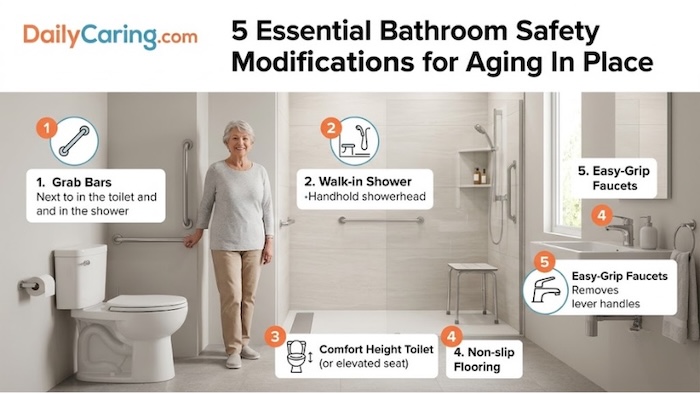
Beyond grab bars, the physical layout of bathroom fixtures requires careful evaluation, starting with toilet height. Standard 15-inch toilets present a significant hazard for an aging body, demanding excessive joint flexion and powerful quadriceps strength just to transition to a standing position. While the Americans with Disabilities Act recommends a height of 17 to 19 inches for wheelchair accessibility, residential safety often calls for a custom fit based on the individual’s anthropometric measurements. By calculating the exact height needed to reduce joint stress, caregivers can determine the specific raise required for safe, independent transitions.
Lighting is another critical factor that frequently contributes to household accidents. Aging eyes naturally suffer from decreased pupil size and lens clouding, which drives up the demand for ambient illumination. However, simply installing excessively bright bulbs often creates harsh glares that obscure depth perception, proving to be even more dangerous than a dimly lit room. The objective for caregivers is uniform illumination paired with high contrast. Utilizing bulbs with a Color Rendering Index of 80 or higher and a color temperature between 2700 K and 3000 K helps establish stark visual boundaries, ensuring that the edge of a bathtub remains clearly distinguishable from the surrounding floor.
Flooring materials also play an underestimated role in household safety. Standard ceramic tile is undeniably water-resistant, but it offers zero shock absorption. If a fall does occur, a tile floor provides no energy dissipation, frequently resulting in shattered hips and severe trauma. Industry analysts compare various materials, noting that rubber flooring and textured cork offer exceptional traction and impact absorption to protect aging joints and bones, whereas traditional ceramic tile carries a high fracture risk.

Additionally, household thresholds often go overlooked as major tripping hazards. A standard door saddle creates a sudden height variation right where a carpet meets a tile floor. For seniors experiencing a shuffle gait, this transition almost guarantees a trip-and-fall incident, making it vital to replace standard thresholds with graded door saddles that establish a smooth, zero-edge transition.
Executing these structural changes successfully requires specialized knowledge, which is why experts strongly advise against relying on standard handymen or general contractors. Instead, families are encouraged to work with a Certified Aging-in-Place Specialist. Administered by the National Association of Home Builders, the CAPS designation signifies that a professional has undergone rigorous training focused on the unique biomechanical needs of older adults, mobility-barrier solutions, and structural load-bearing requirements for safety installations. Vetted professionals can be located through official industry directories.
Financial considerations often surface when families contemplate home modifications. While professional installation of grab bars, upgraded lighting, comfort-height toilets, and threshold removals typically demands an upfront investment ranging from two thousand to five thousand dollars, industry advocates frame this expenditure differently. When contrasted against the baseline cost of a single reactive fall resulting in emergency hospitalization, surgical hip replacement, and subsequent rehabilitation—which frequently exceeds fifty thousand dollars—proactive modifications serve as an essential insurance policy. Failing to secure the environment leaves the home hostile to an aging body, ultimately threatening an older adult’s ability to safely age in place and often precipitating an unwanted transition to a skilled nursing facility.



