Introduction
The landscape of federally-funded healthcare is set to undergo a profound transformation following the passage of the 2025 federal budget reconciliation law. Under the new legislation, strict eligibility restrictions are being introduced for numerous categories of lawfully present immigrants who rely on vital public health programs. These federally-backed initiatives include Medicaid, the Children’s Health Insurance Program (CHIP), subsidized coverage through the Affordable Care Act (ACA) Marketplace, and Medicare.
While undocumented immigrants have long been ineligible for federally funded health coverage under longstanding federal policy, the 2025 reconciliation law extends these exclusions to specific groups of lawfully present individuals. Notably, the eligibility restrictions for Medicaid and CHIP are scheduled to take effect on October 1, 2026. These sweeping policy shifts will eliminate coverage eligibility for multiple groups of lawfully present noncitizens, including refugees and asylees who have not yet secured a green card.
Projections from the Congressional Budget Office indicate that the newly mandated eligibility restrictions within Medicaid and CHIP will reduce federal spending by $6.2 billion over the coming decade. However, this fiscal contraction is expected to come at a severe human cost, with independent analyses estimating that an additional 100,000 individuals will lose their health insurance and join the ranks of the uninsured by 2034. When factoring in parallel restrictions across other federal health programs like the ACA Marketplace and Medicare, broader research anticipates that roughly 1.4 million lawfully present immigrants could ultimately lose coverage.
In response to the legislation, the Centers for Medicare & Medicaid Services has released comprehensive guidance and an implementation toolkit designed to assist state agencies in navigating the transition. Beyond the individuals who will directly lose coverage due to the rewritten eligibility parameters, experts warn of substantial collateral coverage losses. Many beneficiaries who remain legally eligible for assistance could still find themselves disenrolled due to administrative barriers, particularly if they encounter difficulties understanding or responding in a timely manner to official notices requesting verification documents and information. Simultaneously, state health departments will face unprecedented administrative burdens as they work to overhaul their enrollment systems and operational workflows.
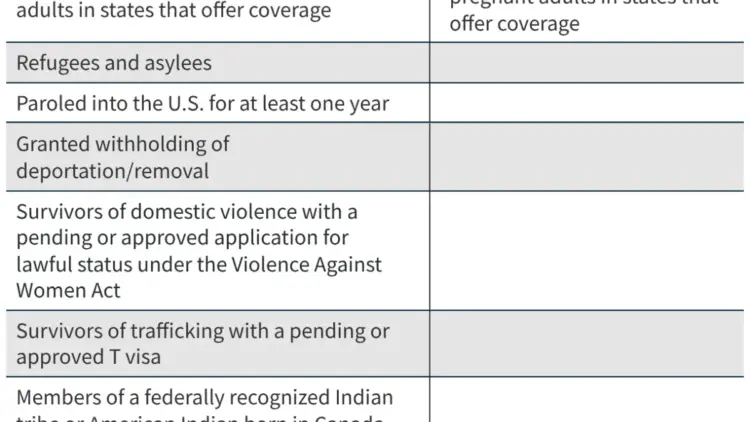
Beginning October 1, 2026, the 2025 reconciliation law explicitly restricts Medicaid and CHIP eligibility to lawful permanent residents—commonly known as green card holders—Cuban and Haitian entrants, individuals residing in the United States under the Compacts of Free Association, and lawfully residing children and pregnant immigrants located in states that choose to exercise specific coverage options. This policy effectively strips eligibility away from numerous other populations of lawfully present immigrants, such as refugees and asylees without green cards.
These changes operate alongside the framework established by the landmark 1996 Personal Responsibility and Work Opportunity Reconciliation Act, which limited Medicaid and CHIP eligibility to certain classes of immigrants deemed to possess a qualified status. That foundational 1996 legislation also imposed a mandatory five-year waiting period on many qualified groups before they could enroll in benefits, even if they met all other financial and categorical requirements. The 2025 reconciliation law leaves the underlying architecture of the 1996 law intact, meaning lawful permanent residents generally remain subject to the five-year waiting period alongside standard statutory exceptions, while Cuban and Haitian entrants and COFA migrants remain exempt.
States retain the discretion to provide coverage to lawfully residing children and pregnant individuals without enforcing the five-year wait by utilizing the Immigrant Children’s Health Improvement Act option, often referred to as the CHIPRA 214 option. Furthermore, state agencies retain the authority to offer targeted prenatal care and pregnancy-related benefits to low-income children from conception to the end of pregnancy, regardless of the immigration status of the parents. Federal expenditures tied to Emergency Medicaid and CHIP Health Services Initiatives are explicitly exempted from the new immigrant eligibility restrictions. Emergency Medicaid functions as a vital reimbursement mechanism for hospitals mandated by federal law to provide emergency medical stabilization to individuals who meet standard income criteria but lack an eligible immigration status. Meanwhile, CHIP Health Services Initiatives permit states to dedicate a limited portion of their CHIP allocations toward public health initiatives designed to improve health outcomes for low-income children.
Implementation of Immigrant Eligibility Changes
State health agencies face a rigorous operational timeline to ensure compliance with the federal mandates. Jurisdictions are required to redetermine the eligibility status of all potentially affected existing Medicaid enrollees under the updated rules by October 1, 2026, and must conduct all fresh eligibility determinations in accordance with the new statutes starting on that same date. CMS characterizes potentially affected beneficiaries as individuals currently receiving full Medicaid or CHIP benefits who fail to satisfy the newly minted immigration criteria. Because individual states maintain varying levels of detail within their historic enrollee databases, the capacity to identify impacted populations will differ significantly, prompting some states to conduct broader reverification sweeps across all noncitizen enrollees.
For individuals flagged as potentially affected, state agencies are instructed to first attempt to reverify satisfactory immigration status through existing electronic data matches and internal records before initiating direct contact with the enrollee. State eligibility systems will query the Department of Homeland Security’s Systematic Alien Verification for Entitlements program alongside Social Security Administration databases. If a satisfactory status is successfully verified—including validation under the specialized options for lawfully residing children or pregnant individuals—the enrollee retains full coverage and receives a notification from the state. However, federal officials acknowledge that SAVE provides a static, point-in-time verification and fails to automatically update past responses when an individual’s immigration category evolves. Consequently, many beneficiaries may have successfully adjusted their status to that of a lawful permanent resident or secured another qualifying classification that is not immediately reflected in the automated database.
When state agencies fail to verify satisfactory status through pre-existing electronic data matches, they are mandated to issue a formal request for additional information to the enrollee, granting a reasonable timeframe to respond. If a beneficiary responds by declaring U.S. citizenship or a satisfactory immigration status, but the state remains unable to validate this claim via SAVE, the agency must institute a 90-day reasonable opportunity period. During this window, full coverage must be maintained, which may extend the individual’s benefits past the October 1 deadline. Enrollees who successfully submit documentation that is subsequently verified through SAVE will retain their coverage. Conversely, if an individual provides documentation indicating an ineligible status or fails to respond within the designated window, the state must evaluate whether the person qualifies under alternative pathways, such as state-elected options for children and pregnant individuals or Emergency Medicaid. Prior to terminating coverage or reducing benefits, states are legally obligated to issue formal advance notice, which must include instructions regarding the right to a Medicaid fair hearing or a CHIP review. For Medicaid beneficiaries, states must provide at least ten days of advance notice, while CHIP enrollees must receive timely, adequate written notice detailing the proposed termination and review opportunities.
To operationalize the statutory shifts, states must fundamentally update their eligibility systems, financial claiming protocols, and enrollment data reporting mechanisms. CMS guidelines stipulate that states must ensure precise financial claiming for individuals who qualify exclusively for Emergency Medicaid. Furthermore, systems must possess the capability to isolate and track all costs, including administrative expenditures, associated with state-funded health programs for immigrants to prevent the improper draw-down of federal matching funds. State agencies failing to execute these technological updates risk losing federal financial participation for their broader Medicaid claims. Additional adjustments will be required across a wide array of administrative materials, including application and renewal paperwork, beneficiary notices, community outreach collateral, and scripts utilized by call center personnel and caseworkers. Presumptive eligibility applications must also be revised, and frontline workers retrained to ensure that expedited enrollment pathways for pregnant individuals and children align perfectly with the updated eligibility parameters.
Issues to Consider
The structural narrowing of federal health programs will leave individuals who lose their Medicaid eligibility with severely restricted coverage options. While disenrolled individuals may still fall back on Emergency Medicaid, that safety net is strictly limited to acute medical emergencies. Lawfully residing immigrant children and pregnant individuals will maintain coverage only if they reside in states that have chosen to adopt specific optional coverage pathways, resulting in a fragmented landscape where benefits vary wildly by geography. Subsidized coverage through the ACA Marketplace will likewise be restricted exclusively to lawful permanent residents, Cuban and Haitian entrants, and COFA migrants beginning January 1, 2027. While other lawfully present immigrants may legally purchase Marketplace plans at full cost, the unsubsidized premiums will remain financially prohibitive for the vast majority.
As comprehensive coverage disappears for thousands, affected residents will increasingly turn to community health centers for care delivered on a sliding fee scale, though these facilities may offer a more limited scope of specialty services. While a handful of states historically stepped in to bridge coverage gaps with fully state-funded programs, several jurisdictions have recently moved to scale back or cap enrollment in these initiatives due to mounting fiscal pressures and higher-than-anticipated public demand.
Even among immigrants who technically maintain their legal eligibility for Medicaid, procedural disenrollments and widespread coverage disruptions are anticipated. These disruptions are expected to stem from a mixture of administrative confusion, language barriers, and acute fear. Widespread apprehension regarding enrollment in public programs has been exacerbated by broader federal immigration policy shifts, including evolving interpretations of the public charge rule, new data-sharing agreements established between CMS and Immigration and Customs Enforcement, and heightened federal enforcement actions. Navigating complex verification requirements without targeted assistance frequently leads eligible families to drop out of the system prematurely.
To counteract these administrative coverage losses, experts emphasize that accessible, culturally competent outreach and consumer assistance will be paramount. Federal health officials are encouraging state agencies to deploy robust communication strategies to prepare enrollees for impending redeterminations, including labeling renewal envelopes to highlight their time-sensitive nature. Trusted community-based organizations will play an indispensable role in raising awareness, helping families decipher official correspondence, and connecting them with alternative resources for low-cost care. Linguistic access remains a critical bottleneck, as notices must be easily understood by populations with limited English proficiency.
An analysis of notices collected from 16 state health agencies illustrates substantial variation in how information is communicated to enrollees. Most reviewed notices successfully identified which groups of lawfully present immigrants remained eligible for coverage, but significantly fewer explicitly listed the categories of individuals facing disenrollment. States that are actively transitioning affected populations into state-funded coverage alternatives, such as California and Oregon, utilized notice language focused on program transitions rather than outright termination. The clarity of verification instructions also varied widely. Some states provided explicit inventories of acceptable documentation, while others issued broad requests for proof or directed recipients to external websites for guidance.
Furthermore, the accessibility of submission pathways differed across jurisdictions, with some states offering multiple digital, postal, and in-person options, while others restricted submissions to mail or in-person delivery. Readability scores for the examined notices—evaluated using the SMOG readability formula commonly applied to health literature—spanned a wide spectrum, ranging from a fourth-grade reading level to a tenth-grade level, highlighting significant disparities in how easily enrollees can comprehend their rights and obligations.
The simultaneous rollout of immigrant eligibility restrictions alongside other major policy mandates from the 2025 reconciliation law will place a punishing administrative strain on state agencies. States are tasked with implementing these complex changes while simultaneously rolling out mandatory work requirements and stepping up the frequency of eligibility redeterminations for expansion adults. Meeting these short-term operational deadlines will require significant state budget investments to hire and train caseworkers and expand outreach infrastructure. Although enhanced federal matching funds are available for technological system upgrades—offering a 90 percent federal match for design and installation and a 75 percent match for ongoing operations—states are simultaneously confronting overall reductions in federal Medicaid funding and tightening fiscal conditions driven by slowing revenue growth. Specifically concerning immigrant populations, the reconciliation law reduces the federal matching rate for Emergency Medicaid services provided to expansion adults down to the standard matching rate starting October 1, 2026.
Compounding these operational challenges, state agencies are currently navigating gaps in federal guidance regarding specific noncitizen populations. Detailed directives regarding individuals enrolled in both Medicare and Medicaid remain unreleased, creating uncertainty over how Medicaid eligibility shifts will interact with Medicare enrollment and cost-sharing assistance, particularly given that Medicare immigration rules operate on a separate timeline. Furthermore, many states face complex hurdles in verifying eligibility among noncitizens who gain automatic Medicaid enrollment through approval for Supplemental Security Income. Administered by the Social Security Administration, SSI provides monthly cash assistance to disabled individuals who cannot work, frequently serving as their sole gateway to Medicaid and long-term care services. While the 2025 reconciliation law leaves SSI immigrant eligibility rules untouched, some recipients will still lose their associated Medicaid coverage. States are currently awaiting finalized guidance detailing how the Social Security Administration will modify its State Data Exchange files to help identify impacted noncitizen SSI recipients.
Additional uncertainties persist due to pending technical instructions from federal authorities. CMS is in the process of updating its Transformed-Medicaid Statistical Information System Data Guide and plans to issue future clarifications regarding how enrollment data submissions must categorize enrollee immigration status. Furthermore, all states are required to submit updated State Plan Amendments reflecting the new immigrant eligibility restrictions by the end of December 2026, yet have only been informed that revised SPA templates are forthcoming. Similar technical assistance remains pending regarding the potential impacts on currently approved Section 1115 demonstration waivers. State agencies overseeing managed care contracts have been instructed to evaluate whether the immigration changes necessitate capitation rate adjustments or amended rate certifications based on guidance issued in late 2025, leaving complex actuarial determinations largely to local discretion. Finally, states attempting to establish parallel state-funded health coverage programs must navigate separate payment and contracting structures that remain subject to rigorous federal oversight and potential scrutiny.