
WASHINGTON — A sweeping reconciliation law enacted in 2025 is setting the stage for a major policy shift that could jeopardize health coverage for hundreds of thousands of vulnerable Americans. Beginning January 1, 2027, or sooner at the option of individual states, 44 jurisdictions will be required to condition Medicaid eligibility for adults in the Affordable Care Act (ACA) expansion group and certain waiver programs on strict work requirements. While the statutory framework provides mandatory exemptions for individuals classified as "medically frail," an interim final rule issued by the Centers for Medicare & Medicaid Services (CMS) in June 2026 establishes a restrictive approach to defining medical frailty. Policy analysts warn that this complex framework could create significant barriers, leaving many individuals with severe health care needs and disabilities at risk of losing their coverage.
The impending policy collision directly impacts adults with significant health conditions who rely on the ACA Medicaid expansion while navigating the notoriously lengthy and intricate application process for the Supplemental Security Income (SSI) program. SSI is a means-tested federal cash assistance program administered by the Social Security Administration for individuals with limited resources who are unable to work due to a disability. Approval for SSI generally confers automatic qualification for health coverage through Medicaid, exempting enrollees from work requirements. However, because the federal disability determination process can span many months or even years, applicants rely heavily on interim Medicaid coverage to stay insured while they are unable to work.
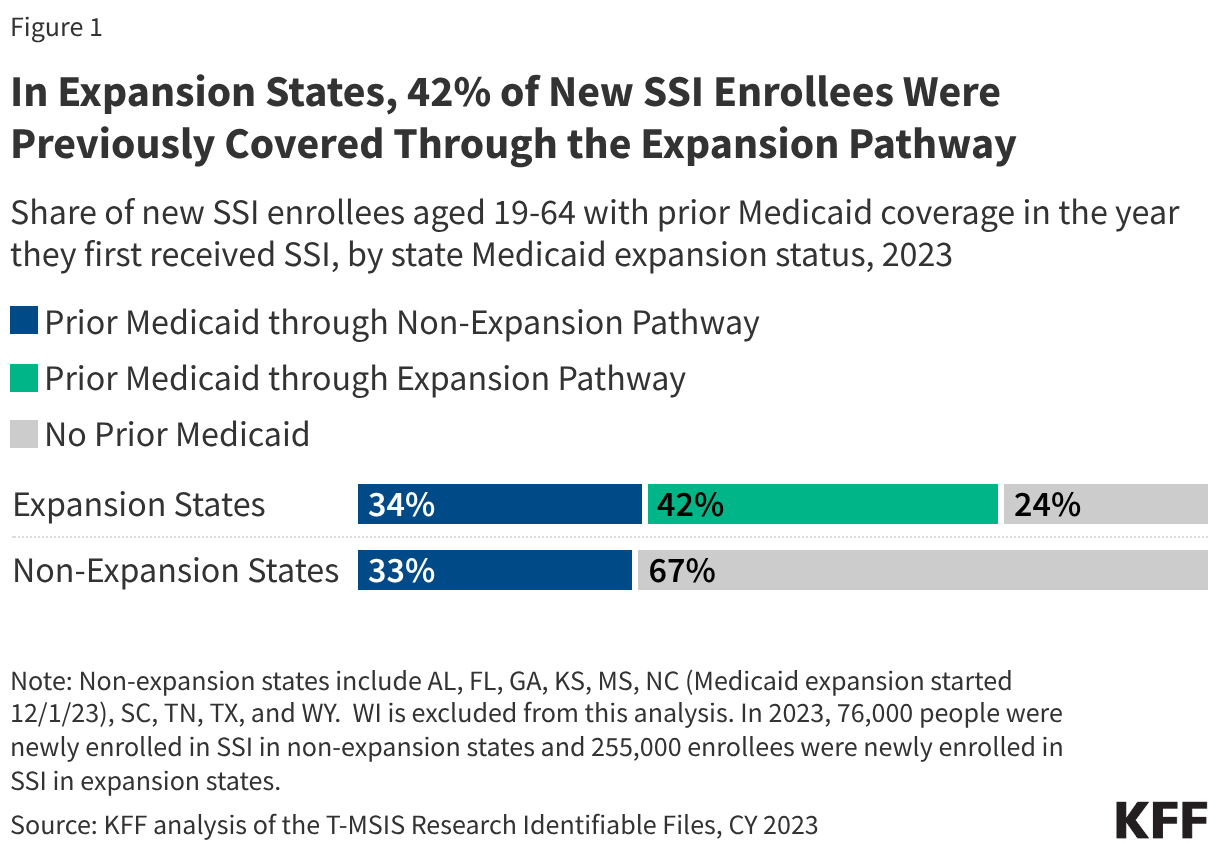
Recent policy analysis from KFF highlights the magnitude of this reliance. In 2023, approximately 223,000 SSI applicants aged 19 through 64 had Medicaid coverage while waiting for a final disability determination, including more than 106,000 individuals whose coverage came through the ACA expansion. The data reveals a stark contrast between expansion and non-expansion states. In ACA expansion states, 76 percent of new SSI enrollees had prior Medicaid coverage through a different pathway—with 42 percent specifically covered through the expansion—compared to just 33 percent in non-expansion states. In 2023 alone, over 100,000 new SSI enrollees relied on ACA Medicaid coverage before receiving their official disability entitlement. Without this safety net, these low-income individuals would likely have remained entirely uninsured.
Demonstrating eligibility for SSI is an arduous journey, particularly for applicants under the age of 65 who must prove they have a qualifying disability. The process requires navigating a complex five-step evaluation overseen by state Disability Determination Services offices, which are heavily funded by the federal government—including a $2.6 billion allocation in fiscal year 2025. The initial hurdle requires applicants to show that their current earnings fall below the threshold of substantial gainful activity, which stands at $1,690 per month in 2026. Subsequent steps assess whether an applicant has a severe impairment across specific body systems, evaluate whether the condition meets established criteria for immediate disability recognition such as those under the compassionate allowance program, and analyze residual functional capacity against national employment data.
This determination process is notoriously slow. As of May 2026, the initial processing time for disability applications averaged 184 days, leaving roughly 862,000 individuals waiting for an initial decision. Many applicants face unfavorable initial rulings and must navigate the appeals process, extending the timeline further, though legal representation has been shown to improve approval odds and shorten the overall duration.
When the new Medicaid work requirements take effect in January 2027, non-exempt enrollees will need to document at least 80 hours per month of work, community service, or half-time school attendance. Because SSI applicants are, by definition, unable to engage in substantial gainful activity, meeting these community engagement benchmarks through employment or volunteering is virtually impossible. Consequently, these individuals will have to secure an exemption from the work mandates, with the medical frailty exclusion serving as their primary avenue to retain coverage.
However, the interim final rule released in June 2026 imposes a strict two-part test for medical frailty, requiring individuals to demonstrate both a qualifying physical or mental health condition and an impairment severe enough to impede their ability to meet community engagement standards. This creates a challenging administrative hurdle, forcing SSI applicants to undergo concurrent, separate assessments of their ability to work under entirely different criteria for Medicaid and SSI on vastly different timelines. While federal rules mandate that states process income-based Medicaid applications within 45 days and conduct expansion renewals every six months starting in 2027, SSA disability determinations take significantly longer. This mismatch guarantees that many applicants will face Medicaid work requirement reviews long before their disability status is officially resolved.
To mitigate potential coverage losses, CMS has released updated guidance outlining a tiered medical frailty framework that states may voluntarily adopt. Under this approach, states can utilize existing administrative data, such as medical claims, to automatically identify medically frail enrollees through a multi-tiered system, reserving manual documentation processes and provider determinations for cases where data is insufficient. While self-attestation will remain an option in 2027, it will be restricted to once per continuous enrollment period starting in 2028, requiring states to actively collect verification documents at renewal. Health policy experts caution that even with robust data-sharing mechanisms, the administrative complexity and strict documentation demands could still result in eligible individuals with disabilities losing vital Medicaid coverage while awaiting their final SSI determinations.



