
Originally published on July 29, 2026, this report has been updated to reflect newer guidance from the Centers for Medicare & Medicaid Services (CMS) regarding the medical frailty exclusion.
A sweeping shift in federal healthcare policy is drawing intense scrutiny from policy analysts and healthcare advocates, who warn that upcoming changes could place vulnerable Americans at risk of losing their health insurance. Under the 2025 federal budget reconciliation law, 44 states are required to condition Medicaid eligibility for adults in the Affordable Care Act expansion group on meeting strict work requirements. Set to take effect on January 1, 2027—or sooner at individual state discretion—these mandates apply to millions of adults, including individuals who suffer from severe health conditions and are currently navigating the lengthy and complex process of applying for federal disability benefits.
While the legislation includes mandatory exemptions, most notably for individuals classified as "medically frail," the practical implementation of this exclusion poses a significant hurdle. Recent regulatory guidance issued in a June 2026 interim final rule outlines a restrictive definition and verification framework for medical frailty. Because the expansion group provides critical healthcare coverage to many adults with significant medical needs and disabilities, the new policy could create dangerous coverage gaps for individuals who are entirely unable to work while they wait for their federal disability determinations to be finalized.
The Vital Safety Net of Medicaid During Disability Applications
The Supplemental Security Income program, administered by the Social Security Administration, is a means-tested federal initiative that provides monthly cash assistance to individuals with limited income and resources who cannot work due to a disabling condition. Approval for SSI generally qualifies an individual for health coverage through Medicaid, exempting them from future work requirements. However, securing an SSI determination is rarely a swift procedure. The application process routinely spans many months, and in some cases years, leaving applicants completely uninsured if they lack alternative coverage pathways.
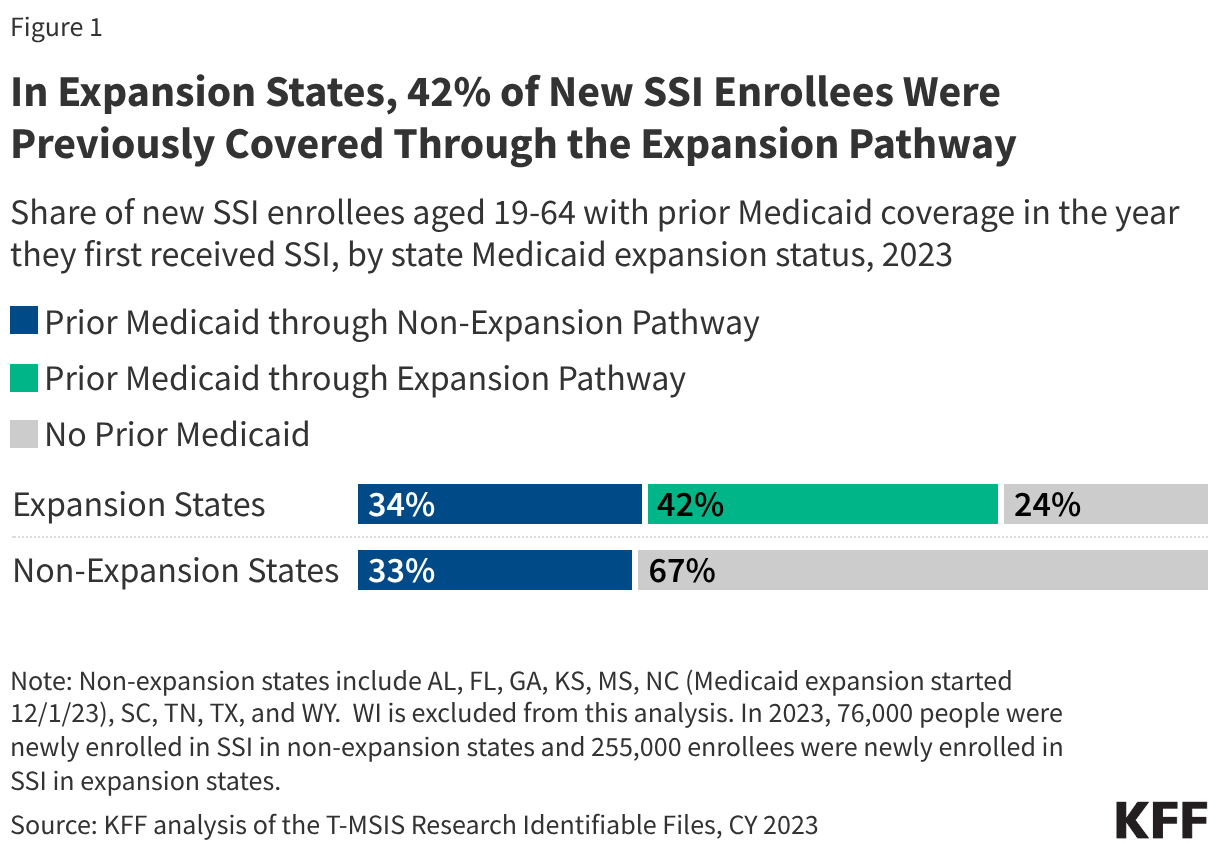
During this protracted waiting period, Medicaid serves as an indispensable bridge. Recent KFF policy data reveals that the proportion of new SSI enrollees between the ages of 19 and 64 who rely on Medicaid prior to their official SSI entitlement is twice as high in ACA expansion states compared to non-expansion states. In 2023 alone, more than 100,000 new SSI enrollees possessed ACA Medicaid coverage before their disability status was formally approved.
Nationwide, approximately one in five Medicaid enrollees live with a disability, a figure that climbs to 43 percent among adults aged 50 to 64. Yet, only about one-third of these individuals receive SSI income and qualify for Medicaid on that basis alone. The remainder rely on alternative pathways, including the ACA Medicaid expansion. In 2023, a total of 223,000 SSI applicants aged 19 through 64 maintained Medicaid coverage while waiting for a determination, including over 106,000 individuals whose coverage came through the ACA expansion.
In expansion states, 76 percent of new working-age SSI enrollees were covered by Medicaid through a different eligibility pathway before their disability determination was finalized, with 42 percent specifically utilizing the expansion pathway. By contrast, only 33 percent of new SSI enrollees in non-expansion states had prior Medicaid coverage during their application window. New SSI applicants who lacked prior Medicaid coverage were frequently left entirely uninsured due to their low incomes and complete inability to work.
Demonstrating Eligibility Through a Complex Federal Process
Proving eligibility for SSI is an intricate hurdle for applicants under the age of 65, requiring them to meet strict financial thresholds alongside a rigorous demonstration of disability. As of 2026, applicants must possess monthly income no higher than $2,073 and resources restricted to $2,000 for individuals or $3,000 for married couples. Furthermore, they must establish that their medical impairment prevents gainful employment for at least a year or is expected to result in death.
The Social Security Administration relies on a complex five-step evaluation process for adult disability claims, funded through billions of dollars allocated to state Disability Determination Services offices. The initial step requires proof that an applicant’s current earnings fall below the substantial gainful activity threshold, set at $1,690 per month in 2026. Subsequent steps assess whether the applicant suffers from a severe physical or mental impairment categorized across fourteen distinct medical systems, ranging from musculoskeletal and cardiovascular disorders to neurological and mental health conditions.
While certain severe conditions allow applicants to qualify automatically under accelerated programs like the compassionate allowance framework—which has approved over one million claims for fast-tracked individuals since 2008—the vast majority of applicants must undergo exhaustive functional capacity assessments. These final stages evaluate an individual’s ability to engage in past relevant work or any other job existing in the national economy, factoring in age, education, and work history.
This occupational assessment relies heavily on historical data, including the Department of Labor’s Dictionary of Occupational Titles, which has not been comprehensively updated since 1991. Although the Social Security Administration has partnered with the Department of Labor in recent years to develop a modern occupational survey at a cost of hundreds of millions of dollars, a fully updated system has yet to be implemented. Consequently, the disability determination pipeline remains notoriously backlogged. Federal performance data from mid-2026 indicates that the average processing time for an initial disability application stands at 184 days—surpassing six months—while roughly 862,000 individuals remain caught in the backlog awaiting initial decisions. Many face unfavorable initial rulings and must navigate lengthy appeals, though securing legal representation often improves approval odds and accelerates final resolutions.
The Looming Collision Between Work Requirements and Disability Waivers
Beginning January 2027, non-exempt adults enrolled in the ACA expansion group will be mandated to participate in work or qualifying community engagement activities for at least 80 hours per month, or maintain at least half-time student status. Because SSI applicants must demonstrate earnings below the substantial gainful activity level, they are fundamentally unable to log 80 monthly work hours or reliably fulfill community service mandates. To maintain their healthcare coverage while awaiting an SSA decision, these individuals will have to successfully claim a medical frailty exclusion.
However, the interim final rule issued by federal regulators introduces a restrictive two-part test for medical frailty, requiring individuals to demonstrate that a specific physical or mental health condition actively impairs their ability to meet community engagement standards. This creates administrative friction, as Medicaid eligibility determinations operate on much faster timelines than federal disability reviews. States must process income-based Medicaid applications within 45 days and, starting in 2027, conduct enrollment renewals every six months rather than annually.
As a result, many SSI applicants will face concurrent, separate assessments of their work capacity conducted under entirely different criteria: one managed by state Medicaid agencies for work requirement exemptions, and another managed by federal disability examiners for SSI benefits. This administrative duplication risks imposing heavy burdens on individuals already coping with severe health crises, potentially resulting in wrongful coverage terminations.
Recent guidance from the Centers for Medicare & Medicaid Services attempts to soften these administrative blows by directing states to verify medical frailty through ex parte reviews whenever possible, utilizing existing administrative data without requiring additional paperwork from the applicant. Federal officials have outlined an optional tiered framework that allows states to identify medically frail enrollees using historical claims data, encounter records, or individualized manual reviews where data is insufficient.
While self-attestation will remain an available verification avenue in 2027, subsequent rules will restrict self-attestation to once per continuous enrollment period, forcing states to collect formal medical documentation at renewal time. Policy experts caution that even with the implementation of data-driven verification tiers, strict documentation hurdles could cause thousands of disabled individuals to experience disruptions in their healthcare coverage while they continue waiting for their federal disability determinations to be resolved.



