
VOLUME 55
September 24, 2026
Highlights
The shifting dynamics of public health in the digital age continue to pose complex challenges for healthcare providers, policymakers, and patients alike. According to the newly released 2026 KFF Women’s Health Survey, traditional healthcare providers remain by far the most trusted source of reliable health information for reproductive-age women. However, the survey also reveals that a vast majority of these women rely on online channels and social media for health guidance, exposing many to widespread false or misleading information. These digital falsehoods are not without consequence, as significant shares of women report altering their contraceptive behaviors—ranging from switching methods to discontinuing use altogether—based on what they encounter online.
At the same time, the rapid integration of artificial intelligence tools into government and healthcare infrastructure is forcing institutions to confront new governance hurdles. While emerging AI technologies promise greater efficiency in public health administration, a recent analysis shows that most state-level AI policies completely overlook health-specific applications, and those that do exist are largely shielded from public view. Amid this regulatory vacuum, a pioneering policy from a local health department in Ohio provides a rare window into how agencies can proactively address AI accuracy, transparency, and public trust.
Featured
KFF Women’s Health Survey Explores Trusted Sources of Information and Exposure to Contraceptive Misinformation
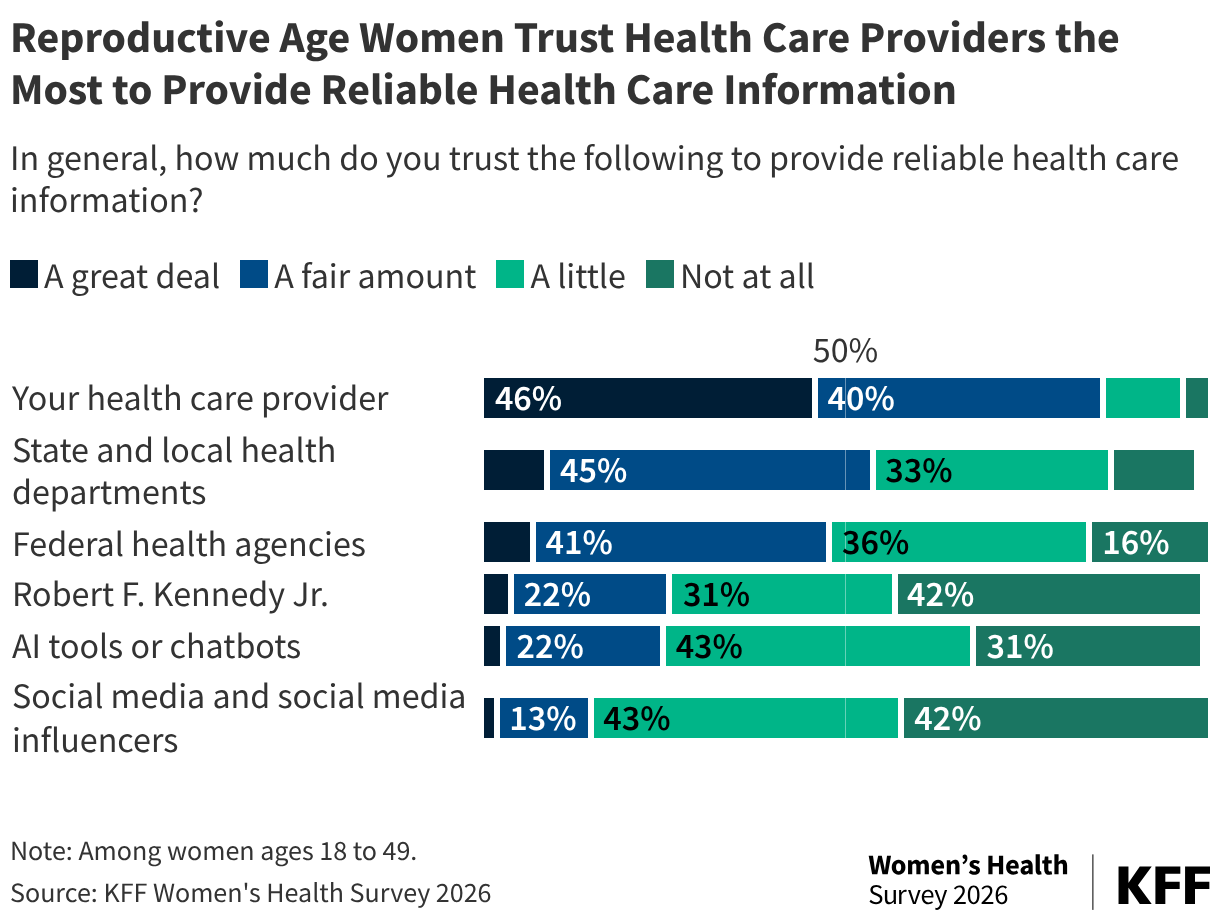
Healthcare providers continue to stand as the bedrock of reliable medical information for reproductive-age women between the ages of 18 and 49. Data from the 2026 KFF Women’s Health Survey indicates that more than eight in ten respondents—approximately 86%—trust doctors, nurses, and other clinical professionals either "a great deal" or "a fair amount" when seeking dependable health guidance. By contrast, far fewer women place their confidence in emerging digital platforms, with only a quarter of respondents expressing similar levels of trust in AI tools and chatbots, and a mere 15% placing trust in social media networks and digital influencers. These stark disparities closely mirror broader public opinion trends captured in previous KFF polling, which consistently highlights high public confidence in traditional medical professionals alongside widespread skepticism toward artificial intelligence in healthcare contexts.
Despite this well-documented skepticism, the reliance on digital ecosystems for health-related queries remains nearly universal. A striking 87% of reproductive-age women report actively searching for health information or advice online, utilizing standard search engines, social media platforms, or AI applications. Furthermore, a substantial number of women encounter content regarding contraception on social media even when they are not actively looking for it. Roughly 35% of respondents noted that they had seen or heard messaging about contraception on social media over the past year, with that figure climbing to 42% among younger women aged 18 to 25.
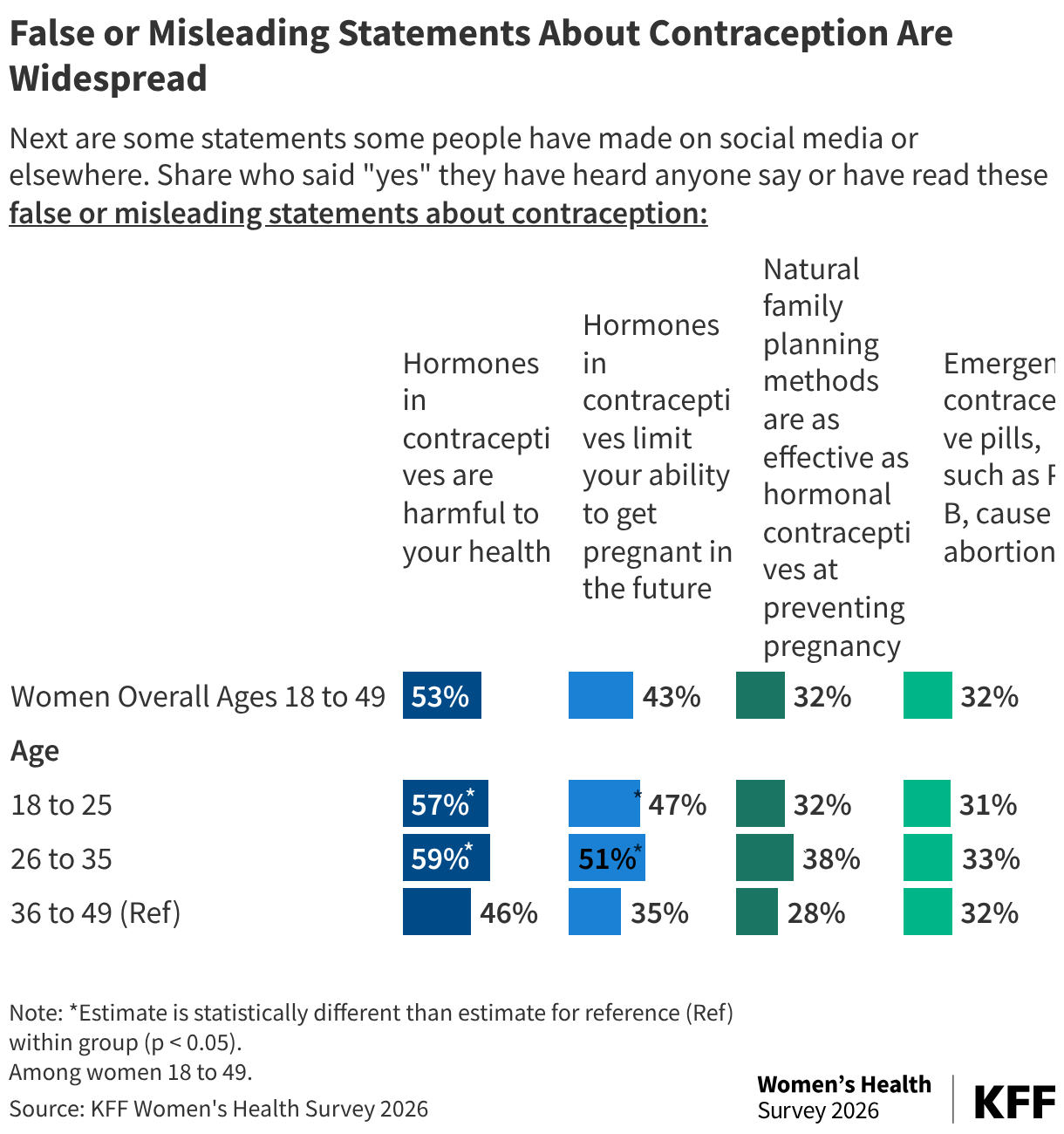
Alongside this casual and intentional exposure, reproductive-age women frequently encounter false or misleading narratives surrounding contraception across social media and other digital channels. Approximately 53% of women in this demographic report hearing the thoroughly debunked claim that hormonal contraceptives are inherently harmful to overall health, while 43% have stumbled upon the incorrect assertion that birth control limits a person’s future fertility. Both of these persistent myths directly contradict current medical evidence and clinical consensus. Additionally, about a third of respondents have encountered false claims suggesting that natural family planning methods are just as effective at preventing pregnancy as hormonal contraception, or that emergency contraceptive pills like Plan B cause abortions—neither of which is factually accurate.
The real-world implications of these digital falsehoods are tangible. Among the women who reported viewing contraception-related content on social media, more than a third took the initiative to search for further information online. Meanwhile, nearly one in five discussed what they had seen with a healthcare provider. Most concerningly, about one in ten women either initiated a new birth control method, switched methods, or completely stopped using hormonal contraception as a direct result of the content they encountered online. These behavioral shifts are even more pronounced among younger women aged 18 to 25, who demonstrate higher rates of searching for additional details, consulting clinicians, and altering their contraceptive routines after digital exposure.
AI & Emerging Technology
Most State AI Policies Overlook Health-Specific Guidance, but One New Example Focuses on Accuracy and Trust
The rapid proliferation of generative artificial intelligence tools has sparked intense debate regarding data accuracy, institutional accountability, and public trust, prompting various levels of government to establish formal AI governance frameworks. A comprehensive analysis of publicly available state-level AI policies, published last month by the Association of State and Territorial Health Officials (ASTHO), reveals that the vast majority of these guidelines focus broadly on government-wide administrative concerns. Issues such as data privacy, cybersecurity protocols, procurement standards, and vendor requirements dominate these official texts. While certain general provisions—such as mandatory human oversight and clear disclosure rules for AI utilization—can theoretically apply to state and local health agencies, the ASTHO analysis highlights a significant structural gap. Very few policies directly address health-specific applications, such as leveraging AI for epidemiological disease surveillance or outbreak detection, and the few specialized health policies that do exist are largely kept private rather than open to public scrutiny.
A notable exception to this trend emerges from the public health department of Ashland County, Ohio, which unanimously approved and published a comprehensive AI governance policy. This newly enacted framework offers a rare, transparent look at how a local health agency is actively regulating the use of generative AI. The document explicitly identifies the preservation of public trust and the mitigation of AI "hallucinations" as core priorities for responsible technological integration, asserting that artificial intelligence must be deployed in ways that actively foster transparency, accountability, and community confidence.
Under the Ashland County guidelines, agency staff are strictly required to verify all factual claims, statistical data, and academic citations generated by AI before incorporating them into official work. Furthermore, the policy mandates human review for any non-minor utilization of AI systems to guarantee absolute accuracy. To enforce compliance, the department established an internal incident tracking framework specifically designed to log and correct instances where AI-generated errors or false information might inadvertently infiltrate published materials.
Beyond these universal verification standards, the Ashland County policy delineates clear, approved use cases for AI within specialized public health domains. These include the analysis of de-identified epidemiological data, the drafting of health promotion content by nursing staff, and the creation of standard inspection communication templates within environmental health divisions. Crucially, the policy explicitly forbids any AI system from independently making clinical, regulatory, or public health decisions on behalf of the agency. By making this governance framework entirely public, Ashland County provides researchers, policymakers, and peer organizations with a valuable blueprint for safeguarding accuracy and maintaining public confidence in the digital age.
Some Medical Journals Are Responding to a Rise in AI-Generated Citations
As generative artificial intelligence tools become deeply integrated into academic workflows, researchers have documented a troubling surge in fabricated references across the medical literature. Numerous investigations have uncovered published papers featuring citations to non-existent studies or referencing legitimate studies that fail to support the specific claims attributed to them. A prominent correspondence piece published earlier this year identified thousands of fake citations scattered across millions of academic papers, noting a sharp acceleration in these anomalies following the widespread adoption of generative AI. Many of these fabricated references are remarkably sophisticated, pairing real authors and plausible-sounding titles with research papers that were never actually written or published.
In response to this growing threat to scientific integrity, several medical journals have begun implementing stricter disclosure requirements regarding AI utilization. However, a broad empirical analysis examining over 5,114 journals and more than 5.2 million papers revealed that undisclosed AI usage in manuscript preparation persists despite these regulatory hurdles.
The prominent journal JAMA updated its author guidelines in response to its own editorial experiences receiving manuscripts populated with inaccurate or entirely nonexistent references, alongside research demonstrating that formal author disclosures of AI assistance remain low. Rather than simply relying on a disclosure-based model, JAMA adopted a more restrictive strategy. The journal now explicitly advises authors against using artificial intelligence to generate, format, or manage bibliographical citations, directing researchers back toward standard, verified reference-management software instead. This policy shift underscores the reality that disclosure requirements alone are often insufficient to catch sophisticated, AI-generated sourcing errors, pushing major publications to restrict certain technological capabilities altogether.
What We’re Watching
As Trust in Federal Health Information Declines, Poll Suggests That Transparency and Data Can Make Information Seem Trustworthy
Public trust in information originating from federal institutions has experienced a measurable downward trend since 2024, according to a comprehensive survey conducted by the AP-NORC Center for Public Affairs Research in collaboration with USAFacts. The proportion of American adults expressing "a great deal" or "quite a bit" of trust in federal healthcare information dropped by ten percentage points over a two-year span, falling from 26% down to 16%. Similar erosion of confidence was observed across other federal reporting areas, including environmental data, labor and employment statistics, and electoral information. These findings closely parallel independent tracking polls conducted by KFF regarding public trust in health information and federal health agencies.
Despite this broader skepticism, the NORC survey sheds light on the specific structural factors that lead individuals to view information as credible and factual. When survey participants were asked to evaluate various characteristics that influence their perception of truthfulness, the transparency of methodology ranked highest. Approximately 71% of respondents stated that clearly explaining how information was gathered is either "extremely" or "very" important in establishing credibility. Additionally, the inclusion of multiple perspectives was deemed important by 63% of adults, while 56% emphasized the necessity of excluding overt personal opinions.
When queried about the likelihood of considering specific types of information factual based on their underlying characteristics, data-driven reporting emerged as the most persuasive element. Six in ten adults reported that information grounded directly in verifiable data is extremely or very likely to be perceived as factual. The identity of the verifying authority also played a significant role, though public confidence varied widely depending on the institution. Roughly half of all respondents indicated they would consider information factual if it had been independently verified by professional scientists. Lower shares expressed similar confidence in academic institutions, while only a small minority placed their trust in verifications performed by the federal government or AI chatbots.
These insights suggest that as public trust in institutional messaging continues to fluctuate, health communicators and public agencies may need to pivot their strategies. By prioritizing radical transparency regarding data collection methodologies and emphasizing rigorous scientific verification, organizations can actively work to rebuild credibility in an increasingly skeptical information ecosystem.
Support for the Health Information and Trust initiative is provided by the Robert Wood Johnson Foundation (RWJF). The views expressed do not necessarily reflect the views of RWJF, and KFF maintains full editorial control over all of its policy analysis, polling, and journalism activities. The data shared in this reporting is sourced through media monitoring research conducted by KFF.



