
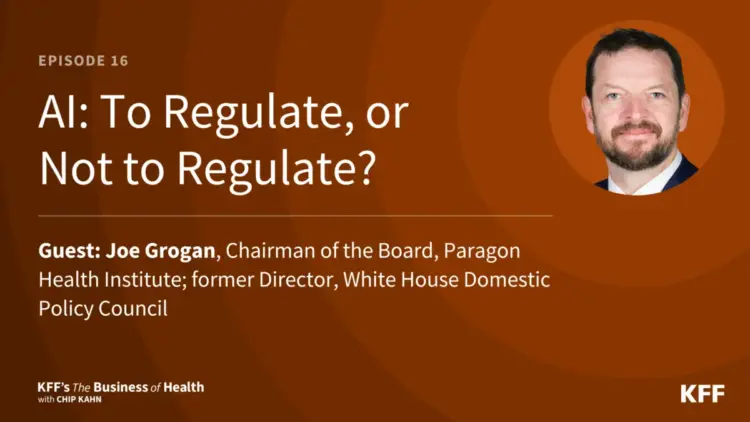
As the technology sector continues to grapple with the rapid acceleration of artificial intelligence, a prominent debate has emerged around how—and by whom—the powerful tools should be monitored. Across the broader tech landscape, numerous industry leaders and developers have openly called for enhanced oversight, debating whether guardrails should be self-imposed by companies or mandated through federal legislation. While that ongoing policy debate continues to capture headlines, the ultimate destination of these regulatory frameworks remains entirely uncertain.
However, according to veteran health policy expert Joe Grogan, the tech and health care sectors may be focusing on the wrong danger entirely. Speaking on a recent episode of The Business of Health with Chip Kahn, Grogan argued that the single greatest threat facing the integration of artificial intelligence into medicine is not a lack of oversight, but rather the implementation of the wrong kind of regulation.
Grogan brings a unique and multifaceted perspective to the discussion, having shaped health care policy from some of the most influential vantage points in Washington and the private sector. His extensive resume includes serving as the Director of the White House Domestic Policy Council, overseeing the federal health care budget at the Office of Management and Budget (OMB), and working on the industry side to help bring a life-saving Hepatitis C cure directly to patients.
Navigating the Regulatory Landscape and Federal Policy
During their comprehensive discussion, host Chip Kahn and guest Joe Grogan delved deeply into the proper role of the federal government in regulating generative artificial intelligence. The conversation comes at a time when health care systems, insurers, and technology developers are attempting to navigate a growing, fragmented patchwork of state-level AI laws. This decentralized regulatory environment creates significant compliance challenges for organizations operating across state lines, potentially stifling innovation and delaying the deployment of beneficial medical technologies.
Grogan pointed out that regulatory missteps could severely impede the medical sector’s ability to harness the full potential of artificial intelligence. Drawing a comparison to international approaches, he highlighted how Europe’s notably cautious and stringent regulatory framework has already created hurdles that slow down technological growth and clinical adoption. For the United States to maintain its leadership in medical innovation, Grogan emphasized that federal and state policymakers must strike a delicate balance between patient protection and the freedom to innovate.
Furthermore, the discussion turned toward the structural financial mechanisms that underpin the American health care system, specifically the reimbursement models managed by the Centers for Medicare and Medicaid Services (CMS). Grogan argued that current CMS reimbursement structures are outdated and fundamentally misaligned with the realities of modern medical technology. For artificial intelligence tools to be successfully integrated into everyday clinical workflows—ranging from diagnostic imaging analysis to administrative efficiency—reimbursement pathways must evolve to incentivize adoption and reward technological value.
The Dual Anxieties: Fear-Driven Policy and Patient Data Security
As the conversation drew to a close, Grogan articulated his two most profound anxieties regarding the current trajectory of artificial intelligence in the medical field. His first major concern centers on the rise of fear-driven policymaking. When lawmakers react to the unknown capabilities of advanced technologies with panic, they risk enacting sweeping bans or overly restrictive mandates that choke off innovation outright, denying patients access to cutting-edge treatments and diagnostic capabilities.
His second major worry addresses the critical vulnerability of patient privacy. As artificial intelligence models grow exponentially more sophisticated, their insatiable appetite for vast quantities of training and operational data increases. Grogan warned that this immense data hunger poses a direct and severe risk to patients’ most sensitive medical information. Safeguarding these private health records against breaches, unauthorized access, and commercial exploitation must remain a paramount priority as health care providers increasingly adopt machine learning and generative AI solutions.

About the Host and the Podcast Series
The Business of Health with Chip Kahn is a weekly podcast that examines the intricate intersections of health care business, public policy, and patient care. Hosted by Charles N. Kahn III, the program features in-depth conversations with industry leaders, policymakers, and innovators who are shaping the future of medicine.
Charles N. Kahn III serves as a senior visiting fellow at KFF, bringing decades of health policy expertise to the platform. In addition to his role at KFF, Kahn is a visiting senior fellow at the American Enterprise Institute, a nonresident senior scholar at the University of Southern California’s Schaeffer Center for Health Policy and Economics, and co-chair of the international Future of Health collaborative.
This particular episode is part of the podcast’s specialized ongoing series focused on artificial intelligence in health care. The series is designed to illuminate the profound ways AI is transforming the medical landscape, featuring firsthand insights from the pioneers deploying these technologies, the administrators managing their real-world consequences, and the experts crafting the policy frameworks that govern them.



