
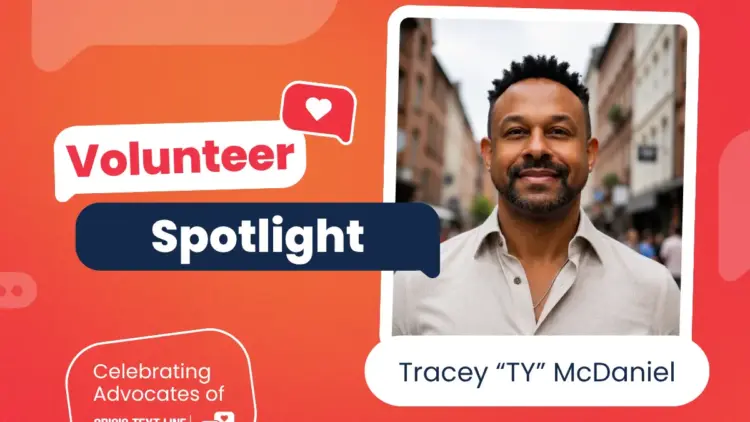
Behind every text conversation that crosses a digital crisis platform, a volunteer Crisis Counselor is waiting on the other side of the screen to listen. This month, the Crisis Text Line is shining its spotlight on Tracey "TY" McDaniel, a dedicated volunteer whose journey began with a solemn promise to a grieving friend and has since blossomed into a deeply personal mission. McDaniel’s story underscores a fundamental message he champions across his professional and personal life: asking for help is a profound act of courage, not a sign of weakness.
The path that brought McDaniel to the Crisis Text Line started from an unimaginable place of loss. When a dear friend tragically lost her son to suicide, McDaniel made a pact to support her in any way possible. That initial commitment provided the momentum he needed to take action, ultimately directing him to the Crisis Text Line.
However, McDaniel’s connection to the cause extends far beyond that single promise. Having been personally impacted by suicide on more than one occasion, the heavy realities of mental health struggles remained with him long after those losses. Those lingering experiences cemented his resolve to find a meaningful way to contribute and make a tangible difference. For McDaniel, supporting individuals navigating their darkest moments is deeply personal. He firmly believes that if being present for someone during a crisis can even marginally alter their trajectory, the time and emotional energy invested are entirely worthwhile.
When discussing the reality of what a volunteer Crisis Counselor actually does, McDaniel is quick to demystify the role for those who might feel intimidated by the prospect. He emphasizes that volunteers are never expected to act as clinical professionals or possess ready-made solutions to complex human problems. People rarely reach out expecting a counselor to magically fix their circumstances. Instead, they are usually searching for a compassionate shoulder to lean on, an unbiased listener who will offer nonjudgmental support, perspective, and gentle guidance. In many instances, the role of a counselor is simply to serve as a beacon of light at the end of a dark tunnel, gently reassuring individuals that they are not navigating their struggles alone.
This volunteer work has left a profound mark on McDaniel’s daily life and his career as a professional people leader. The experience continuously reinforces his belief that every individual deserves grace, understanding, and compassion. In his professional life, mental health and emotional awareness remain top-of-mind. He routinely checks in with his direct reports on a weekly basis, creating a dedicated space for them to discuss how things are unfolding not just professionally, but personally. McDaniel notes that taking the time to genuinely ask someone how they are doing—and actively listening to the response—can fundamentally alter their day.
Among his many interactions on the platform, one specific conversation continues to resonate deeply. It occurred at the beginning of a school year, when a young person reached out for help while experiencing severe bullying. Having navigated the pain of bullying during his own school years, McDaniel immediately recognized the all-consuming weight of that isolation. Taking a deliberate deep breath, he focused entirely on providing a safe, supportive environment where the student felt truly heard and validated.
After spending time listening and de-escalating the immediate distress, McDaniel encouraged the student to speak with a teacher or a school administrator, gently reminding them that they bore no blame, embarrassment, or shame for what they were enduring. That particular exchange has stayed with him because he understood from personal experience how critical it is for a young person to have an unconditional advocate in their corner during a moment of crisis.
Reflecting on the broader landscape of modern society, McDaniel is candid about the mounting pressures that ordinary people face. He points out that contemporary life can be extraordinarily difficult, with homes, schools, and workplaces often functioning as relentless streams of daily stressors. True opportunities to disconnect, decompress, and recharge have grown increasingly scarce, while the constant demands on personal time, energy, and attention continue to escalate. Furthermore, he notes the profound psychological footprint that social media leaves on how people perceive the world and evaluate their own self-worth. When these compounding pressures accumulate, individuals can easily slip into feelings of overwhelming isolation, hopelessness, or despair.
This reality reinforces why having an accessible, nonjudgmental sounding board can create such a vital shift. By offering a safe space for people who are struggling or simply searching for a spark of guidance, a listening ear can help someone endure a fleeting moment of intense distress and recognize that a viable path forward still exists.
For individuals who feel called to volunteer with the Crisis Text Line but hesitate due to self-doubt regarding their qualifications, McDaniel offers a reassuring perspective. He stresses that if someone possesses genuine compassion in their heart and a sincere desire to help others, the necessary technical skills can be successfully taught. Volunteers are not expected to arrive with absolute certainty about what to say or how to manage every conceivable scenario. The training framework equips individuals with the practical tools required to navigate complex situations, provided they maintain an ongoing willingness to listen, learn, and show up for people in need.
Ultimately, McDaniel returns to a core philosophy that guides his entire outlook on community care: mental health is unequivocally equal in importance to physical health. He advocates passionately for the cultural normalization of asking for help, arguing that society must embrace phrases like "I’m not okay" without stigma. Seeking support, he maintains, is an absolute testament to human strength rather than vulnerability.
In a world where many people grapple silently with heavy burdens, McDaniel’s journey serves as a powerful reminder that no one should ever feel compelled to navigate life’s most punishing moments entirely alone.



