
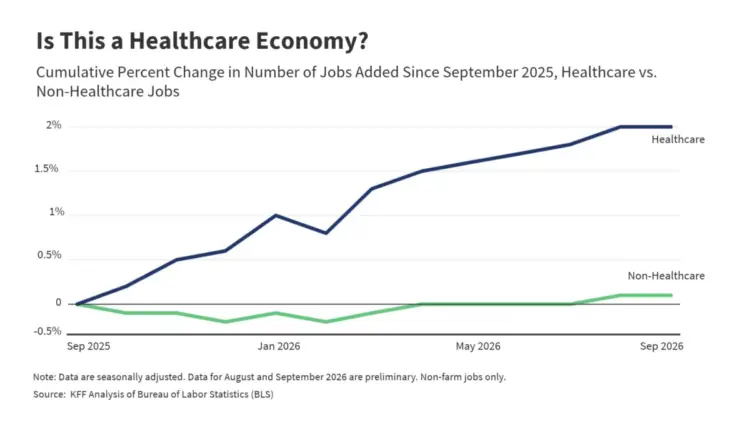
The United States healthcare sector continues to drive employment gains nationwide, significantly outpacing the rest of the job market as broader economic sectors plateau. According to a recent analysis published by the Peterson-Kff Health System Tracker, employment within the healthcare industry has surged past the growth rates of nearly all other non-farm industries, highlighting a striking divergence between medical services and the broader economic landscape.
The comprehensive analysis examines recent trends in healthcare employment, comparing its trajectory directly with the rest of the American economy. Over the observed period since September 2025, the healthcare sector has added an impressive 372,000 jobs, representing a growth rate of approximately 2 percent. In stark contrast, the overall non-farm economy, when excluding healthcare entirely, grew by a modest 124,000 jobs, amounting to an increase of just 0.1 percent over the same timeframe. This massive disparity underscores the unique economic engine that healthcare has become, sustaining momentum while other traditional industries experience stagnation or cooling down.
Drilling down into the specific segments of the industry, the job gains are widespread rather than concentrated in a single medical setting. Employment has increased substantially across physician offices, hospitals, specialized outpatient care centers, and home health environments, alongside various other clinical and administrative settings. This broad-based expansion demonstrates that the demand for medical professionals and support staff is rising across the entire continuum of care, from primary physician practices and community clinics to complex inpatient hospital systems and long-term in-home care services.
Analysts tracking these market dynamics attribute the ongoing boom in healthcare employment to a combination of enduring demographic shifts and structural economic factors. Foremost among these drivers are the aging of the American population and rising rates of chronic illness across various age groups. As the massive baby boom generation advances into older age, the demand for routine medical evaluations, specialized treatments, and continuous management of chronic conditions naturally escalates. This demographic reality creates a persistent, baseline demand for healthcare services that is largely insulated from normal business cycle fluctuations.
Beyond demographic pressures, the analysis highlights the intrinsic resilience of the healthcare sector as a fundamental driver of its sustained job growth. Unlike retail, manufacturing, or corporate sectors that often experience sharp contractions during economic downturns, healthcare services remain an essential necessity regardless of broader macroeconomic conditions. People continue to require medical attention, surgeries, diagnostic testing, and therapeutic interventions whether the broader economy is expanding or contracting.
Furthermore, the sector benefits from relatively higher wages compared to several other service-oriented industries, which helps attract and retain workers even in a competitive labor market. The nature of healthcare work also provides a degree of insulation from common labor market disruptions, such as outsourcing and automation. While technological advancements continuously alter how healthcare is delivered, the hands-on, interpersonal nature of clinical care, nursing, and physician services remains fundamentally tied to human labor, protecting these professions from being easily offshored or replaced by artificial intelligence and automated machinery.
The detailed findings and ongoing tracking of these workforce trends are publicly available through the Peterson-Kff Health System Tracker, an online information hub dedicated to monitoring, analyzing, and assessing the overall performance, economics, and evolving dynamics of the U.S. health system.



