
Introduction
The intersection of shifting federal immigration policies and administrative bottlenecks has created a compounding crisis for vulnerable humanitarian migrants in the United States. Under the 2025 federal reconciliation law, access to federally funded health coverage was abruptly eliminated for refugees and asylees who do not hold a green card, along with several other categories of lawfully present immigrants. Because federal regulations generally limit eligibility for programs like Medicaid, the Children’s Health Insurance Program (CHIP), subsidized Affordable Care Act (ACA) Marketplace plans, and Medicare to lawfully present immigrants who possess Lawful Permanent Resident (LPR) status, the speed at which U.S. Citizenship and Immigration Services (USCIS) processes green card applications is now a matter of urgent health and survival.
Refugees and asylees are legally permitted to apply for LPR status—commonly known as a green card—after completing one full year of physical presence in the United States, or one year after being officially granted asylum. However, recent data analyzed by KFF reveals a stark deceleration in USCIS application completions, sharply rising backlogs, and significantly extended processing times between fiscal year (FY) 2025 and FY2026. With more than 275,000 pending green card applications awaiting a final decision as of mid-2026, thousands of individuals who have diligently applied for permanent residency are facing prolonged periods without access to essential health care, creating profound public health and humanitarian implications.
Background: The Humanitarian Framework and Recent Policy Shifts
Since the enactment of the Refugee Act of 1980, the United States has maintained a formal, structured system for admitting refugees and asylees—individuals and families who are entirely unable to return to their countries of nationality due to a well-founded fear of persecution based on race, religion, nationality, membership in a particular social group, or political opinion. The fundamental right to seek asylum is deeply rooted in international law, and the domestic system reflects a longstanding national commitment to incorporating humanitarian protection as a core pillar of immigration policy.
Refugees and asylees typically arrive in the United States fleeing dangerous, destabilizing conditions, often possessing few to many personal resources and having endured severe trauma during their time in their countries of origin or along their arduous journeys to safety. Historically, the federal government provided these populations with vital transition support upon arrival, including assistance with food, housing, and health care, alongside other time-limited services designed to facilitate successful integration into American society.
However, the broader political and administrative landscape has shifted dramatically. The administration has implemented aggressive measures to significantly curb the entry of refugees and asylees into the United States. These policy actions have included pausing refugee application processing, establishing historically low refugee admission caps, and effectively closing the southern border to the vast majority of migrants, including individuals actively seeking humanitarian asylum.
Despite these broader restrictions, federal law continues to provide a clear pathway for individuals who clear the initial hurdles. Refugees and individuals who have been officially granted asylum are legally entitled to apply for an adjustment to LPR status once they have maintained physical presence in the United States for at least one year. This process requires applicants to file Form I-485, formally known as the "Application to Register Permanent Residence or Adjust Status." It is important to note that asylum seekers whose underlying asylum claims are still pending adjudication are not classified as asylees and therefore remain entirely ineligible to apply for a green card, regardless of how long they have resided in the country while awaiting a legal decision.
The gravity of these administrative timelines has multiplied exponentially due to sweeping legislative changes enacted in 2025. The 2025 reconciliation law dismantled the longstanding eligibility of refugees and asylees for federally funded health coverage and various other public assistance programs. Under traditional federal immigration policy, most lawfully present immigrants—including the majority of standard LPRs—must complete a mandatory five-year waiting period following the acquisition of a "qualified" immigration status before they become eligible to enroll in federally funded programs such as Medicaid and CHIP.
Historically, refugees and asylees were explicitly exempted from this five-year waiting period, provided they met standard income and state-level eligibility criteria. Furthermore, they were permitted to enroll in subsidized ACA Marketplace coverage and Medicare if they otherwise met the qualifications. The 2025 reconciliation law stripped away these historic exemptions. Under the new rules, refugees and asylees who do not yet hold a green card are barred from Medicaid and CHIP—with narrow exceptions for states utilizing specific options to cover lawfully residing children and pregnant individuals—as well as subsidized Marketplace plans and Medicare.
The statutory restrictions governing Medicaid and CHIP took effect on October 1, 2026, while the restrictions impacting subsidized Marketplace coverage and Medicare fully took effect in January 2027. According to projections by the Congressional Budget Office, these eligibility restrictions targeting lawfully present immigrants will ultimately result in approximately 1.4 million individuals becoming uninsured by the year 2034.
Trends in Processing Green Card Applications for Refugees and Asylees
An examination of USCIS administrative data reveals dramatic fluctuations in the volume of I-485 applications received, processed, and left pending over recent fiscal years. Between FY2021 and FY2025, the number of I-485 applications submitted for adjustment to LPR status experienced substantial growth, surging by 274% for refugees—climbing from 22,906 to 85,743—and by 68% for asylees, rising from 44,837 to 75,292. The comparatively lower application numbers observed in FY2021 were widely attributed to pandemic-related disruptions and lingering restrictions on international travel and migrant entry.
However, this upward trajectory shifted markedly when comparing the first three quarters of FY2025 to the corresponding period in FY2026. While I-485 applications received from refugees continued to rise, the growth rate slowed significantly to approximately 10%, moving from 59,754 to 66,013. Conversely, applications received from asylees dropped by roughly 32%, falling from 58,682 to 40,344. This contraction aligns directly with restrictive federal policy changes, including the administration’s decision to slash the refugee admissions cap from 125,000 in FY2025 down to just 7,500 for FY2026, alongside aggressive enforcement actions that effectively sealed the southern border to asylum seekers.
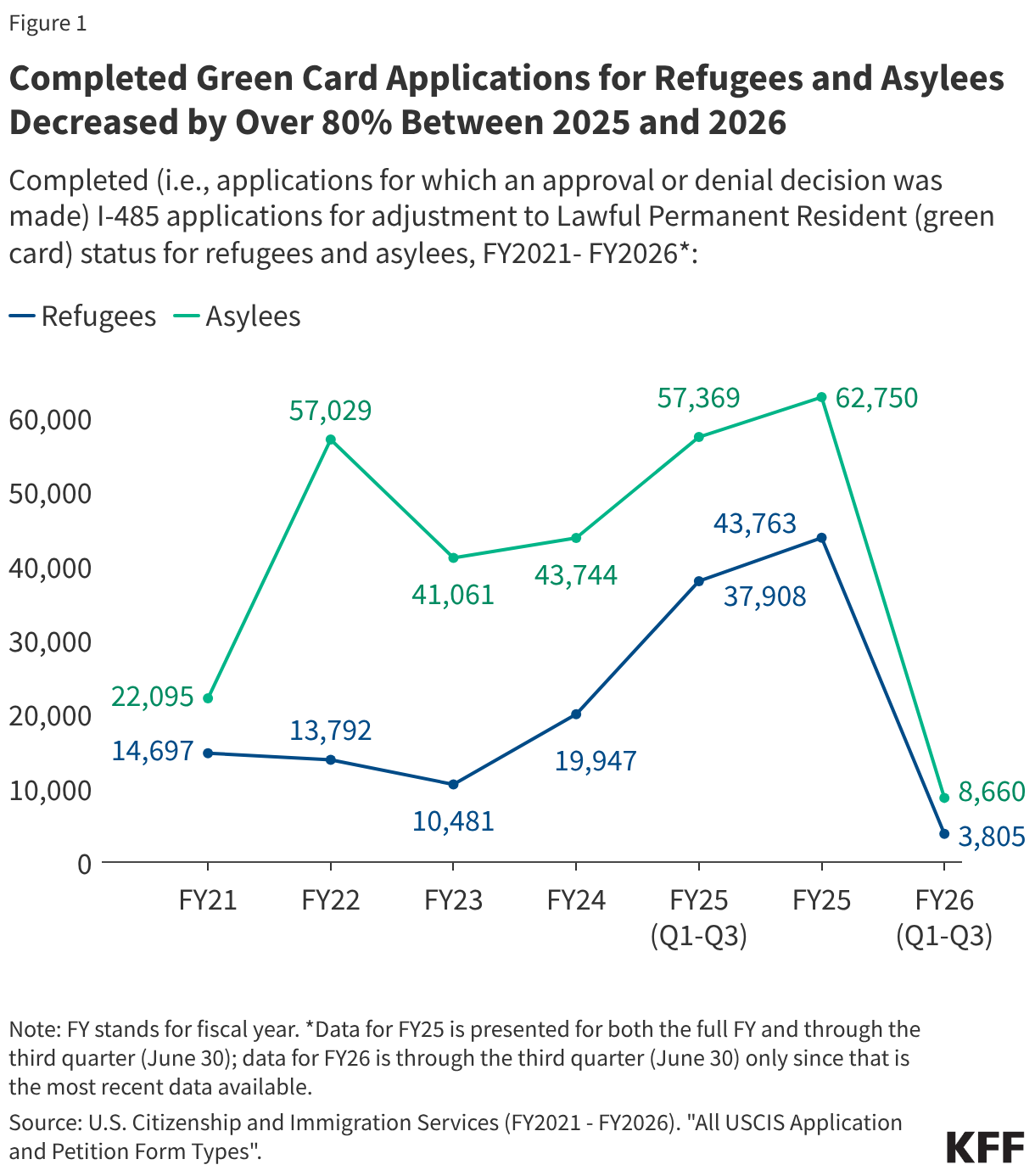
While the intake metrics tell one story, the processing output from USCIS tells an even more concerning tale. Between FY2021 and FY2025, the number of completed I-485 applications—defined as applications for which USCIS issued a formal approval or denial decision—increased considerably, jumping by 198% for refugees from 14,697 to 43,763, and by 184% for asylees from 22,095 to 62,750.
Yet, this productive momentum collapsed between FY2025 and FY2026. Comparing the first three quarters of FY2025 to the same timeframe in FY2026, the number of completed I-485 applications processed by USCIS plummeted by approximately 90% for refugees, dropping from 37,908 down to just 3,805. For asylees, completed applications fell by approximately 85%, dropping from 57,369 down to 8,660.
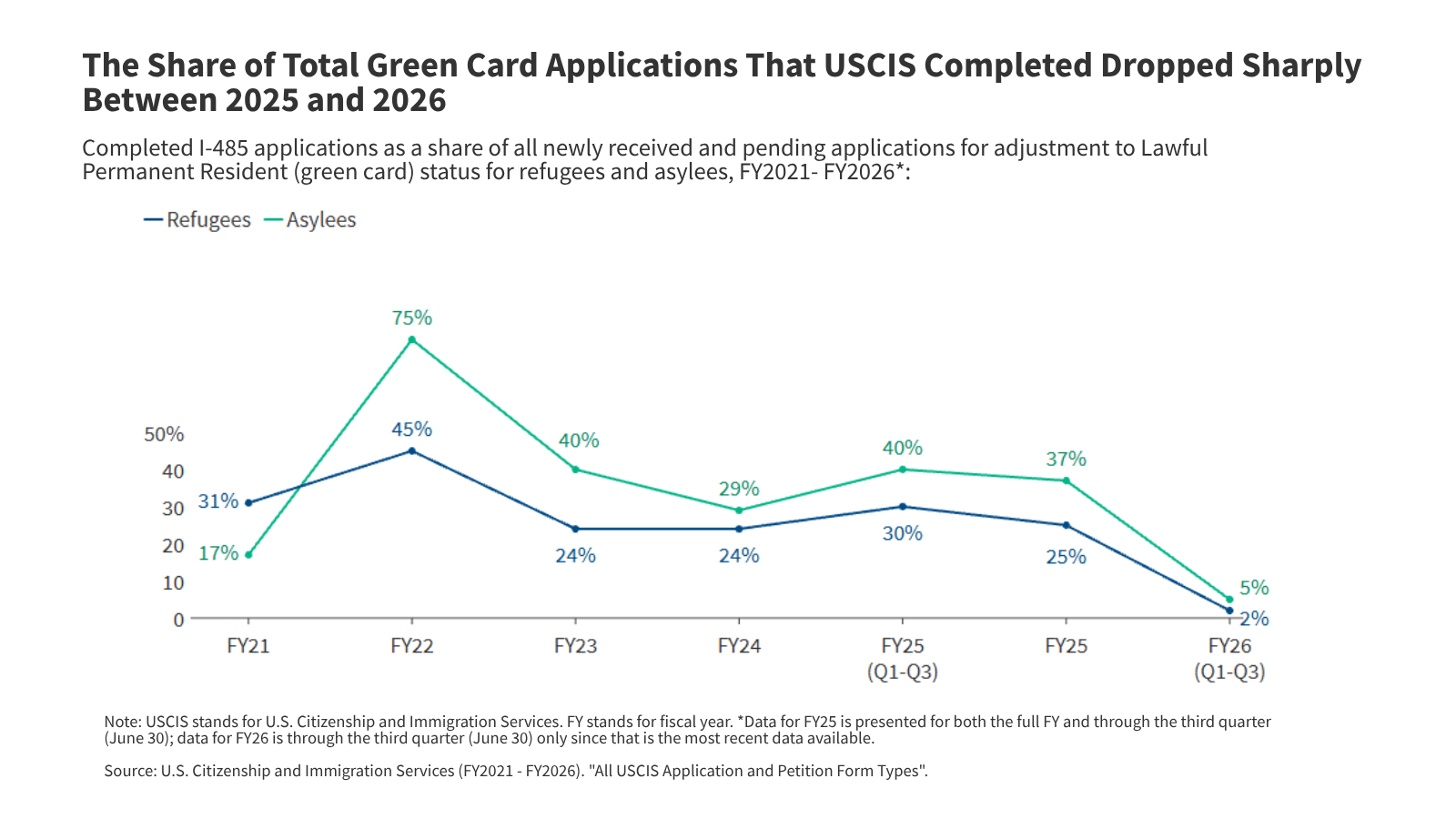
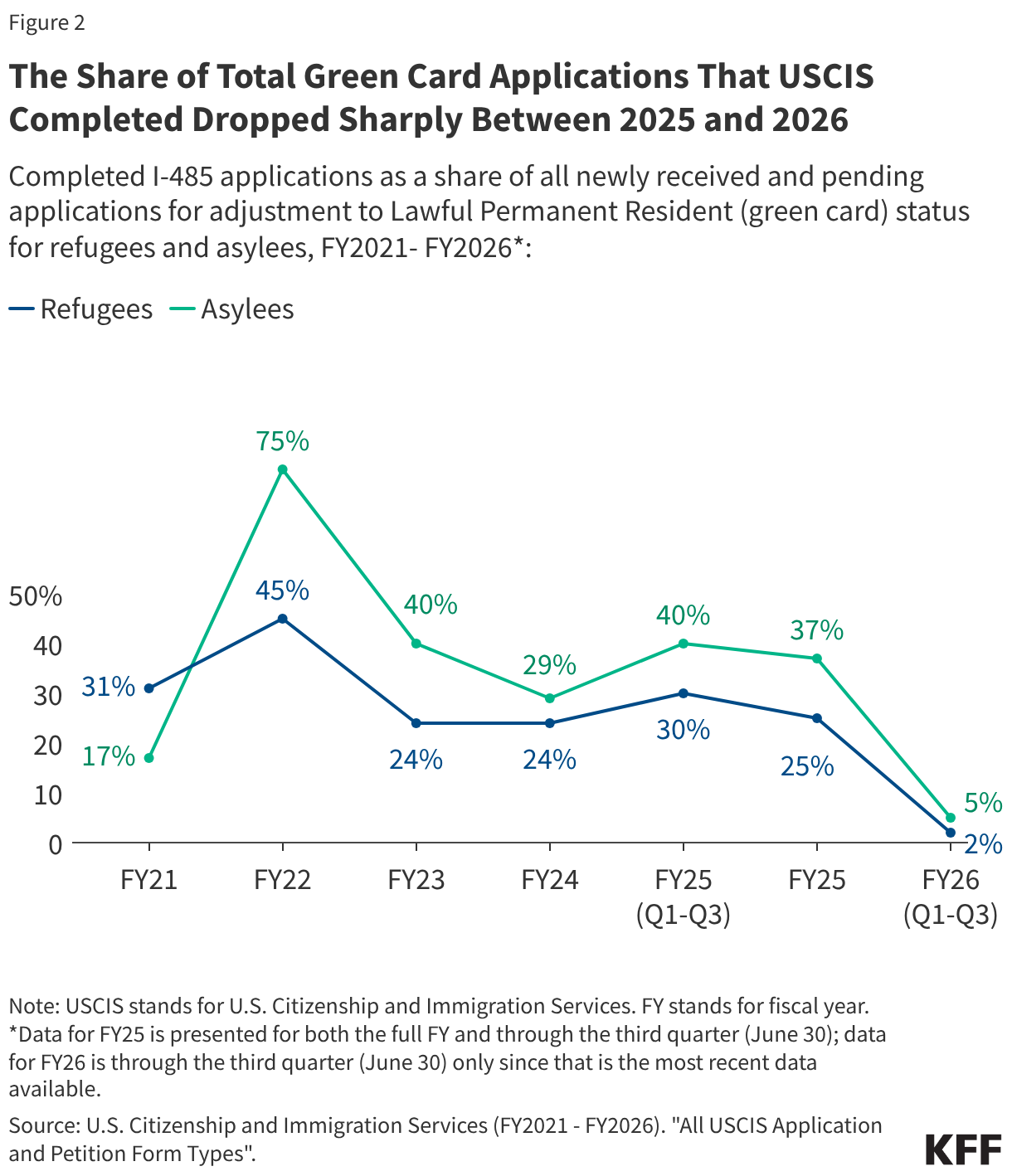
This steep decline in completed cases naturally caused the proportion of processed applications relative to the total active caseload to drop precipitously. Between FY2021 and FY2025, completed I-485 applications as a share of all active inventory—encompassing both newly received filings and carried-over pending cases—shifted from 31% down to 25% for refugees, while rising from 17% to 37% for asylees. But across the first three quarters of FY2025 and FY2026, that completion share fell off a cliff, dropping from 30% down to a meager 2% for refugees, and from 40% down to just 5% for asylees.
Consequently, the volume of pending green card applications swelled to unprecedented levels. At the close of FY2021, pending I-485 applications stood at 24,983 for refugees and 87,997 for asylees. By the end of FY2025, those figures had shifted to 87,573 pending refugee applications—a 251% increase—and 94,482 pending asylee applications.
The backlog worsened dramatically over the course of the following year. Between the third quarter of FY2025 and the third quarter of FY2026, pending applications from refugees surged by 121%, climbing from 67,502 to 149,470. Pending applications from asylees increased by 51%, moving from 83,446 to 126,267. By June 30, 2026, the cumulative total of pending green card applications for refugees and asylees reached 275,737, a figure anticipated to climb even higher by the formal conclusion of the fiscal year.
This massive administrative backlog has had a direct, measurable impact on application processing timelines. The average processing time for green card applications lengthened significantly between the first three quarters of FY2025 and FY2026, stretching from 7.8 months to 13.3 months for refugees, and from 10.7 months to 19.9 months for asylees.
Looking more closely within the 2026 fiscal year itself, the bottlenecks worsened quarter by quarter. The average processing duration for refugee green card applications more than doubled, climbing from 7.6 months in the first quarter to 17.6 months by the third quarter. For asylees, the situation proved even more severe, with average processing times jumping from 12.1 months in the first quarter to an extensive 25.6 months by the third quarter.
With USCIS processing timelines extending far beyond a year—and in many cases stretching past two years—thousands of refugees and asylees who have lawfully applied for their green cards find themselves trapped in an administrative limbo. Having lost their traditional exemptions under the 2025 reconciliation law, these individuals face prolonged periods of being entirely uninsured, underscoring how federal processing delays directly dictate whether vulnerable humanitarian migrants can access basic health care while attempting to establish permanent lives in the United States.



