A major study published in JAMA Neurology has delivered a stark and sobering global health projection, warning that the number of new dementia cases is expected to double worldwide over the coming decades. The findings have ignited renewed discussions among healthcare professionals, researchers, and family caregivers about the immense societal and economic ramifications of cognitive decline on a global scale.
For the millions of family caregivers currently supporting a loved one with dementia, alongside individuals looking ahead at their own long-term cognitive health, projections of this magnitude underscore an escalating crisis. Understanding the underlying forces driving these numbers is viewed by medical experts as the crucial first step toward improved prevention, early diagnosis, and comprehensive care planning. However, public health advocates emphasize that bringing this impending epidemic under control will ultimately require coordinated global leadership, robust public policy, and sustained international advocacy.

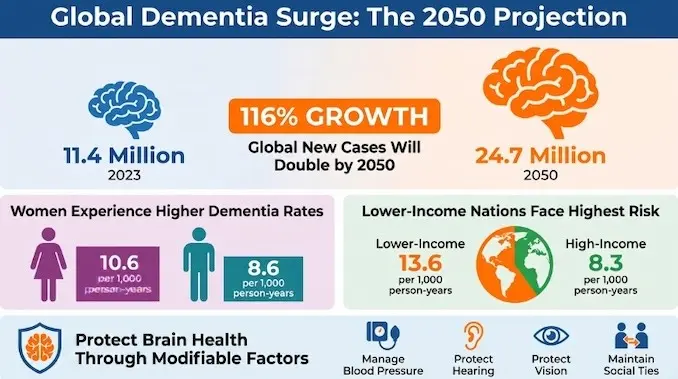
The latest data reveals a dramatic trajectory for global health systems. In 2023, researchers estimated there were approximately 11.4 million new cases of dementia worldwide. Looking ahead to the middle of the century, that annual figure is projected to surge to 24.7 million new cases by the year 2050, representing a staggering 116% increase.
Public health researchers emphasize that this sharp upward spike is not primarily driven by the disease itself becoming biologically more aggressive or infectious. Instead, the dramatic growth is largely attributed to the rapid and unprecedented aging of the global population. Because advancing age remains the single most significant risk factor for developing dementia, and because human life expectancy has climbed steadily across the globe, a larger absolute number of people are reaching the advanced ages where cognitive impairment most commonly manifests.
Dr. Emer MacSweeney, a consultant neuroradiologist, noted that these sobering statistics should not be interpreted as an inevitable or unalterable consequence of growing older. Rather, she described the projections as an urgent wake-up call for health systems worldwide to accelerate investments in prevention, early detection, and innovative treatment pathways.

A closer examination of the data also reveals a significant demographic divide in who is most vulnerable to the condition. The study highlighted a notable gender gap, finding that the incidence rate for women stood at 10.6 new cases per 1,000 person-years, compared to 8.6 new cases per 1,000 person-years for men.
While researchers acknowledge that women generally outlive men—and that sheer longevity plays a role in lifetime risk—they point out that lifespan alone does not entirely account for the disparity. Sex-specific biological factors, including the hormonal shifts experienced during menopause and lifetime exposure to estrogen, are believed to play a substantial role in shaping long-term brain health. This physiological reality has led medical professionals to emphasize the critical need for women to prioritize both cognitive and cardiovascular health well before entering their senior years.
Geographical disparities are equally pronounced, pointing directly to the well-documented intersection between vascular health and cognitive function. The research revealed that low- and middle-income countries face a markedly higher incidence of dementia, recording 13.6 cases per 1,000 person-years, compared to just 8.3 cases per 1,000 person-years in high-income nations.

Public health analysts attribute this geographical divide to broader trends in cardiovascular care and lifestyle factors. Over recent decades, high-income countries have achieved steady, measurable declines in public smoking rates, alongside improved management of chronic conditions such as high blood pressure and elevated cholesterol. Conversely, many low- and middle-income regions are experiencing rising rates of obesity, stroke, and cardiovascular disease. For medical professionals and caregivers alike, the underlying message is clear: protecting and maintaining cardiovascular health is intrinsically linked to preserving long-term brain health.
While aging and certain biological factors cannot be altered, medical experts emphasize that a substantial portion of an individual’s cognitive trajectory is influenced by modifiable risk factors. Healthcare professionals consistently recommend focusing on the fundamental pillars of health to support long-term brain function, including rigorous blood pressure management, the protection of sensory health, and the maintenance of active social connections throughout life.
The prospect of reaching 24.7 million new annual cases of dementia by 2050 presents an immense challenge for healthcare infrastructure and family support systems worldwide. Nevertheless, researchers and advocates maintain that this future is not entirely predetermined. By acknowledging the vital connection between heart health and cognitive resilience, and by implementing targeted lifestyle and medical interventions, individuals and societies can work to mitigate their overall risk. Medical professionals continue to stress that addressing this rising tide of global cognitive decline will require both individual vigilance and a unified commitment from global leaders before the mid-century milestone arrives.