As federal policy shifts toward stricter community engagement mandates across major safety-net programs, states are facing complex administrative hurdles to ensure eligible vulnerable populations do not lose critical lifelines. The Supplemental Nutrition Assistance Program (SNAP)—the nation’s primary federal aid initiative designed to combat food insecurity among low-income households—has long required certain participants to meet work rules as a condition of receiving benefits. Soon, however, a massive operational shift will introduce similar work mandates to the healthcare sector.
Beginning January 1, 2027, or sooner at the individual option of participating states, 44 states will be required to condition Medicaid eligibility for adults in the Affordable Care Act expansion group and enrollees in specific waiver programs on meeting strict work requirements. Despite these upcoming rules, federal law outlines mandatory exclusions for individuals who are deemed "medically frail." To qualify for this protection, enrollees must possess a qualifying health condition and actively demonstrate that the condition impairs their ability to fulfill the mandated work hours.
The Centers for Medicare & Medicaid Services recently released information detailing a potential approach that states can use to verify these medical frailty exclusions. However, adoption of this federal framework remains strictly optional for states, leaving a cloud of uncertainty regarding the exact administrative processes local agencies will ultimately deploy.
Given this widespread ambiguity surrounding how state governments will verify Medicaid medical frailty exemptions, policy experts are looking closely at how SNAP has historically managed remarkably similar administrative challenges. Just as Medicaid will exempt individuals unable to work due to health limitations, SNAP excludes individuals who are determined to be physically or mentally unfit for employment. While the established SNAP framework offers valuable administrative insights, fundamental differences in how eligibility is established mean that Medicaid verification protocols will diverge from SNAP in several critical ways.
How Have States Historically Determined Ability to Work for the SNAP Program?
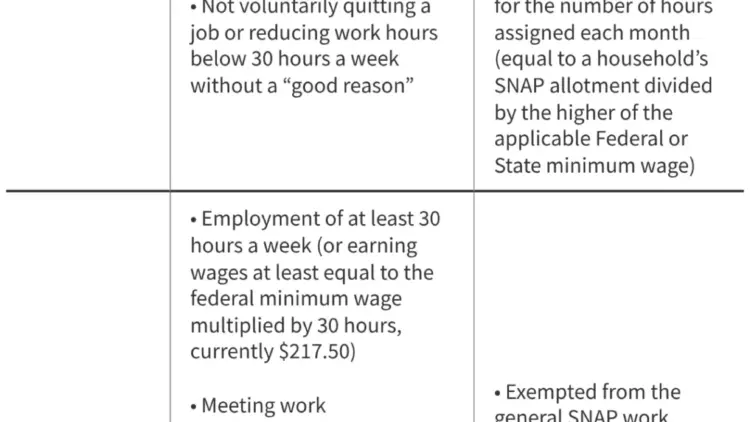
States have historically maintained significant flexibility in how they define the statutory exemption for individuals deemed physically or mentally unfit for employment. Most adult SNAP recipients under the age of 65 must meet general work requirements, which include registering for work, accepting suitable employment offers if tendered, participating in assigned employment and training programs or workfare, and avoiding voluntary job quits or arbitrary work-hour reductions below 30 hours per week without a validated good reason.
Furthermore, time-limited work requirements apply to specific individuals who fail to qualify for an exemption. These rules dictate that non-exempt adults must work or participate in an approved work program for at least 80 hours per month to receive SNAP benefits for more than three months within a 36-month period.
Federal regulations leave it entirely up to state agencies to define physical and mental fitness and establish internal procedures for verifying general work requirement exemptions. Rules governing time-limited work requirements offer only slightly more specific parameters, clarifying that an individual is exempt if they are physically or mentally unfit for work.
Because federal guidance grants substantial discretion, definitions vary widely across state lines. Some states have adopted expansive interpretations of physical or mental limitations, encompassing populations such as chronically homeless individuals or survivors of domestic violence when those adverse circumstances severely impact their physical or mental health. Additionally, states must exempt individuals who receive any form of temporary or permanent disability benefits, including Supplemental Security Income, Worker’s Compensation, Veterans Affairs support, Railroad Retirement, developmental disability services, or private disability insurance, though documentation standards can vary significantly.
A mandatory component of the standard SNAP application and recertification lifecycle is a phone or in-person interview conducted by an eligibility worker who screens enrollees for potential exemptions. As of 2023, most states reported screening for physical or mental limitations at the initial application stage, while others initiate screening during the mandatory interview prior to final certification. Over half of state agencies also reported granting frontline staff considerable discretion regarding the types of physical or mental limitations that could be considered for exemptions. For instance, visual observations made by eligibility workers during interviews—such as noting that a client relies on an oxygen tank—can serve as the sole basis for an exemption determination.
When determining whether an applicant is obviously unfit for work, some jurisdictions consistently demand formal medical documentation, whereas many others readily accept client statements or only request verification when an eligibility worker deems the situation questionable. States that do not enforce blanket documentation rules often specify that verbal or written client statements constitute acceptable verification unless frontline workers find the narrative unclear or suspicious.
An evaluation of SNAP work requirement exemption processes revealed that some eligibility workers felt mandatory documentation reduced overall staff burden and personal responsibility by increasing consistency and minimizing subjective decision-making. However, regularly requiring strict documentation invariably amplifies the administrative burden for vulnerable enrollees, healthcare providers, and eligibility workers who must process the paperwork and frequently request additional clarification. Participants are routinely reevaluated for exemption status at recertification intervals every six to twelve months, with evaluations consistently showing that information collected at recertification rarely differs from data gathered during the initial application.
When an individual’s unfitness to work is not immediately obvious to frontline workers, states are required to obtain a formal statement from a medical professional to verify exemption status, though state-level procedures for collecting provider attestations vary extensively. Some states go a step further, demanding formal provider documentation for every single person seeking an exemption. The specific data requested from healthcare providers to substantiate an exemption differs widely from state to state.
States may also accept alternative forms of provider documentation, such as a basic written statement or a direct phone call to an eligibility worker. Because healthcare providers are rarely provided with detailed regulatory guidance regarding how to assess fitness for work, their determinations of who qualifies for an exemption inherently vary.
State administrators may soon choose to overhaul their SNAP verification workflows in response to a major new mandate stemming from recent federal reconciliation legislation. Beginning in October 2027, the law requires states to pay a portion of SNAP benefit costs if their payment error rate—a measure tracking overpayments and underpayments driven primarily by administrative errors rather than outright fraud—exceeds six percent. The state’s financial liability increases progressively as the error rate climbs above the threshold, up to a defined statutory cap.
Prior to these new fiscal penalties, state SNAP verification policies balanced documentation requirements aimed at promoting program integrity against the administrative friction additional paperwork creates for participants. In light of massive new financial liabilities tied to payment error rates, states are actively rebalancing these priorities. For example, to avoid administrative errors and subsequent fiscal penalties, Arizona recently instituted new rules requiring enhanced documentation for data points where the state previously accepted unverified client statements unless specifically flagged as questionable.
How May the Medicaid Process Compare to SNAP?
In sharp contrast to traditional SNAP workflows, the upcoming Medicaid process for verifying individuals who qualify for the medical frailty exclusion will require states to systematically exhaust available electronic data before requesting documentation directly from individuals or healthcare providers. Medicaid programs possess robust historical claims data that standard SNAP agencies typically cannot access.
An interim final rule released by federal regulators instructs states to utilize claims and encounter data from the preceding 12 months to attempt automated verification of medical frailty status prior to reaching out to the enrollee. CMS subsequently outlined a tiered medical frailty framework that enables states to identify individuals as medically frail using claims data alone in the first tier, combining claims data with encounter or other health data in the second tier, or deploying an individualized manual process requiring supplemental documentation in the third tier where state data is absent or insufficient.
While this tiered structure will allow many individuals to be verified automatically through existing data systems, full automation remains impossible. Data limitations—such as a complete lack of historical health records for new applicants and recent enrollees, or providers inconsistently coding medical conditions or failing to use state-designated diagnostic codes—mean that states will inevitably require additional documentation for a significant portion of the population.
Similar to SNAP administration, state Medicaid agencies will ultimately rely on healthcare providers to verify an individual’s ability to work and establish medical frailty status, particularly in instances where electronic claims or administrative data are entirely absent. Because the Medicaid program does not utilize standard client interviews, eligibility workers will play a less pronounced role in the verification process. However, in states where SNAP and Medicaid programs are jointly administered or share robust data systems, Medicaid agencies may leverage information initially gathered during SNAP interviews and screening processes.
When states cannot verify medical frailty through available administrative data, they must rely on formal confirmation from treating clinicians to validate underlying health conditions and assess an individual’s capacity to participate in community engagement activities. Current federal rules offer minimal detail regarding the specific data elements states must collect from providers. Absent comprehensive federal guidance, states will likely develop divergent forms and collect disparate data points, echoing the historic variation observed in SNAP. Some states may choose to design unified provider attestation forms that satisfy both Medicaid and SNAP exemption criteria; North Carolina, for instance, has already created a centralized provider attestation form that can be deployed to determine eligibility across both programs. Relying heavily on busy clinicians to determine work capacity without standardized guidelines risks producing inconsistent and uneven assessments.
Beginning in January 2028, state flexibility to accept self-attestation within the Medicaid program will be substantially more restricted than current practices in SNAP. While SNAP states vary in how they utilize client statements to establish unfitness for work, federal rules mandate additional verification only when that initial information is deemed questionable, without capping the overarching ability to accept client statements.
Conversely, the Medicaid rule severely limits reliance on self-attestation starting in January 2028. While states are permitted to accept self-attestation throughout 2027 in the absence of reliable electronic data, they may only accept self-attestation of medical frailty status a single time during an individual’s continuous enrollment period starting January 1, 2028. For subsequent renewals, states will be required to verify medical frailty through administrative data or demand formal documentation from individuals, initiating a much more time-consuming and friction-heavy verification cycle. Prior to the publication of the interim final rule, the vast majority of states had expressed a strong preference for utilizing self-attestation as a primary verification source for the medical frailty exemption.
Ultimately, state Medicaid medical frailty verification policies will diverge significantly, with local decisions heavily influenced by the constant threat of severe federal financial penalties. Operating with limited federal guardrails, states must independently design approaches to operationalize medical frailty exclusions. The Medicaid rule explicitly notes that states will be flagged as noncompliant during federal audits if reviews reveal frequent approvals of medical frailty status without sufficient clinical support demonstrating that the condition directly impairs work capacity.
Caught between the threat of financial sanctions and the necessity of minimizing administrative burden while preventing wrongful coverage terminations, state administrators face a monumental balancing act. Furthermore, states are forced to implement these intricate Medicaid eligibility and enrollment policy overhauls simultaneously as they prepare for sweeping updates to the Medicaid payment error rate measurement program. These upcoming changes will heighten the financial consequences of eligibility error rates exceeding three percent, potentially forcing states to reevaluate their tolerance for administrative risk across all enrollment determinations as the 2027 implementation deadlines approach.